


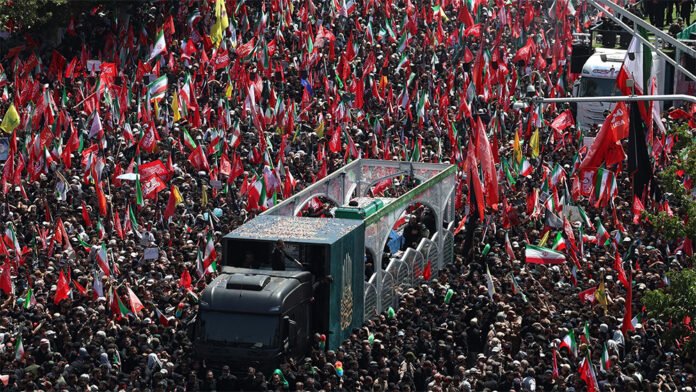
The carefully choreographed week-long funeral of Ayatollah Khamenei, killed in US-Israeli airstrikes on February 28, was a message to the world of unity and solidarity within Iran. The gathering of his supporters was possibly the largest seen in the globe in recent times.
While estimates of numbers have varied, the Financial Times mentions mourners to be around 12 million, across all locations, out of a total possible population of 93.2 million.

This can be compared to the funeral of Ayatollah Ruhollah Khomeini, Iran’s first supreme leader, in 1989, where an estimated 5-7 million out of a population of 53 million attended. It was also claimed by the west that the state was involved in mobilisation of masses.
A number of countries sent representatives to the funeral. The Iranian Foreign Minister Seyed Abbas Araghchi shared on X, ‘Iran is pleased to receive representatives from over 70 countries.’
This funeral could be compared to the funeral of Ayatollah Ruhollah Khomeini, Iran’s first supreme leader, in 1989, where an estimated 5-7 million out of a population of 53 million attended. It was also claimed by the west that the state was involved in mobilisation of masses
India was represented by the Governor of Bihar, Lt General Syed Ata Hasnain and Minister of State for External Affairs, Pabitra Margherita. Each delegation was received by a separate Quranic verse. What surprised the world was numbers present at different funeral locations. Trump mentioned on the funeral that he had always believed Khamenei was ‘hated’ adding, ‘maybe its fake tears’.
While Iran’s new supreme leader, Ayatollah Mojtaba Khamenei, did not attend the funeral, his three brothers were present. No reason was given for his absence, though speculations were plenty.

Iran had projected from the start that Ayatollah Khamenei had refused to move to a secure location, when US-Israel airstrikes began, claiming he would only do so, if a similar arrangement existed for the public of Iran. He was killed in initial strikes. This narrative made him a martyr as also enhanced his standing.
It was also reported that the US applied pressure on nations not to send representatives to the funeral. The report adds that the US threatened some African nations with reduction in aid, if they participated. As a result of US pressure, 13 nations either cancelled their participation or downgraded their representation.

What surprised the world was numbers present at different funeral locations. Trump mentioned on the funeral that he had always believed Khamenei was ‘hated’ adding, ‘maybe its fake tears’
The funeral conveys multiple messages. Permission for global media to be present and record the event indicated that Iran was conveying unity with no indication of mass mobilisation.
It was simply a public outpouring of grief for a spiritual leader, who refused to be evacuated. This despite severe economic hardships including skyrocketing inflation. The last time a large gathering was visible in Iran was during protests against a collapsing economy.
Had the US continued with its sanctions or even tightened them, protests against the regime would have re-emerged. The military option only unified Iranians under their flag.
The mass gathering also challenged Trump and Netanyahu’s assumption that the people of Iran are desperate for a regime change.
The funeral conveys multiple messages. Permission for global media to be present and record the event indicated that Iran was conveying unity with no indication of mass mobilisation
Iran’s narrative from the funeral was that the new regime has been accepted by the people. For US and Israel, it was that aerial actions alone will not result in a politico-military victory. If it has to ensure a regime change, boots on the ground are essential. The same is not an easy option for the US-Israel combine.
Calls for revenge reverberated through the crowd, conveying that many considered his death as an extra-judicial killing and enhanced his standing.
The Ayatollah was also a respected religious head, whose targeting was an error as it brought Shia’s across the world together. For the world, this mass presence was a message that the Iranian nation was unwilling to be cowed down by threats from the US.
Pride and belief in the regime as also support on its unwillingness to bend to US demands was another message. This gives the current government the ability to prolong negotiations as against Trump’s desperation for an early conclusion.
Attacks on ships in the Hormuz Straits soon after the funeral flowed from the confidence provided to the regime by the public. US’s subsequent attacks on Iran failed to deter crowds at funeral services across the nation.
Iran’s narrative from the funeral was that the new regime has been accepted by the people. For US and Israel, it was that aerial actions alone will not result in a politico-military victory. If it has to ensure a regime change, boots on the ground are essential. The same is not an easy option for the US-Israel combine
The funeral covered three Iranian cities and two holy sites in Iraq conveying victory in its ongoing conflict and honouring his death as a martyr. The Iranian President Masoud Pezeshkian returned from the Iraqi city of Najaf as soon as hostilities recommenced with the US.
In each location, crowds gathered well before the anointed time, displaying that they backed the Ayatollah despite his crushing uprisings and protests. This sent the message that Iran possesses large numbers of supporters in countries where Shia population exists.
The attendance of representatives from over 70 nations, including from the neighbourhood displayed that Iran’s regional relations continue despite some of them being targeted during the war.
Was the attendance due to Iran’s ability to control the Hormuz Straits or the Ayatollah’s position as a religious teacher or relations between nations will remain debateable. Attendance by members of its proxies indicate that they remain true to Iran, despite attacks on them by Israel.
India has maintained its ties with Iran, US and Israel without letting relations with one impact the other. It has invested in the Chabahar Port as a means to enhance trade relations with Central Asia. Its delegation was at the middle level and conveyed the right message to all parties of the conflict.
Overall, the funeral was well-choreographed, narratives and messages flowing from it conveyed that Iran remains politically stable and the regime is in no danger in the coming days
Pakistan, on the contrary, was represented by its Prime Minister and failed marshal, amongst others. It was possibly the highest-ranking delegation present at the funeral.
Pakistan hopes to continue mediating between the US and Iran. Shehbaz’s comments that the Ayatollah was ‘a great scholar and leader whom millions of Muslims will remember,’ and, ‘Pakistan and Iran will march together under all circumstances,’ was criticised by many in the US, who questioned its role as a neutral negotiator.
Overall, the funeral was well-choreographed, narratives and messages flowing from it conveyed that Iran remains politically stable and the regime is in no danger in the coming days.
US air strikes alone will never succeed in bringing about a political solution. Either the US negotiates or employs ground forces, both of which suits Iran.
Finally, it displayed that despite it blocking the Hormuz Straits, resulting in increase in oil prices, its ties with the rest of the world remain stable.
The writer is a strategic analyst and a motivator. He can be reached at @kakar_harsha. The views expressed are of the writer and do not necessarily reflect the views of Raksha Anirveda





