


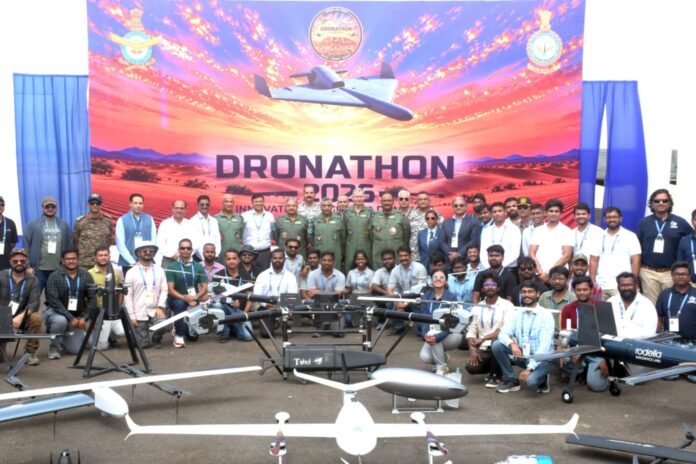
The three-day Dronathon event, running from 14 to 16 September 2026 at the Pokhran Field Firing Range in Jaisalmer, brings together more than 20 defence companies, start-ups, micro, small and medium enterprises, public-sector units and individual innovators. Air Marshal Ashutosh Dixit, Vice Chief of the Air Staff, inaugurated the exercise on 14 September.
Unlike a conventional technology exhibition, Dronathon-2026 is intended to test whether emerging unmanned systems can produce reliable operational effects in demanding and contested conditions. The Indian Air Force is evaluating how systems perform against practical requirements, evolving threats and changing battlefield circumstances.

The exercise covers surveillance and reconnaissance, autonomous operations, swarm technologies, electronic warfare and counter-unmanned aircraft systems. Industry participants are also demonstrating expendable intelligence, surveillance and reconnaissance platforms, loitering munitions, logistics drones, mapping systems and systems using artificial intelligence, autonomous navigation and real-time data transmission.
The IAF has framed the event as a move from “technology demonstration to operational effect”. That shift is significant. Defence forces worldwide are increasingly using relatively inexpensive drones for intelligence gathering, targeting, resupply, electronic warfare and precision attacks. At the same time, the spread of unmanned aircraft has created an urgent need for systems that can detect, identify, track and neutralise hostile drones.
A key feature of the opening day was the demonstration of Vayu UTtaM, an indigenously developed, multi-mode unmanned traffic-management system. During a live trial at Pokhran, the system detected and tracked both military and civilian unmanned aircraft.
The ground-based system is designed to coordinate unmanned-aircraft operations in increasingly crowded airspace and help identify unauthorised or rogue drones. Its potential applications extend beyond military missions to civil aviation, public safety, critical infrastructure protection and general airspace management.

The IAF also released its UAS Roadmap, giving Indian industry, academic institutions and research organisations greater visibility into the service’s future capability priorities. The roadmap is intended to encourage focused innovation and align private and public-sector development with operational requirements.
That approach places emphasis not only on finished aircraft but also on the wider unmanned ecosystem. The IAF says future capability will depend on domestic expertise in propulsion, sensors, payloads, communications, autonomy, electronic warfare, countermeasures and airspace management.

The event supports the government’s Aatmanirbhar Bharat, or self-reliant India, defence initiative. It also gives the IAF a direct interface with developers, allowing it to compare competing technologies in the field rather than relying solely on specifications or controlled demonstrations.
For participating firms, the Pokhran trials could provide valuable feedback on reliability, integration and combat utility. For the IAF, the exercise may help identify systems that are mature enough for further trials, accelerated procurement or eventual induction.
The Dronathon comes as India seeks to strengthen its unmanned capabilities and build a complementary force in which manned aircraft and autonomous systems operate together. The immediate outcome will be measured not by the number of drones displayed, but by which technologies can withstand operational pressure and deliver usable results.
With drones rapidly reshaping modern warfare, Pokhran has become a testing ground for a broader ambition: turning India’s expanding unmanned-technology industry into a dependable military capability.






