


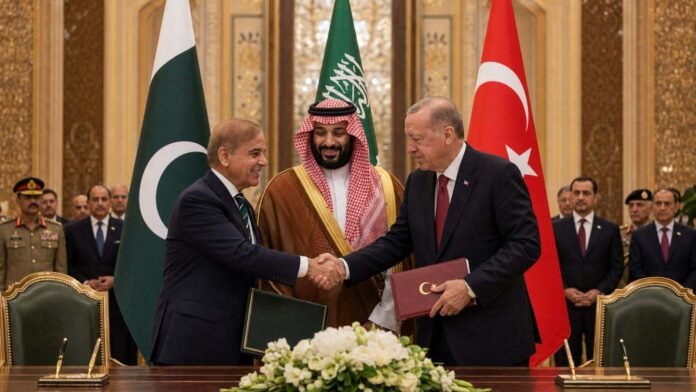
The Strategic, Political and Defence Committee of the Makkah Alliance held its first meeting in Istanbul on August 31, 2026, where the foreign ministers of Saudi Arabia, Türkiye and Pakistan announced that the Makkah Joint Defence Agreement, signed in Makkah on August 7, had been renamed the “Makkah Defence Alliance”. They also announced a permanent secretariat in Riyadh, to be headed for its first three years by a Pakistani Secretary-General.
Bangladesh Foreign Minister Khalilur Rahman, addressing the third session of the 13th Parliament, indicated Dhaka’s positive stance on the Makkah Defence Alliance, stating that if member nations express interest in including Bangladesh, Dhaka will view the proposal favourably.

Previously, Bangladesh’s State Minister for Foreign Affairs Humayun Kabir and Shama Obaid also voiced a positive outlook regarding Bangladesh’s alignment with the alliance.
Currently, Iran is the only country reported by regional media to have received an explicit invitation to join the Makkah Defence Alliance (also known as the Makkah Joint Defence Agreement). In late August 2026, a senior Iranian official stated that the country had received an invitation to join the alliance.
The Pakistan Foreign Ministry clarified in September 2026 that expanding the alliance is currently not on the cards as the three founding nations focus heavily on setting up their initial operations and permanent secretariat in Riyadh, and once the structural framework is fully operational, the alliance will be open to all regional countries that share similar stances on collective security and deterrence.
While no other formal invitations have been made public, several Muslim-majority nations have actively signalled strong interest in joining the alliance or are closely tracking its development According to a post on X, Bangladesh, Egypt, Syria and six to seven other nations have been invited to join the Makkah Defence Alliance.

Bangladesh is not represented at the 18th BRICS Summit, having formally decided to completely skip the event, choosing not to send any official representatives.
Bangladesh State Minister for Foreign Affairs Humayun Kabir clarified that India did not invite Prime Minister Tarique Rahman or any official from the Bangladeshi government in a bilateral capacity.

Instead, the invitation was extended to the Prime Minister solely in his role as the current chair of BIMSTEC (the Bay of Bengal Initiative for Multi-Sectoral Technical and Economic Cooperation), and since the invitation was tied specifically to the head of the BIMSTEC chair nation, there was no scope or protocol to substitute him with another government official or diplomat.
Following its inception in Makkah on August 7, 2026, foreign ministers from Saudi Arabia, Türkiye and Pakistan convened in Istanbul to formalise the pact as the “Makkah Defence Alliance”. The alliance established a permanent secretariat in Riyadh. Pakistan will hold the Secretary-General post for the initial three-year term to oversee structural operations
However, the real reason for Dhaka staying away during a time of growing diplomatic tension between Dhaka and New Delhi, is largely regarding former Prime Minister Sheikh Hasina’s continued presence and recent public activities in India.
Dhaka wants Sheikh Hasina, who has been sentenced to death by Bangladesh, extradited. Concurrently, Mohammad Ali Manik, General Secretary of the US chapter of Awami League South, has called on India to launch a military attack on Bangladesh; expressed through posts and comments on X.
Reacting to Bangladesh’s potential inclusion in the Makkah Defence Alliance on an account named ‘South Asian Index’, Manik argued that India should take military action similar to Russia’s invasion of Ukraine following Ukraine’s attempt to join NATO. Manik warned that failing to act now, would prove costly.
China has strategic interests in Bangladesh, where it has built Asia’s largest submarine base, and is establishing an airbase at Lalmonirhat – close to India’s Siliguri Corridor.
Bangladesh is a major participant in China’s Belt and Road Initiative (BRI). Bangladesh has welcomed Chinese participation in the USD 1 billion Teesta River Comprehensive Management and Restoration Project and has sought China’s financial and technical support.
Reports from late August and September 2026 confirm that Bangladesh government has approved a proposal to buy 20-24 J-10CE multirole fighter jets from China, rather than the Pakistan-assembled JF-17s.
While US-Bangladesh are finalising ACSA (Acquisition and Cross-Servicing Agreement) and GSOMIA (General Security of Military Information Agreement) agreements, giving the US logistical port access in the Bay of Bengal and ports in Bangladesh, Pakistan-Bangladesh defence cooperation is growing stronger.
Notably, Turkey has become one of Bangladesh’s most critical security allies. Bangladesh has already inducted over 15 different categories of Turkish military hardware, including: HİSAR-O medium-range and SİPER long-range AD systems; TRG-300 Tiger Multi-Launch Rocket Systems (MLRS) and MKE Boran howitzers; Bayraktar combat drones (UAVs) and Otokar Cobra light armoured vehicles.
Turkish engineers are currently providing technological support to Bangladesh to build artillery shells and plans to set-up a joint drone production facility for naval boats in Bangladesh. Bangladesh plans specialised defence manufacturing zones in Chittagong and Narayanganj with Turkish collaboration.
There are concerns in India about fallouts about Bangladesh joining the Makkah Defence Alliance. Interestingly, Pakistan has refused Saudi Arabia’s demand to attack the Houthis in Yemen despite the Saudi-Pakistan Defence Arrangement (SPDA) and the Makkah Defence Alliance, saying the latter does not include offensive action.
Diplomatic tensions between Dhaka and New Delhi flared as Bangladesh opted to completely skip the 18th BRICS Summit. Although India extended an invitation to Prime Minister Tarique Rahman solely as the BIMSTEC Chair, Dhaka abstained from sending any delegation, largely driven by India’s refusal to extradite convicted former Prime Minister Sheikh Hasina
The China-Pakistan-Turkey-Bangladesh axis, coupled with the Turkey-Pakistan-Bangladesh radical Islamist nexus, is a matter of concern. But this needs to be meshed with current state of Bangladesh and the lien New Delhi has over Dhaka.
India-Bangladesh bilateral trade currently stands at approximately USD 13 billion, making India Bangladesh’s second-largest trading partner.
Dhaka appears cocking a snook at India because of Sheikh Hasina even though India continues to engage Bangladesh through DG-level border talks between the BSF and BGB to manage regular migration and smuggling, while keeping a watchful eye on Dhaka’s shifting alliances.
But Bangladesh’s foreign policy faces multiple challenges in engaging multiple players like the US, China, Pakistan and Turkey, having their individual national priorities, even as undermining India’s growth may be a common factor.
The issue is stabilising foreign reserves but weighed down by sluggish GDP growth, high inflation, and deep-seated banking vulnerabilities. While on track to graduate from Least Developed Country (LDC) status to a developing nation, major macroeconomic challenges persist for Bangladesh.
Robust inflows from the Bangladeshi diaspora remain the primary lifeline for stabilising the nation’s currency and balance of payments, while FOREX reserves stand at USD 36.38 billion. Energy Crisis Energy crisis remains the biggest concerns as Bangladesh is paying its highest spot price for LNG since the US-Israeli war on Iran.
China and Türkiye are rapidly solidifying their defence presence in Bangladesh. Beijing is assisting with submarine and airbase infrastructure, the Teesta project and a sale of J-10CE fighters. Meanwhile, Ankara provides advanced air defence systems, MLRS and Bayraktar drones, alongside plans for joint drone production and specialised defence manufacturing zones
Multilateral forecasts place FY26 GDP growth between 3.7% and 4.0%, with the ADB’s latest revision for FY27 at 4.5%, a downgrade driven by energy shortages, banking fragility and subdued exports.
The ADB projects 8.8% inflation in FY27. Bangladesh’s total debt at the end-March 2026 was Tk 22.6 lakh crore, increasing debt servicing and pressuring budget implementation.
India has repeatedly voiced deep concerns over the vulnerability, safety and political standing of Hindu communities and other minorities in Bangladesh, who face increased risks from rising religious extremism and radicalisation.
Speeches by Islamic radicals in Bangladesh against Hindus and India have vitiated the atmosphere and escalated regional tensions; one example is the speech by Islamist radical Harun Izhar in Chittagong.
Bangladesh may want to reduce dependence on India but it cannot entirely do without India due to immutable geographical realities and critical economic interdependencies, like: low-cost imports of essential food commodities like onions, rice, wheat, sugar, and vegetables – resulting in severe shortages and food price inflation if India restricts exports.
Fundamental raw materials like cotton, yarn and chemical inputs for its ready-made garment sector; importing 1.8 MT high-speed diesel annually to power its northern agricultural and industrial zones; importing over 1,160 MW electricity from the Indian grid to counter chronic internal generation deficits and natural gas shortages; upstream rivers dictate agricultural outputs, flood controls and ecological health in downstream Bangladesh.
Due to the extreme asymmetry in size, power and geography, Bangladesh is virtually surrounded by India, making it highly vulnerable to a total blockade; India has the absolute military, geographic and economic capacity to completely choke Bangladesh in the event of a full-scale war.
However, following the 2024 regime change and subsequent happenings, India faces significant non-traditional, asymmetric, and proxy security threats from Dhaka.
Coupled with the growing China-Pakistan-Bangladesh axis, an anti-India regime in Dhaka granting China naval footprint or intelligence access in the Bay of Bengal, could increase India’s eastern naval flank vulnerability.
India faces heightened non-traditional security risks along its eastern flank. Beyond the potential threat of a foreign naval or intelligence footprint in the Bay of Bengal, the porous border risks amplified ISI intelligence activities, cross-border infiltration, cyber threats and potential deployment of foreign proxy fighters from West Asian conflict zones into South Asia
This nexus also increases the vulnerability of the Siliguri Corridor. Recent spikes in violence against the Hindu minority in Bangladesh create massive internal political pressure and refugee influx risks for India.
Pakistan’s ISI continues to use the porous India-Bangladesh border to monitor Indian military and railway movements. Smuggling, infiltration and illegal migration activities are set to increase.
Bangladesh’s inclusion in the Makkah Defence Alliance will increase the cyber threat to India, as well as foreign fighters.
According to recent ground reports, Turkey is sending Muslim Brotherhood proxy fighters from Syria to Saudi Arabia to fight the Houthi; these Islamic fighters are under the command of Abu Hamza who recently clashed with Syrian forces in central and northern Syria.
Abu Hamza is a Syrian warlord and commander of the Turkish-backed Sultan Suleiman Brigade, identified by Armenian prosecutors as a key organiser in recruiting Syrian fighters for the 2020 Artsakh War; where fighters were moved through Turkey without standard passport or ID checks, transported via Turkish civilian airports and flown to Azerbaijan, where they were met by Azerbaijani personnel and issued uniforms, Kalashnikovs, PKS machine guns and RPGs.
India has witnessed foreign fighters in J&K. We may now see them even in the northeast, and they need not come through the India-Bangladesh border. After all, American mercenary Matthew Aaron VanDyke and the six Ukrainians captured by the National Investigation Agency (NIA) did not infiltrate across any border.

The author is an Indian Army veteran. The views expressed are of the author and do not necessarily reflect the views of Raksha Anirveda





