


New Delhi: DRDO’s latest initiative marks a decisive step in India’s pursuit of advanced unmanned warfare capabilities, building directly on lessons from Operation Sindoor.
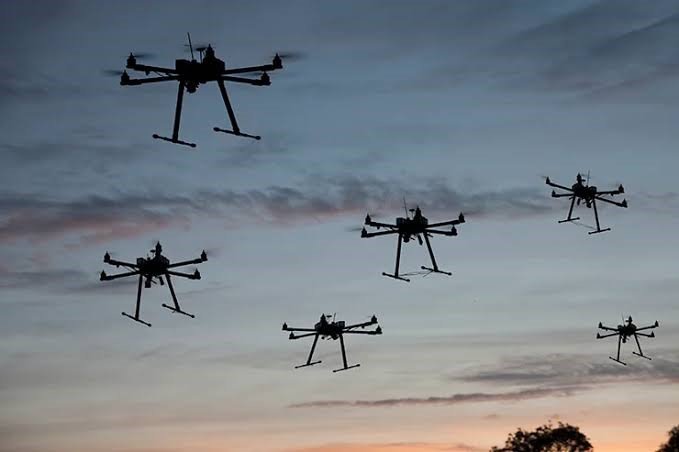
The Defence Research and Development Organisation has issued a Request for Proposal (RFP) under its Technology Development Fund, seeking the creation of a jam‑proof swarm of fifty drones.

These drones must fly in extremely close formation, maintaining a separation of no more than fifty centimetres, and manoeuvre as a single system even under heavy jamming and strong winds. The requirement sets a demanding technical bar. Each drone must hold its position to within five centimetres across all three axes, even in winds of twenty metres per second and at altitudes up to five thousand metres. Positional errors must be corrected within five hundred milliseconds, ensuring the swarm remains intact under dynamic conditions.
The design envisages a seven‑by‑seven grid of at least forty‑nine “slave” drones, coordinated by a single “master” drone. Commands will be issued from a ground station, meaning one operator will control the entire cluster. This approach reflects the military’s renewed emphasis on swarm warfare, loitering munitions, and counter‑UAS systems following Pakistan’s deployment of between eight hundred and one thousand drones across the western border during Operation Sindoor.
The Army has since accelerated trials of indigenous loitering munitions and counter‑drone systems, including at Babina. Private firms and startups are increasingly being engaged to deliver rapid innovation, while the TDF route remains reserved for the most complex, cutting‑edge technologies.
The drones must carry payloads ranging from five hundred grams to two kilograms, remain airborne for at least thirty minutes, and recharge within fifteen minutes. The system must be deployable within five minutes, highlighting its operational agility. A maritime requirement has also been specified: drones launched from moving ships must return to the launch point rather than fixed coordinates.

Electronic warfare resilience is a central thrust. The RFP calls for a five‑kilometre jammer‑proof communication link in the S‑band, High Frequency band or C‑band, equipped with Electronic Counter‑Countermeasure features. Critical technologies identified include high‑precision navigation, swarm intelligence, control algorithms, flight‑control systems, Artificial Intelligence, edge computing, cyber security, and electronic warfare protection.
DRDO has emphasised augmentation of Navigation with Indian Constellation (NAVIC), an indigenous autopilot stack, and domestic manufacture of sensors such as Inertial Measurement Units and LiDAR systems. The project mandates over seventy percent indigenous content, with commercial off‑the‑shelf components from adversary countries explicitly barred.

The final package will comprise fifty drones, batteries with one hundred per cent spares, communication and control subsystems, and all algorithms, applications, and source codes. Prototype development and functional testing are targeted within twelve months, with qualification, trials, technology transfer, and project closure scheduled within twenty‑four months.
The programme is restricted to Indian Micro, Small and Medium Enterprises and startups, with Defence Public Sector Undertakings and other PSUs excluded from bidding. One development agency will ultimately be selected to deliver the system. This initiative underscores India’s determination to achieve technological sovereignty in unmanned warfare, ensuring resilience against electronic disruption and adaptability in contested environments.






