


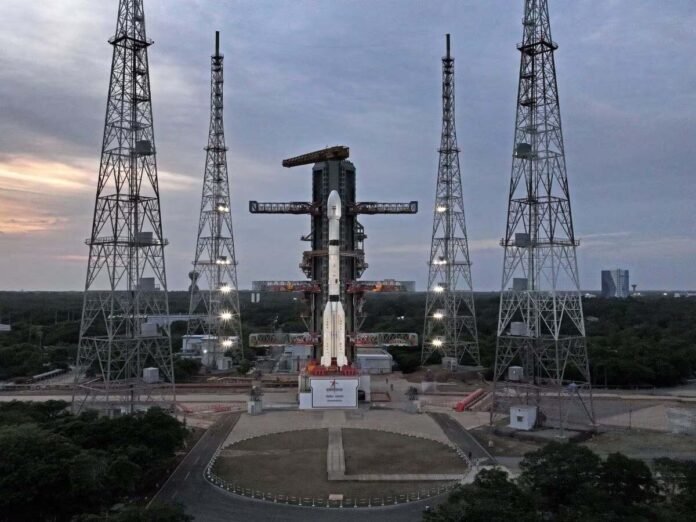
Bengaluru. The Indian Space Research Organisation on Friday, September 04, 2026 successfully launched the GSLV-F17 rocket carrying EOS-05, marking its first successful mission of 2026 and a significant recovery after a series of recent setbacks.
The 51.7-metre-tall Geosynchronous Satellite Launch Vehicle lifted off from the second launch pad at the Satish Dhawan Space Centre in Sriharikota at 2.55 am amid light rain. At 3.14 am, the rocket placed EOS-05 into a Sub-Geosynchronous Transfer Orbit, completing what ISRO described as a precise and textbook mission.

ISRO Chairman V Narayanan announced the success shortly after the launch, saying the vehicle had “successfully and precisely injected” the advanced Earth-imaging satellite into its intended orbit. He said the mission was the 107th launch from Sriharikota and the 19th flight of India’s GSLV rocket.
EOS-05 is India’s first imaging satellite designed to operate from geosynchronous orbit, approximately 36,000 kilometres above Earth. Unlike satellites in low Earth orbit, which pass over the same area periodically, a geosynchronous spacecraft can repeatedly observe a broad region from a fixed orbital position.
That capability is expected to improve India’s ability to monitor weather systems, cyclones, floods, agricultural conditions, environmental changes and large-scale infrastructure. Frequent imaging could also support disaster management by providing authorities with more consistent information during rapidly changing emergencies.
EOS-05 is India’s first imaging satellite designed to operate from geosynchronous orbit, approximately 36,000 kilometres above Earth. Unlike satellites in low Earth orbit, which pass over the same area periodically, a geosynchronous spacecraft can repeatedly observe a broad region from a fixed orbital position
The satellite has a payload mass of 2,367 kilogrames, making it the heaviest spacecraft India has launched into geosynchronous orbit, according to ISRO. The rocket’s total lift-off mass was 420.5 tonnes.

GSLV-F17 used a three-stage configuration comprising a solid-fuel core, four liquid-fuel strap-on boosters, a liquid-propulsion second stage and an indigenous cryogenic upper stage. The successful performance of the cryogenic stage was met with loud cheers in the mission control room, particularly because earlier GSLV missions had faced difficulties during this phase.
The rocket achieved a perigee of 171 kilometres and an apogee of 31,260 kilometres, slightly exceeding the stated nominal apogee of 29,000 kilometres. The satellite entered the transfer orbit at an inclination of 19.28 degrees, Narayanan said.

The launch also carried institutional importance for ISRO. The agency had endured an extended gap between launches following recent failures involving the NVS-02 navigation satellite, the EOS-09 Earth-observation mission and the EOS-N1 mission.
The success of GSLV-F17 therefore provides a boost to confidence in India’s medium-lift launch capability, particularly its cryogenic technology. It also restores momentum to a busy space calendar planned for the current financial year
NVS-02 was classified as a partial failure after it could not reach its intended geostationary orbit, while the other missions failed to achieve their objectives.
The success of GSLV-F17 therefore provides a boost to confidence in India’s medium-lift launch capability, particularly its cryogenic technology. It also restores momentum to a busy space calendar planned for the current financial year.
Narayanan said six more launches had been targeted, including the NVS-03 navigation satellite. ISRO teams are also preparing for the Gaganyaan programme, with the first uncrewed mission expected during the financial year.
Former ISRO directors K Radhakrishnan, Kiran Kumar and S Somanath attended the launch, along with representatives of the Indian Air Force and Indian Navy. Their presence underlined the wider strategic and civilian significance of a mission designed to provide near-continuous observation of India and surrounding areas.
With EOS-05 now in orbit, the focus will shift to commissioning its instruments and beginning regular observations. The satellite’s data could strengthen forecasting, emergency response and national planning, making Friday’s launch an important step in expanding India’s space-based Earth-monitoring capabilities.






