


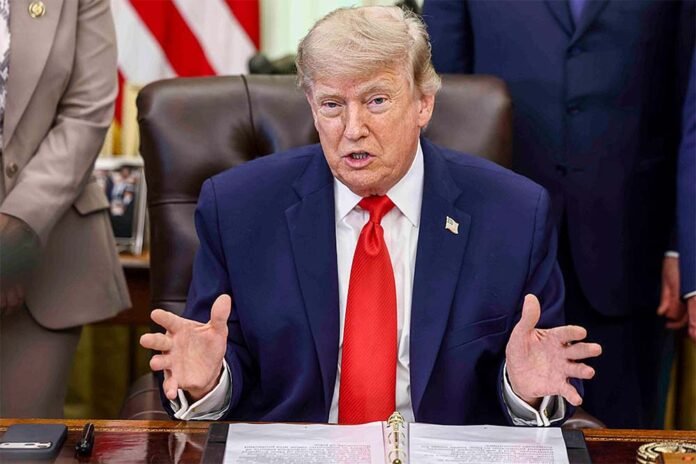
Although US President Donald Trump has announced reaching an agreement with Iran and lifting of the naval blockade on Iranian ports, including the Strait of Hormuz, Tehran said the situation on the ground will change only after Washington fulfils several commitments outlined in preliminary understanding reached between the two sides.
That means, Iranians don’t trust Trump and his approach, which has since February 28, oscillated between threats and engagement, creating uncertainty over the durability of the agreement and raising questions whether diplomatic assurances will translate into tangible action.

America’s Callous Attitude Towards India
The US’s West Asian strategy is increasingly pushing it into a quagmire that will ultimately result in eroding America’s credibility, influence and strategic position in the region. However, what is hurting New Delhi, in particular, is America’s callous attitude towards India, a strategic partner with which it shares democratic values, a common commitment to maintaining a free and open navigation and an open maritime order.
Despite this, in the last one week, the US Navy has struck three ships in the Gulf, all with Indian crew on board. Three Indian nationals were killed when their Palau-flagged oil tanker was struck by the US Navy in the Gulf of Oman on June 8. Shockingly, the US Navy, deployed to impose the Strait of Hormuz’s blockade, did not come to rescue the rest of Indian seafarers who were on board the ill-fated vessel.
Following the incident, India summoned US Charge’ d’Affaires Jason Meeks and lodged a strong protest. On June 12, India summoned the US Charge’ d’Affaires again after another merchant vessel carrying 20 Indian crew members came under American navy’s attack off the coast of Oman on June 11. Yet, America has maintained unapologetic silence; it has refused to express remorse or sorrow over its attack on non-militarised vessels.
The US’s West Asian strategy is increasingly pushing it into a quagmire that will ultimately result in eroding America’s credibility, influence and strategic position in the region. However, what is hurting New Delhi, in particular, is America’s callous attitude towards India
A video of three Indian seafarers circulating in social media, maintains that ships with Indian crew on board are being targeted by the US Navy. If it is true, it clearly suggests Americans are undertaking such acts deliberately and they are doing so to deter India and its interests.

Moreover, its insensitivity towards the loss of innocent lives in the Gulf only explains its deep-rooted disregard for the concerns of a key strategic partner. It was apparent when US Secretary of State Marco Rubio said “all commercial vessels should immediately comply with orders from US forces.”
Unambiguously, a belligerent tone, Rubio said this in response to External Affairs Minister S Jaishankar’s call to his American counterpart wherein he “reiterated India’s strong protest at the attacks by the US Navy that killed three Indian mariners” and termed such actions against commercial shipping as unjustified.

These incidents exposed Americans’ chicanery. They took place just 36 hours before US President Donald Trump lavished praise on Narendra Modi on June 11 for becoming India’s longest-serving Prime Minister. Taking to his social media platform, Truth Social, the US President described Prime Minister Modi as his friend and called him a “Great”
US’s Trickery
These incidents exposed Americans’ chicanery. They took place just 36 hours before US President Donald Trump lavished praise on Narendra Modi on June 11 for becoming India’s longest-serving Prime Minister. Taking to his social media platform, Truth Social, the US President described Prime Minister Modi as his friend and called him a “Great”.
Trump went on to say, “He (Prime Minister Modi) is a strong, healthy, and wise man, and will have many years of Greatness and Success ahead of him!”. Yet, the statement did little to enthuse anyone in India. Instead, it deepened the growing sense of resentment towards the US under the Trump administration.
Many Indians view America’s conduct as extremely contradictory – praising Prime Minister Modi publicly while repeatedly acting against India’s interests since Trump’s return to the White House in the second term.
During his maiden visit to India on May 23-26, US Secretary of State Rubio, responding to a question on the Iran war, said, “Whereas India and the United States are concerned, we both have a very strong interest in ensuring that there is safe and unimpeded maritime commerce.”
Many Indians view America’s conduct as extremely contradictory – praising Prime Minister Modi publicly while repeatedly acting against India’s interests since Trump’s return to the White House in the second term
However, the facts on the ground tell a different story. As a result of the US-led blockade, 13 Indian-flagged vessels are currently stranded in the Strait of Hormuz. More than 18,000 Indian seafarers remained stranded across the region, including 562 serving on Indian-flagged vessels. The disruption speaks volumes of the US’s assertive and unilateral approach, which has placed significant strain on maritime trade and the safety of seafarers in the region.
But under Trump’s second term, the US administration has placed stress on an approach that suits American interests, unwillingness to go by rules and employ coercive instruments in the pursuit of strategic objectives. Experts say the Oman incidents reflect this attitude of America; the dwindling superpower which shares no warmth in its relations with India since the last one year. Despite this, no one imagined that ups and downs in US-India ties over trade and tariff, Russian oil imports and Pakistan, would spill over so menacingly and brutally against Indians.
Experts say the effect of these developments is likely to leave a lasting imprint on Indian public opinion and policymaking circles. For decades, India has invested considerable diplomatic wealth in building a comprehensive strategic partnership with the US. Yet, strategic partnerships cannot be sustained on rhetoric alone. They require mutual sensitivity to each other’s core interests, concerns and vulnerabilities.
Growing Gulf Between US and Global South
Moreover, the incidents reinforce a growing perception across the Global South that the US increasingly applies international norms selectively. Countries are willing to support a rules-based order only when they believe the rules apply equally to all. When powerful states appear willing to bypass those very principles in pursuit of short-term strategic objectives, they undermine the legitimacy of the system they seek to lead.
At a moment when geopolitical tensions are reshaping the global balance of power, the US can ill afford to alienate countries whose cooperation it seeks. For India, the lesson is equally clear: strategic partnerships are valuable, but national interests and the safety of Indian citizens must remain paramount
For the US, the danger is a gradual erosion of influence. Allies and partners may continue to engage with America, but they will do so with greater caution, hedging their bets and seeking alternative arrangements to safeguard their interests. India, with its long-standing tradition of strategic autonomy, is particularly unlikely to sideline its national interests to the calculations of any external power.
The events in Oman, therefore, represent more than an isolated maritime controversy. They are a test of the credibility of America’s partnership with India and of Washington’s claim to uphold an open and secure international order. Unless the US addresses India’s concerns transparently, acknowledges the loss of innocent lives and demonstrates greater respect for the interests of its partners, the damage inflicted by these incidents may outlast the immediate crisis itself.
And then at a moment when geopolitical tensions are reshaping the global balance of power, the US can ill afford to alienate countries whose cooperation it seeks. For India, the lesson is equally clear: strategic partnerships are valuable, but national interests and the safety of Indian citizens must remain paramount. The Oman incidents have served as a stark reminder that in an increasingly uncertain world, nations ultimately rely on their own strength, diplomacy and judgment to protect their people and secure their interests.

The writer is a senior journalist with wide experience in covering international affairs. The views expressed are of the writer and do not necessarily reflect the views of Raksha Anirveda





