


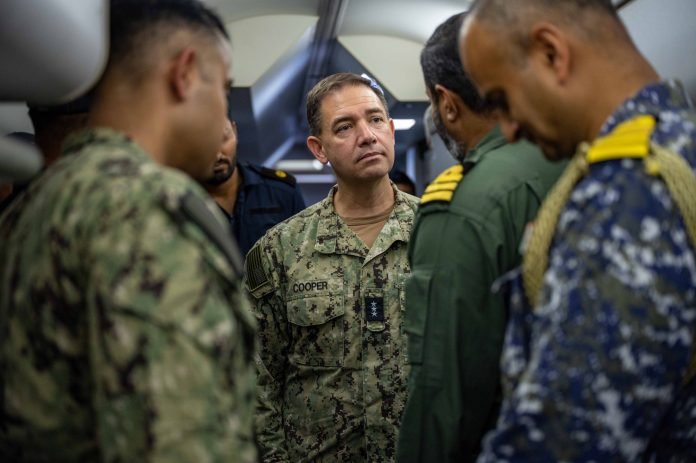
Washington: President Donald Trump’s nominee to serve as the next head of US Central Command warned lawmakers that Iran still has “considerable tactical capabilities” even after recent airstrikes from Israeli and American forces, and will remain a security threat for the foreseeable future.
Vice Adm Charles B. Cooper II, who has served as the top deputy at Central Command since February 2024, said that the recent assaults have degraded some of Iran’s military but declined to give specifics on whether their fledgling nuclear program has been eliminated.

Even without it, he said that Iranian aggression and support for militant groups in the region would remain a top concern for American defence planners. “I think we would all agree that Iran is the number one source of instability in the region, and the number one source and sponsor of terror throughout the world,” he said in testimony before the Senate Armed Services Committee.
“Deterring Iran will be a priority … We’ve got to be in a three-point stance every day.”
Taking off from the US heartland, B-2 stealth bombers, aided by refueling tankers and fighter jets, delivered a total of 420,000 pounds of explosives. Over the weekend, US military assets bombarded several key underground uranium enrichment plants in Iran, delivering what the White House has claimed is a knockout blow to the country’s nuclear program. The move came after several days of similar Israeli strikes against key military and production sites.
The strikes followed almost two years of conflict between Israel and Iran’s main proxy groups in the region: Hezbollah, Hamas and the Houthis. Over time, the Israel Defence Forces have severely damaged these militias, which Iran has long sponsored as a deterrent against Tel Aviv, its main adversary.

President Donald Trump wrote on social media that “it was my great honour to destroy all nuclear facilities and capability” in Iran, and suggested the threat from that country is now minimal.
Pentagon leaders have thus far touted the mission as a success but declined to publicly reveal just how much damage was done to the Iranian programs. And Cooper’s comments made it clear that senior military officials still see the country as a significant problem to peace and stability in the region.

The lack of detail on the current status of the Iranian nuclear program and the damage it incurred was a point of frustration for Democratic lawmakers, who have pressed the administration for more specifics on the threats posed by Iran and the status of their nuclear ambitions.
Pentagon leaders had planned briefings on the weekend airstrikes for House and Senate lawmakers, but those meetings were later postponed until the end of the week.
“This last-minute postponement is outrageous, evasive and derelict,” Senate Minority Leader Chuck Schumer, said in a statement. “Senators deserve full transparency, and the administration has a legal obligation to inform Congress precisely about what is happening.”
Democratic lawmakers have voiced worries that the military actions were premature and lacked justification, given past intelligence reports casting doubt on Iran’s ability to assemble a nuclear weapon. They also criticised the administration for putting US military personnel in harm’s way with the preventative action. Iran launched multiple missiles at a US military base in Qatar, though no casualties or significant damage was reported.
Republican lawmakers on the Senate panel did not share those concerns, and largely praised Trump’s decision to strike Iran during hearing. “Iran didn’t become a terrorist state because the United States bombed their nuclear bunkers,” said Senator Tom Cotton. “The United States bombed their nuclear bunkers because they are a terrorist state.”
Senate lawmakers have discussed plans to vote on potential new limits to presidential war powers this week, but the timing of that Democratic-led effort could be impacted by the rescheduled congressional briefings.
Pentagon leaders have said there are no plans for additional strikes against Iran but left open the possibility of more military action if needed.






