


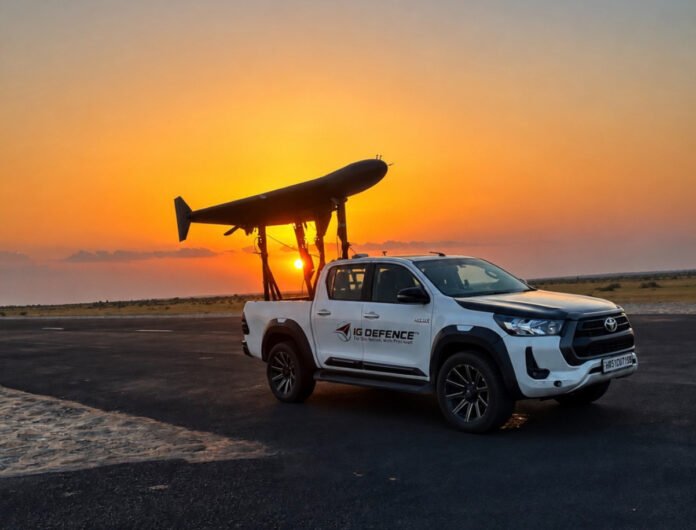
New Delhi: KAL, a long-range one-way attack drone indigenously designed and developed by IG Defence, has successfully completed a trial at the Pokhran Field Firing Range in Rajasthan, marking a significant milestone in India’s development of indigenous long-range unmanned strike capabilities.
The successful trial comes at a time when long-range one-way attack drones have become an increasingly important component of modern warfare. The operational use of Iranian-origin Shahed-136 and Russian Geran-2 systems in the Russia-Ukraine war has demonstrated how relatively low-cost unmanned platforms can provide long-range strike capability, impose sustained pressure on air-defence networks and enable high-volume attack campaigns.

The technology has subsequently spread across theatres, with Shahed-class systems also being employed in the Middle East and against maritime targets in the Red Sea, underscoring the growing geopolitical significance of long-range unmanned strike systems.
KAL is designed to operate in this emerging class of long-range one-way attack systems, with a specified range of up to 1,000 kilometres, endurance of 7–8 hours, payload capacity of up to 50 kg, and an operating altitude of up to 5,000 metres above mean sea level. The platform incorporates a navigation suite combining multi-band GNSS and inertial navigation systems (INS) to support autonomous flight throughout its mission profile.
KAL is designed for precision engagement of designated targets, including infrastructure, radar installations, air-defence systems and other strategic targets, subject to mission configuration and applicable operational authorisations.
The evolution of the Shahed/Geran family has also highlighted a broader transformation in defence technology: the ability to produce long-range unmanned strike platforms at scale is increasingly becoming an important element of national military capability. Recent analysis of the Russia-Ukraine conflict has documented the rapid expansion of Shahed-type drone production and their increasing role in long-range strike campaigns. For countries seeking greater strategic autonomy, this has created a growing requirement for indigenous systems that combine range, payload, autonomous operation and scalable manufacturing.

KAL represents IG Defence’s response to this emerging requirement. The platform has been developed indigenously across its major systems, with the Pokhran trial providing an important validation milestone for the integrated airframe, propulsion, avionics, navigation and mission architecture.
KAL forms part of GRID STRIKE, IG Defence’s long-range precision-strike portfolio, and can be integrated with the company’s GRID Battle Management System, an AI-powered C5ISRT architecture designed to coordinate unmanned platforms and battlefield information. The focus of KAL’s development, however, remains the creation of an indigenous long-range unmanned strike capability.

Commenting on the successful trial, Bodhisattwa Sanghapriya, Founder and CEO of IG Defence, said, “The successful completion of KAL’s trial at Pokhran is a significant milestone for IG Defence and for India’s journey towards self-reliance in advanced defence technology. The wars and conflicts of recent years have demonstrated that long-range one-way attack drones are no longer a niche capability; they are becoming an important element of modern warfare and are influencing how nations think about precision strike, air defence and strategic deterrence.”
He added, “KAL has been designed around this emerging requirement, with a focus on long range, autonomous operation, payload capability and scalable indigenous production. For us, this is not simply about developing another drone; it is about building a sovereign Indian capability in a domain that is rapidly becoming strategically important. We believe India must have the ability to design, develop and manufacture such systems domestically, while creating technologies that can also serve the requirements of friendly nations.”
Beyond KAL, IG Defence is developing a broader portfolio of indigenous defence technologies spanning long-range unmanned strike systems, interceptor drones, FPV combat drones, autonomous UAVs, counter-UAS systems, electronic warfare, AI-enabled swarm technologies, tactical robotics and logistics drones.
The successful Pokhran trial marks another step in IG Defence’s effort to build India-origin defence technologies for an increasingly unmanned and contested battlespace.
Designed in Bharat. Developed in Bharat. For Bharat.






