


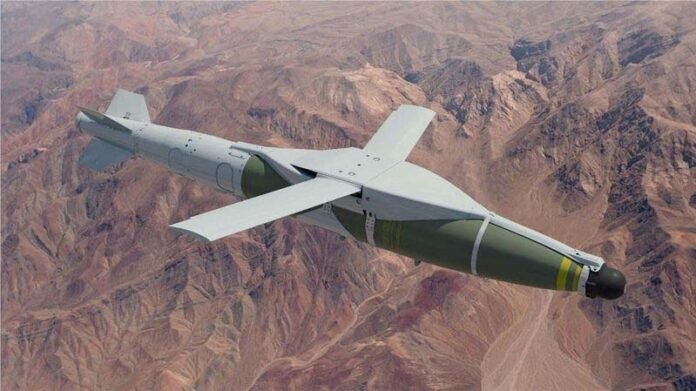
The Indian Navy has initiated the procurement process for ship-borne loitering munitions, commonly referred to as “kamikaze” or “suicide” drones. By issuing a formal Request for Information (RFI), the Ministry of Defence has laid the groundwork to integrate sea-based loitering systems across surface warships.
A Tactical Paradigm Shift in Naval Warfare
Unlike standard anti-ship cruise missiles or traditional reconnaissance unmanned aerial vehicles (UAVs), loitering munitions bridge the operational gap between surveillance platforms and precision strike ordnance.

These weapon systems can launch from warships, fly into designated operational sectors and loiter overhead for hours while scanning for threats. Once a high-value asset is identified, the drone transitions into a steep terminal dive, crashing directly into the target to detonate its forward-mounted warhead.
Performance Benchmarks
According to technical specifications outlined in the RFI document, the Navy is seeking high-performance systems capable of projecting force over expansive ocean sectors and littoral zones. Key operational requirements include:
- Operational Range & Endurance: A striking radius of at least 1,000 kilometres coupled with a loitering flight time of nine hours or more.
- Flight Dynamics: A cruise speed exceeding 75 knots, an operational ceiling of 15,000 feet and terminal attack dive speeds greater than 200 knots.
- Low-Observable Profile: A design optimised for low radar cross-section (RCS) to evade detection by adversary naval radar arrays.
Guidance will rely on an integrated electro-optical and infrared (EO/IR) seeker package combining forward-looking infrared (FLIR) imaging with a daylight camera. This dual-sensor configuration enables day-and-night navigation, surveillance and target acquisition in all weather conditions.
Advanced Communications and Safety Features
To ensure mission success in hostile electronic warfare environments, the proposed munitions must feature anti-jamming mechanisms and autonomous flight capabilities. The drones will navigate along pre-set waypoint coordinates and automatically return toward their control terminal’s last known location if data links drop. Should communication fail permanently, the systems will divert to a pre-designated safe termination point to avoid civilian or unintended targets.

Crucially, the RFI highlights a dynamic control-handoff feature. A drone launched by one warship can have its data link transferred mid-flight to operators aboard a second vessel or a shore-based command station, drastically extending target engagement flexibility across networked naval forces.
Deploying long-range loitering munitions from naval combatants allows launch platforms to remain positioned far beyond the reach of adversary anti-ship defences. This standoff distance significantly enhances warship survivability while projecting lethal power over expansive sea lanes and littoral zones.

Aligning with Global Trends and ‘Aatmanirbhar Bharat’
India’s push to field ship-launched kamikaze drones aligns with global naval strategies influenced by recent conflicts, such as the war in Ukraine, where loitering munitions have disrupted maritime operations. Deploying these platforms provides the Indian Navy with a scalable, cost-effective alternative to costly anti-ship cruise missiles for engagements against opportunistic surface assets and coastal installations.
Procurement will proceed under the Defence Acquisition Procedure (DAP), prioritising categories like Buy (Indian-IDDM), Buy (Indian), and Buy & Make (Indian). This approach ensures domestic defence manufacturers – including contenders like Solar Industries, Bharat Forge, Tata Advanced Systems and Nibe – receive preferential standing, reinforcing New Delhi’s Aatmanirbhar Bharat initiative to build indigenous military technological capabilities.
Although the Ministry of Defence has not yet formally announced the financial layout, sources estimate the overall potential value of the programme between ₹15,000 crore and ₹18,000 crore. The issuance of the Request for Information (RFI) marks the critical first phase in the procurement process, allowing defence officials to map indigenous technical maturity and evaluate the manufacturing capacity of local industry players before issuing formal tenders.
If successfully developed and manufactured within India, the ship-launched loitering munition project will represent a major milestone for the domestic defence supply chain. Besides strengthening the operational readiness of the Indian Navy, the project is expected to foster deeper research partnerships, expand skilled aerospace engineering roles and cement India’s status as a developer of advanced, export-ready military hardware.






