


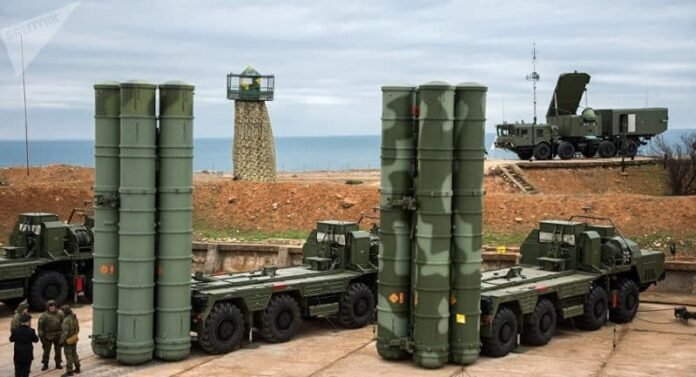
New Delhi: India has formally received its fourth squadron of the Russian-made S-400 Triumf, known domestically as the ‘Sudarshan Chakra’, marking a decisive boost to its long-range air defence shield.
The system, delivered by ship a few days ago, will soon be deployed in an operational sector, with the fifth squadron expected in the coming months.

India signed the $5.43 billion agreement in 2018 to procure five S-400 regimental systems from Russia. The first three squadrons were inducted by 2023, but deliveries of the remaining two were delayed due to the Russia-Ukraine conflict and sanctions-related disruptions.
With the fourth squadron now in India, officials confirm that deliveries are back on track, and the final unit is scheduled to arrive later this year.
Each S-400 squadron comprises 16 vehicles, including command-and-control units, advanced radars, and missile launchers. A squadron is divided into two batteries, each with six launchers, together capable of deploying 128 missiles.
Under the deal, India is acquiring 60 launchers and 6,000 missiles with engagement ranges varying from 120 km to 380 km. This layered capability allows the system to counter fighter aircraft, surveillance platforms, drones, cruise missiles, and ballistic missiles.

The operational significance of the S-400 was highlighted during Operation Sindoor in May 2025, when the system achieved a record-range kill by downing a high-value Pakistani surveillance aircraft at over 300 km.
Defence sources emphasised that the Sudarshan Chakra played a decisive role in neutralising hostile aerial threats, forcing adversary aircraft to retreat deep into their own territory. Its combat validation has led India’s Defence Acquisition Council to approve plans for five additional squadrons beyond the original order, potentially expanding the fleet to ten.

The arrival of the fourth squadron strengthens India’s multi-layered air defence network, which integrates imported and indigenous systems.
Alongside the S-400, India fields medium-range platforms such as Barak-8 and is advancing Project Kusha, an indigenous long-range air defence programme under DRDO. Project Kusha aims to deliver three tiers of interceptor missiles with ranges between 150 km and 400 km, supported by advanced radars and integration into the Indian Air Command and Control System (IACCS).
Defence industry partners such as Solar Industries, Bharat Electronics Limited, and Bharat Dynamics Limited are involved in development and production, with operational deployment targeted between 2028 and 2030.
Project Kusha is designed to rival global systems like the S-400 while offering cost advantages, with interceptor prices projected at ₹40–50 crore compared to over ₹100 crore for Russian equivalents. It incorporates advanced radar arrays optimised for stealth detection and promises high single-shot kill probabilities.
The system is expected to form part of the wider Sudarshan Chakra concept, a unified network combining imported and indigenous assets to counter drones, ballistic missiles, and emerging hypersonic threats.
The induction of the fourth S-400 squadron thus represents both an immediate operational boost and a bridge towards India’s long-term goal of strategic autonomy in air defence.
It consolidates deterrence against Pakistan and China while reinforcing India-Russia defence ties, even as New Delhi accelerates indigenous programmes to reduce reliance on foreign suppliers.






