


Even as Europeans continue to maintain a stereotype mindset against India, there is growing realisation across the continent that the South Asian giant cannot be overlooked or undermined, given its pool of skilled talent, size of economy, appetite for cutting-edge technologies and potential to reshape the future global order.
Europeans’ mindset against India has not changed; their poor and myopic view about the country continues to hound them, irrespective of the fact that it is the 5th economic power of the world and ranks 38th in Global Innovation Index and 3rd in research publications.

Yet, Norwegian news outlet ‘Aftenposten’ in a cartoon depicted Prime Minister Narendra Modi as a snake charmer, with the headline ‘A sneaky and slightly annoying man,’ indicating clearly their racist and pugnaciously derogatory outlook towards India.
In doing so, however, the publication exposed itself to a fundamental question: how much does it truly understand about India, a civilisation with an unparalleled historical legacy, including the ancient Licchavi Republic, which flourished in the 6th century BCE, long before much of the world had even become familiar with the concept of democracy.
There are several examples that India can cite to demonstrate its contributions to the world, but Norwegian dailies and journalists, in their bid to flaunt press freedom, markedly stooped low to demean the South Asian country, which remains among the fastest-growing economies despite the West Asia conflict and persistent uncertainty surrounding global growth.
Europeans’ myopic view of India has not changed. Norwegian news outlet ‘Aftenposten’ in a cartoon depicted Prime Minister Modi as a snake charmer, with the headline ‘A sneaky and slightly annoying man,’ indicating clearly their racist and pugnaciously derogatory outlook towards India
Hypocrisy of Nordic Media
It was the reason, during the just-concluded India-Nordic summit in Oslo, countries like Norway, Sweden, Finland, Iceland and Denmark, with their combined economy of over $2 trillion, sought to deepen their engagement and cooperation with India. What, however, was significant was that it was held weeks before Beijing had planned to host the 8th Nordic Economic and Trade Cooperation Forum meeting.

According to China’s Ministry of Commerce, the two-way trade between the two sides from January to August 2025 totalled approximately $38 billion, up 7.1% year on a year-on-year basis. In comparison, India’s trade with Nordic nations collectively stood at $19 billion in 2024, which pales before China’s voluminous trade engagement with Nordic countries. Yet, nothing can be more hypocritical than the Nordic countries’ public opinion on China. In 2025, from Denmark to Finland and Sweden, each one voiced its concern over the human rights situation at the 60th session of the UN Human Rights Council (UNHRC) in Geneva.
Norway, ranking first in the world press freedom index, has no guts to confront China directly. Norwegian newspaper ‘Aftenposten’ has on record acknowledged that China blocks its website whenever it publishes articles critical of Beijing on human rights, censorship, Xinjiang, Tibet, Hong Kong, treatment of dissidents or writes anything in support of Taiwan.

In fact, the Norwegian government adopts a pragmatic approach in dealing with China. To keep Beijing in good humour, Oslo, which awarded the Nobel Peace prize to the Dalai Lama in 1989 for advocating peaceful solutions based upon tolerance and mutual respect, snubbed the Tibetan spiritual leader by refusing to meet him when he arrived in the country in May 2014.
In 2016, Norway signed a normalisation agreement with China, six years after diplomatic relations had frozen between the two countries. Only a few local journalists came up with their mighty pen to deplore Norway’s act, even though the Oslo-Beijing deal included a pledge from Oslo stating that the Nordic country “attaches high importance to China’s core interests” and “will not support actions that undermine them.”
Importance of India-Nordic Nations Ties
Clearly, Norway does not want to mix realpolitik with ideology for the sake of its national interest and this is what guided the Nordic country to further cement ties with India. Prime Minister Modi, who visited Norway at the invitation of the Norwegian Prime Minister, was the first Indian Prime Minister to make an official trip to the country in 43 years.
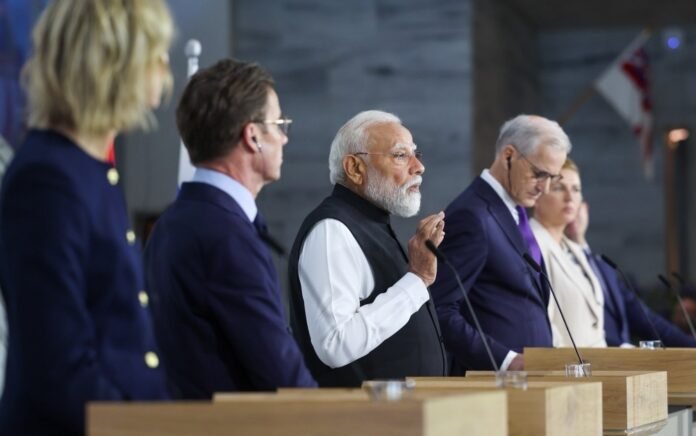
During the India-Nordic summit, Norway, Sweden, Finland, Iceland and Denmark, with their combined economy of over $2 trillion, sought to deepen their engagement and cooperation with India. Significantly, it was held weeks before Beijing had planned to host the 8th Nordic Economic and Trade Cooperation Forum meeting
And the visit took place close on the heels of the coming into force of the India-European Free Trade Association (IEFTA) and the Trade and Economic Partnership Agreement (TEPA). Since the purpose of Prime Minister Modi’s visit to Norway was to attend the third India-Nordic summit and push technology-driven diplomacy in the region, he was pulling all levers of the country’s strategy by elevating India-Nordic relationship to a Green Technology and Innovation Strategic Partnership.
Norway and its Nordic neighbours are considered world leaders in renewable energy, green technologies, and sustainable source handling. For example, Norway is using seaweed, algae and other biomass sources for energy, fertilisation and other purposes, including sustainable fuels. Norway, a major oil and gas producer, is also known for its hydropower technology.
In early 2021, Norway had 1,681 hydropower plants with an accumulated installed capacity of 33 GW. Similarly, Iceland is a pioneer in geothermal energy. According to the World Bank, nearly 27% of Iceland’s electricity requirement is generated by geothermal power, while 73% electricity is produced by hydropower. On the other hand, Denmark is a pioneer in wind energy.
Of the total electricity consumption in Denmark, approximately 50% generated by wind and solar energy. Finland is a world leader in a circular economy — a regenerative production and consumption model designed to minimise waste and pollution, keep products and materials in use for as long as possible, and regenerate natural systems.
During Finnish President Dr Alexander Stubb’s state visit to India on March 4-7, 2026, the two countries agreed to advance the deeper collaboration in the circular economy, climate action and sustainability. On the other hand, for Sweden, the largest of the Nordic countries, green energy is the lifeline of its electricity production, which sustains its car manufacturing industry, iron and steel firms.
Nordic nations are at the forefront of niche technologies in innovation, clean and green tech solutions, renewable energy, e-mobility, digitalisation, ICT, AI, blue economy, maritime solutions, port modernisation, skill development, agriculture and food processing, health and life sciences, and green shipping, says Sibi George, Secretary (West) in the Ministry of External Affairs
Almost 75% of Sweden’s electricity production comes from hydroelectric power systems and nuclear power, while around 16% comes from wind power. Sweden’s electric grid is currently 98% fossil-free.
Nordic Nations’ Power Play with Critical Technologies
As the 21st century is heading towards an era defined by technology, innovation and energy transition, with nations competing against each other for global leadership, strategic influence, and economic dominance, India, with its vast pool of resources and talent, wants to proactively engage with Nordic countries and other powers for its successful energy transition.
But then, Nordic countries are not just a hub for green technologies, they are also home to high tech, semiconductors and quantum technologies. For instance, the resource-rich Nordic nations, which are increasingly reducing their dependencies on China by harnessing domestic rare earth reserves, deep-sea mining, and vast mineral deposits, are positioning themselves as pioneers in 5G/6G, quantum technology, and photonics.
In particular, Finland, which is considered a leader in quantum technology, is currently busy enhancing Europe’s defence capabilities through advanced quantum applications. While Sweden, like the Netherlands, is emerging as a hub for semiconductor expertise, research and innovations. Prime Minister Modi’s visit to Norway and other Nordic nations was aimed at elevating the scope of cooperation in cutting-edge technologies, green transition, defence innovation, and strategic industries.
As the 21st century is heading towards an era defined by technology, innovation and energy transition, with nations competing against each other for global leadership, strategic influence, and economic dominance, India with its vast pool of resources and talent, wants to proactively engage with Nordic countries and other powers for its successful energy transition
Nordic nations, with a combined economy over $2 trillion, “are at the forefront of niche technologies in the areas of innovation, clean and green tech solutions sustainability, renewable energy, including offshore wind, green hydrogen and green methanol, e-mobility, digitalisation, ICT, AI, blue economy, maritime solutions, port modernisation, skill development, agriculture and food processing, health and life sciences, and green shipping,” Sibi George, Secretary (West) in the Ministry of External Affairs, said.
Conclusion
Ironically, even as parts of the Nordic media attempt to caricature India, Nordic governments themselves are steadily expanding strategic partnerships with New Delhi in areas ranging from green energy and digital innovation to semiconductors, quantum technology, maritime cooperation and critical minerals.
This contrast reveals the gap between ideological posturing and geopolitical reality. Unlike their selective moralism towards China, Nordic nations recognise that engagement with India is indispensable for economic resilience, technological diversification and democratic cooperation in an increasingly uncertain world.
Prime Minister Modi’s visit to Norway and the India-Nordic summit, therefore, carried significance far beyond symbolism. They underscored India’s emergence as a trusted partner in the global green transition and advanced technology ecosystem. As the world moves towards a future driven by innovation, clean energy and strategic technologies, India and the Nordic countries have strong reasons to deepen collaboration based on mutual interests and shared democratic values.

The writer is a senior journalist with wide experience in covering international affairs. The views expressed are of the writer and do not necessarily reflect the views of Raksha Anirveda





