


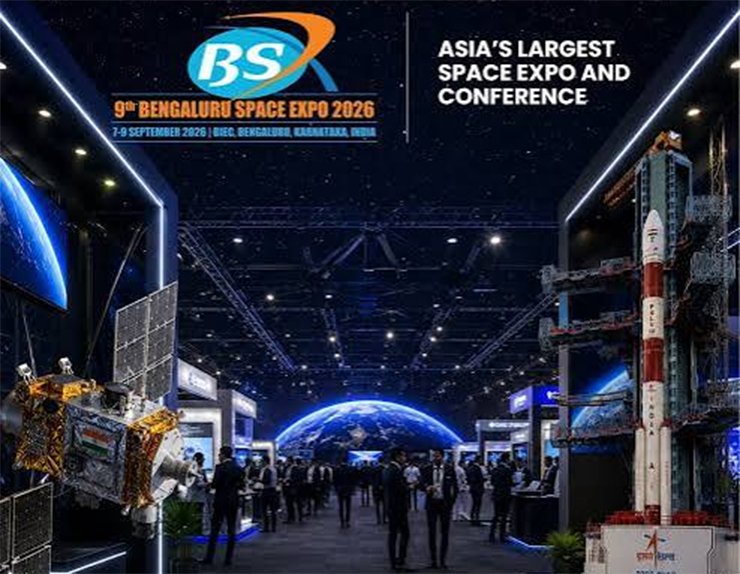
Organised by the Confederation of Indian Industry with ISRO, IN-SPACe and NSIL, this year’s BSX edition carries the theme “Harnessing Space for Global Progress: Innovation, Policy and Growth”. Beyond the plenaries and the keynotes, it is the exhibitor hall where India’s newest space companies will do their real selling – to satellite operators, investors and governments scouting for launch and imaging partners. Here’s a look at some of the Indian names to watch.
Dhruva Space – the host with the most
Hyderabad-based Dhruva Space isn’t just exhibiting at BSX 2026, it’s the event’s title sponsor this year – a marker of how far the satellite-systems builder has travelled since its early nanosatellite launches. The company designs and manufactures satellite platforms, ground systems and orbital deployers for customers across the private-sector value chain. CEO and co-founder Sanjay Nekkanti has said the Expo gives Dhruva a direct line to international customers and technology partners, and a chance to explore contributions to space programmes in both established and emerging markets – squarely aimed at converting BSX footfall into cross-border deals.

Skyroot Aerospace – chasing the Vikram dream
Also from Hyderabad, Skyroot Aerospace remains India’s most closely watched launch-vehicle startup, developing the Vikram family of rockets named after space pioneer Vikram Sarabhai. Having already made history with the sub-orbital Vikram-S flight, Skyroot is co-sponsoring this year’s BSX and will use the floor to talk directly to satellite companies about upcoming missions, orbital requirements and integration timelines – essentially building its order book for dedicated, responsive launches as it moves toward orbital flights.
Pixxel – seeing the world in 200 colours
Bengaluru’s Pixxel returns to BSX 2026, riding real momentum. Its hyperspectral imaging satellites capture roughly 200 bands of visible and infrared light, producing far more granular data than conventional Earth-observation cameras – useful for spotting crop stress, mineral deposits or gas leaks invisible to the naked eye. Founder and CEO Awais Ahmed has been vocal about India’s shift from a space-faring nation to a space-solutions provider for the world, and Pixxel’s stall is expected to be one of the busier ones on the innovation and start-up pavilion.
GalaxEye – all-weather eyes in orbit
Another Bengaluru-based company making waves, GalaxEye tackles a problem that has long dogged Earth observation: clouds and darkness blinding optical cameras. Its Mission Drishti satellite, launched on a SpaceX Falcon 9 earlier this year, combines radar and optical imaging on a single 190-kilograme spacecraft – India’s largest privately built Earth-imaging satellite so far – with an onboard AI chip that processes signals in orbit. Expect GalaxEye to lean on that milestone heavily while courting new government and commercial clients at BSX.
Bellatrix Aerospace – space’s quiet mover
Bellatrix Aerospace, a co-sponsor of BSX 2026, builds the less glamorous but equally critical hardware: orbital transfer vehicles that act as “taxis”, ferrying satellites to their precise final orbits after a rocket’s main job is done. The company has also tested an indigenous green propulsion system under DRDO projects and is developing a very-low-earth-orbit satellite with South Korea’s TelePIX. Its presence signals how India’s space-tech story now extends well beyond rockets and cameras into orbital logistics.

Astra Microwave Products – the RF backbone
A veteran name among the newer startups, Astra Microwave Products is co-sponsoring BSX 2026 and brings decades of expertise in radio-frequency and microwave components – the unglamorous but essential technology behind satellite communications, radar and secure defence-grade links. Its presence at the expo underscores how India’s space ecosystem rests on established component manufacturers as much as on flashy new-age launch startups.
Abyom Spacetech & Defence – betting on reusability
Rounding off the list is Gorakhpur-based Abyom Spacetech & Defence, a younger entrant developing reusable rocket launch vehicles with support from IN-SPACe. Rather than letting booster stages splash into the ocean or burn up, Abyom wants to land and reuse them – the same cost-cutting logic that transformed global launch economics elsewhere. With its rocket design already reviewed by ISRO’s Vikram Sarabhai Space Centre, the company will use BSX to build visibility ahead of ground testing.

Beyond India: who else is showing up, and why
BSX 2026 isn’t just an Indian trade show with a global label – organisers are expecting exhibitors and delegates from roughly 20 countries, up from 14 at the 2024 edition, with dedicated country pavilions built into the exhibition hall itself. Each visiting nation is arriving with a fairly specific ask.
United Kingdom: The UK gets its own dedicated conference slot – “UK & India: Driving Growth in the Space Economy” – reflecting a relationship that already runs deep on the corporate side. UK-headquartered connectivity specialist Smiths Interconnect is exhibiting to pitch its RF and fibre-optic hardware for mission-critical satellite and defence systems, and London is broadly targeting deeper co-development ties and market access for UK small-sat and downstream-data firms into India’s fast-growing commercial space sector.
Europe (EU bloc): A separate “Europe-India Space Connect” session is built around building partnerships for the NewSpace economy – European agencies and companies are using BSX to scout co-development opportunities in launch, components and Earth-observation data, areas where Indian costs and European technology are seen as complementary.
Japan: With a dedicated “Japan-India Collaborations: Opportunities, Challenges and the Road Ahead” session, Tokyo’s delegation – expected to include JAXA-linked stakeholders – is targeting joint missions and technology exchange, building on existing India-Japan cooperation in lunar exploration and satellite navigation.
Australia: Canberra’s “Capability Complementarity: From Innovation to Specialisation” session frames Australia’s pitch plainly: rather than compete with India across the board, Australian companies want to plug into specific gaps – ground stations, launch-site geography and specialised manufacturing – where the two countries’ strengths don’t overlap.
Russia: Roscosmos is listed as BSX 2026’s space agency partner, continuing a legacy relationship that dates back to India’s earliest crewed-spaceflight ambitions. Moscow’s interest centres on human spaceflight cooperation (relevant to India’s Gaganyaan programme) and keeping Russian launch and propulsion technology relevant to Indian customers even as the country’s space budget stays defence-heavy.
South Korea: While it doesn’t have a headline plenary slot, South Korean industry is present through partnerships already in motion – TelePIX’s tie-up with Bengaluru’s Bellatrix Aerospace on a very-low-earth-orbit satellite being the clearest example – with Seoul’s companies targeting Indian manufacturing scale and launch access in exchange for imaging and sensor technology.
The United States: Washington doesn’t headline a country session this year, but American interest shows up through the investor and advisory community – law firm Cooley, for instance, is sending partners specifically to track deal flow – signalling that US venture capital and space-tech firms see BSX as a barometre for where to place bets in India’s private space sector rather than a government-to-government showcase.
Taken together, the country pavilions tell their own story: legacy partners like Russia are defending old ground in human spaceflight, Western allies like the UK, Europe, Japan and Australia are chasing narrower, capability-specific tie-ups, and the US is watching capital flows more than signing government pacts. For India, hosting all of them under one roof is itself the point – a chance to play matchmaker rather than merely a supplier.
The bigger picture
Taken together, these companies capture the breadth of India’s private space sector today: launch vehicles from Skyroot and Abyom, satellite platforms from Dhruva Space, imaging innovation from Pixxel and GalaxEye, orbital mobility from Bellatrix and the component backbone supplied by firms like Astra Microwave.
Add in Hyderabad’s wider cluster – XDLINX, TakeMe2Space, N Space Tech India and Avon Defence, among others – and BSX 2026 looks less like a trade show and more like a coming-out party for an industry that barely existed a decade ago.
With around 12,000 business visitors and 1,000 conference delegates expected over three days, the real test for these companies won’t be the booths themselves but the deals struck on the sidelines – the international customers, technology tie-ups and investor conversations that decide which of these names become the Skyroots and Pixxels of the next decade.






