


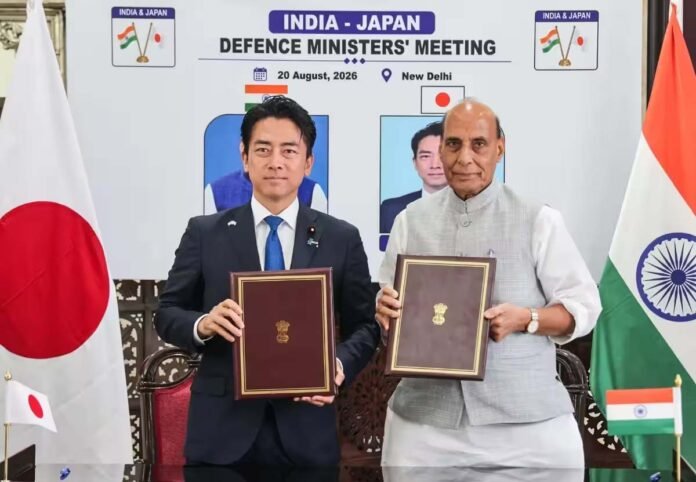
On August 20, 2026, India and Japan signed their first-ever defence-only joint statement and a landmark maritime security pact. It’s not just paperwork – it’s a signal that two of Asia’s biggest democracies are done hedging and are ready to build real naval muscle together, with China’s shadow looming over every clause.
The Pacts: What Actually Got Signed
Defence Minister Rajnath Singh and his Japanese counterpart Shinjiro Koizumi – on his first trip abroad since taking the job – signed a Memorandum of Arrangement on maritime security cooperation. Strip away the diplomatic language and here’s what it actually does: it locks in closer coordination between the Indian Navy and the Japan Maritime Self-Defence Force on maritime domain awareness, search-and-rescue, humanitarian relief and – notably – mine countermeasures and undersea security, an area both navies have historically kept close to the chest.

It also opens the door to something bigger: exchanges between the two countries’ special operations forces, and cooperation with India’s future integrated theatre commands once they’re up and ready. That’s the language of two militaries planning to actually operate together, not just shake hands at summits.
This wasn’t a bolt from the blue. Koizumi’s trip began a day earlier in Mumbai, where he toured the Western Naval Command – India’s frontline outfit for the Arabian Sea and the wider Indian Ocean.
Rajnath Singh framed the whole visit around aligning India’s MAHASAGAR vision (Mutual and Holistic Advancement for Security and Growth Across Regions) with Japan’s long-running Free and Open Indo-Pacific initiative, calling the two “deeply interlinked” – a way of saying the Indian Ocean and the Pacific are now, in practice, one strategic theatre.
Beyond the maritime pact, PM Modi pushed Japanese companies and defence start-ups to co-develop and co-produce equipment with Indian firms under Make in India initiative, with joint naval shipbuilding and warship design floated as the next big-ticket item. Singh also welcomed Japan’s recent loosening of its Three Principles on Transfer of Defence Equipment and Technology – the export-control framework that has long limited how much hardware Tokyo can actually sell abroad. That relaxation matters enormously for what comes next.

India and Japan just moved past symbolism. Rajnath Singh and Shinjiro Koizumi signed a Memorandum of Arrangement locking in naval coordination on mine countermeasures, undersea security and search-and-rescue – plus a path toward special forces exchanges and cooperation with India’s future theatre commands. This is what two militaries planning to operate together actually looks like.
The India-Japan Relationship: From Symbolism to Substance
For years, India-Japan defence ties were long on symbolism – annual summits, “Special Strategic and Global Partnership” branding, the occasional joint exercise – and comparatively short on binding commitments. This week changes that calculus. The two sides didn’t just talk; they put a signature on a document that commits their navies to information-sharing and joint operational planning, and they agreed to hold the fourth round of the 2+2 Foreign and Defence Ministerial Dialogue in Tokyo before the end of 2026.
There’s also a quieter story here about interests converging out of necessity rather than sentiment. Japan is watching an assertive China press against the Senkaku Islands and probe deeper into the Pacific; India is watching Chinese survey ships, submarines and a growing People’s Liberation Army Navy footprint edge into the Indian Ocean, a space New Delhi has always considered its own backyard.

Both sides used near-identical language on Thursday, opposing “unilateral actions” that impede freedom of navigation and overflight – diplomatic code that everyone in the region reads the same way. Add joint concern over Russia-North Korea arms cooperation and rising Middle East tensions choking the Strait of Hormuz, and you have two countries whose threat perceptions have simply started to overlap.
Beijing won’t need the fine print to get the message. A pact built around mine countermeasures, undersea security and sea-lane protection – wrapped in talk of “unilateral actions” and “coercion” – reads as a direct response to China’s expanding footprint from the South China Sea to the Indian Ocean’s chokepoints
Impact on Indo-US Ties
None of this happens in a vacuum from Washington. India and Japan are both Quad partners alongside the US and Australia, and a tighter bilateral maritime architecture between Delhi and Tokyo effectively thickens the Quad’s connective tissue without needing a fresh multilateral treaty – something that’s easier to sell domestically in all four capitals.
For Washington, an India that’s building interoperability with Japan is an India edging closer to the kind of “networked” Indo-Pacific security architecture the US has been quietly encouraging for a decade, one built on overlapping bilateral and minilateral pacts rather than a single NATO-style alliance India has always resisted joining.
It also gives the US comfort that its two most important Indo-Pacific partners are hedging against China together, reducing the burden on American naval assets stretched thin by simultaneous crises in the Middle East and East Asia.
Impact on Indo-China Ties
Beijing didn’t need to see the fine print to understand the message. A pact focused explicitly on mine countermeasures, undersea security and sea-lane protection, wrapped in language about “unilateral actions” and “coercion”, is a pointed response to China’s expanding presence from the South China Sea to the Indian Ocean’s chokepoints.
The most underreported detail: India directly asked Japan not to transfer advanced defence tech to Pakistan, citing Islamabad’s history of nuclear and missile exchanges with North Korea. It’s New Delhi using its Japan relationship to shape who else gets access to that technology – a quiet expansion of regional leverage
This adds another layer to an India-China relationship that remains frozen at the trust level even as trade continues. Expect Beijing to read the India-Japan tightening as confirmation of an informal containment coalition forming around it – even though neither Delhi nor Tokyo will ever use that word publicly.
India, characteristically, will keep insisting this is about safeguarding its own maritime lifelines, not joining anyone’s anti-China bloc – a distinction China is unlikely to find convincing.
Impact on Pakistan
The most striking, underreported thread from these talks was India’s direct request that Japan not transfer advanced defence technology to Pakistan. New Delhi’s reasoning traces a well-worn but serious concern: Pakistan’s documented history of nuclear and missile technology exchanges with North Korea, from AQ Khan’s proliferation network to Cold War-era missile transfers.
India’s message to Tokyo was blunt – anything given to Islamabad carries real risk of onward leakage to Pyongyang, especially as North Korea’s missile testing accelerates. This is India using its warming relationship with Japan not just to build capability, but to actively shape who else gets access to Japanese technology – a subtle but real expansion of Delhi’s regional influence.
Impact on Bangladesh and Other Regional Countries
Bangladesh wasn’t a headline act in these talks, but it sits squarely in the strategic frame both countries are drawing. A more assertive India-Japan maritime posture in the Bay of Bengal and wider Indian Ocean directly affects how smaller littoral states like Bangladesh, Sri Lanka and the Maldives balance their own China and India relationships – all three have taken Chinese port and infrastructure investment while trying not to alienate Delhi.
Beyond the security pact, PM Modi pushed Japanese firms to co-develop and co-produce with Indian companies under Make in India initiative, with joint naval shipbuilding floated as the next big move. Japan’s recent loosening of its arms-export rules is what makes that conversation possible at all
As India and Japan build out MAHASAGAR-style capacity-building and connectivity projects, expect both capitals to court these smaller neighbours more actively, offering an alternative to Belt and Road financing. For Dhaka in particular, an India increasingly backed by Japanese shipbuilding and maritime technology means more pressure – and more incentive – to keep its own security posture aligned with, rather than against, New Delhi’s comfort zone.
The bigger picture: this pact won’t dominate headlines for long, but it’s the kind of unglamorous, technical agreement that quietly rewires how a region’s militaries actually talk to each other. That’s usually where real strategic shifts begin.
The real test is whether the shipbuilding talk becomes an actual production line, whether Tokyo heeds Delhi’s warning on Pakistan, and whether the next 2+2 dialogue in Tokyo adds teeth to what is, for now, mostly a framework.
Pacts like this rarely change a region overnight. But they change the default setting of how two navies think about each other – and that’s exactly what’s being fought over in the Indo-Pacific right now.

-The writer is a New Delhi-based senior commentator on international and strategic affairs, environmental issues, an interfaith practitioner, and a media consultant. The views expressed are personal and do not necessarily carry the views of Raksha Anirveda





