


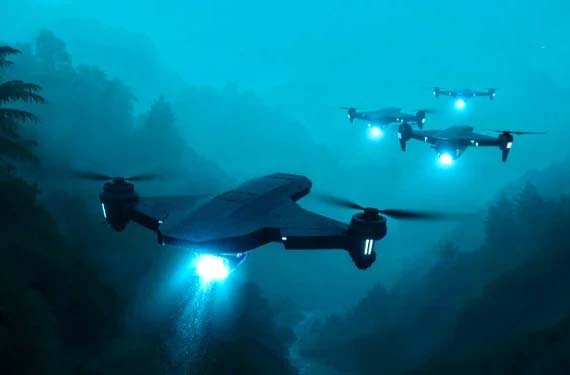
Mumbai. Researchers at the Indian Institute of Technology (IIT) Bombay have introduced a breakthrough control scheme enabling unmanned aerial vehicles (UAVs) to fly in coordinated swarms without depending on GPS, inter-drone communication, or centralised control.
Developed by Professor Dwaipayan Mukherjee and research scholar Chinmay Garanayak, the system relies entirely on bearing-only measurements acquired through onboard cameras to maintain relative positioning and formation. The newly proposed ‘bearing-only’ control paradigm allows each drone to observe nearby units using its onboard camera, deducing bearing information to sustain formation alignment.

According to Garanayak, the goal of bearing-only control is to achieve formation coordination using only interagent bearing data. This eliminates the need for GPS or communication with other drones or a central processor, resulting in a lighter and more power-efficient design.
The IIT-Bombay team applied the control algorithm to Vertical Take-Off and Landing (VTOL) drones, which can rise vertically and hover steadily without runway support. VTOL UAVs are particularly suited for confined or urban environments where traditional fixed-wing drones face constraints. Such autonomy could prove important in surveillance, environmental observation, and defence missions where external positioning systems are compromised.
Relying on onboard cameras instead of range-based sensors reduces susceptibility to noise and lowers system complexity. The absence of GPS and communication modules cuts power consumption and overall weight. This makes the scheme cost-effective and easily deployable for both commercial and tactical operations — especially in GPS-denied or communication-restricted zones, such as during military engagements or covert missions.
VTOL drones pose additional control difficulties due to their underactuated nature — they possess six degrees of freedom but lack independent control in every direction. Traditional models often simplify such dynamics, leading to inaccuracies during dynamic manoeuvres. Professor Mukherjee noted that their approach considers full underactuated dynamics, encompassing position, orientation, velocity, forces, torques, and inertia, offering improved formation stability and responsiveness.

Many previous bearing-only systems have struggled with instability or collapse under varying conditions. The IIT-Bombay researchers developed a mathematically robust control mechanism ensuring convergence to the desired formation, even with imperfect initial positions. Their proofs demonstrate the system’s reliability and capacity to maintain formation persistence across complex trajectories.
The study explored two key operational scenarios. In the first, UAVs maintain constant-velocity formations using bearing and bearing-rate data. In the second, drones adapt to time-varying formations by incorporating their own velocity measurements in addition to bearing information. This flexibility allows drone swarms to execute dynamic reconfigurations — such as moving through enclosed spaces, switching from cluster to linear formations, or adapting to mission-specific pathways.

The research team’s next phase involves experimental validation through real-flight swarm trials. They also intend to extend their work by developing mathematically guaranteed collision avoidance mechanisms — a domain currently dominated by ad hoc solutions lacking formal proof. As Professor Mukherjee emphasised, ensuring theoretical guarantees for intra-swarm and environmental collision avoidance remains a critical step toward fully autonomous, self-reliant drone operations.






