


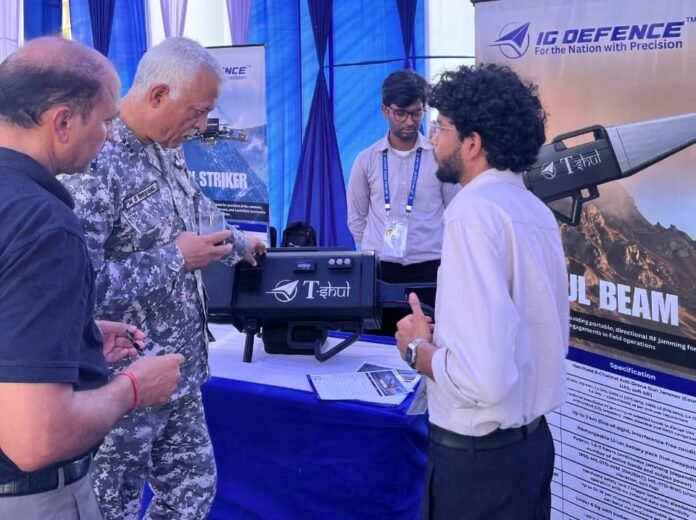
New Delhi: IG Defence, an Indian defence technology company specialising in unmanned and counter-unmanned systems, successfully demonstrated its indigenous T-SHUL BEAM Counter-UAS System at Indian Air Force Dronathan 2026, held at Pokhran from September 14-16.
The demonstration showcased T-SHUL BEAM’s capability to neutralise aerial drone threats through soft-kill electronic countermeasures, highlighting the growing importance of indigenous Counter-UAS capabilities in addressing the evolving drone threat and supporting modern military operations.

T-SHUL BEAM is a man-portable, directional Counter-UAS system developed for the soft-kill engagement of hostile drones. Its multi-band RF architecture is designed to disrupt critical communication and navigation links associated with unmanned aerial systems, including command-and-control, telemetry, video transmission and GNSS.
Its directional architecture enables countermeasures to be focused towards the targeted aerial system, providing a rapidly deployable capability against small UAVs, FPV drones and other low-cost unmanned platforms.
Designed for tactical-edge deployment, T-SHUL BEAM is intended to provide operators with a responsive and localised Counter-UAS capability in operational environments where small drones can emerge with limited warning. The system can support the protection of forward positions, critical assets, temporary deployments and other areas exposed to evolving unmanned aerial threats.
Wg Cdr Anoop Sharma (Retd.), AVP, IG Defence, said, “The rapid evolution of drone warfare has made Counter-UAS capability an essential requirement for modern military operations. T-SHUL BEAM is designed to give operators a mobile and responsive capability against small UAVs and FPV systems, while its integration with GRID enables it to become part of a wider battlespace architecture.”

T-SHUL BEAM operates on GRID — IG Defence’s indigenously developed, AI-powered Battle Management System (BMS) for C5ISRT. GRID integrates sensors, unmanned systems, intelligence, communications and command elements into a common operational picture, enabling commanders and operators to detect, understand, decide and coordinate actions across the battlespace.
The integration of T-SHUL BEAM with GRID connects Counter-UAS capability with a broader network of battlefield systems, allowing operators to incorporate counter-drone assets into an integrated operational architecture. This enables Counter-UAS systems to work alongside sensing, intelligence, unmanned systems and command elements as part of a connected battlespace.

The demonstration at Pokhran marks an important milestone in IG Defence’s development of indigenous Counter-UAS technology and reflects the company’s broader focus on building integrated capabilities across the unmanned warfare spectrum.
From unmanned systems and AI-powered battle management to technologies designed to counter emerging aerial threats, IG Defence is developing an indigenous technology stack for the evolving requirements of the future battlefield.






