


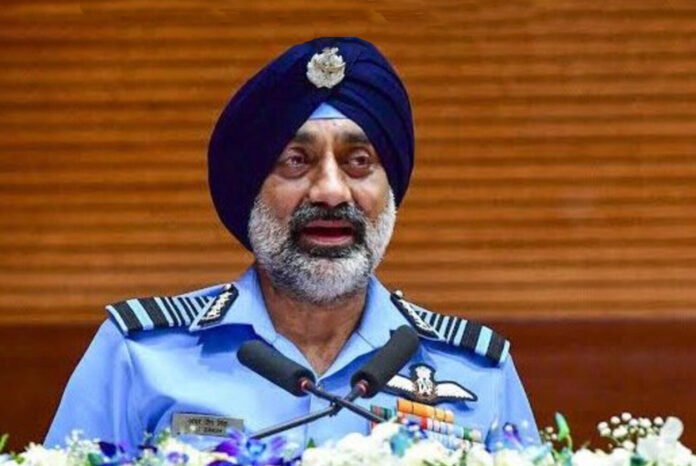
New Delhi. Speaking at a workshop organised by the Society of Indian Defence Manufacturers (SIDM) in New Delhi, Air Chief Marshal AP Singh stressed that India must aggressively pursue complete autonomy in building modern unmanned aerial systems (UAS).
Accelerating Self-Reliance in Defence
Highlighting the rapid pace of technological evolution in modern warfare, he coined a definitive phrase to guide future military manufacturing: “Technology delayed is technology denied”. He noted that fielding critical capabilities only after global adversaries have already advanced past them strips innovations of their strategic value.

The Air Chief emphasised that true self-reliance – or Aatmanirbharta – requires domestic manufacturing ecosystems to build every component locally. Using the metaphor that “every brick has to be made in India”, he cautioned that heavy dependence on foreign supply chains could introduce critical vulnerabilities, particularly if critical components are withheld during an emergency. Achieving a fully indigenous framework means research, development and production must occur natively without reliance on external entities.
Operational Challenges and Airspace Integration
As modern military doctrines increasingly incorporate unmanned systems, the IAF chief pointed out critical operational challenges that need immediate attention. Drones cannot completely substitute traditional fighter aircraft due to their payload limitations and higher failure rates, meaning they must be deployed in large, coordinated quantities. Furthermore, because unmanned platforms and manned fighter jets will frequently occupy the same airspace, seamless integration and precise situational awareness are non-negotiable to avoid operational friction.
To safeguard against friendly fire and accidental engagements, the Indian Air Force is actively collaborating with the Ministry of Civil Aviation and other regulatory bodies. This partnership aims to establish robust identification mechanisms capable of immediately distinguishing between friendly, authorised platforms and unidentified rogue drones.
A Whole-of-Nation Approach
Concluding his address, Air Chief Marshal Singh called for a unified “whole-of-nation approach” involving the military, private defence industries, academic researchers, regulators and financial investors. He urged certification agencies to streamline testing protocols to fast-track the transition of equipment from laboratory concepts to active battlefield deployment. By fostering collaborative ecosystems and eliminating procedural bottlenecks, India can successfully secure its skies and maintain a decisive tactical edge in future conflicts.







