


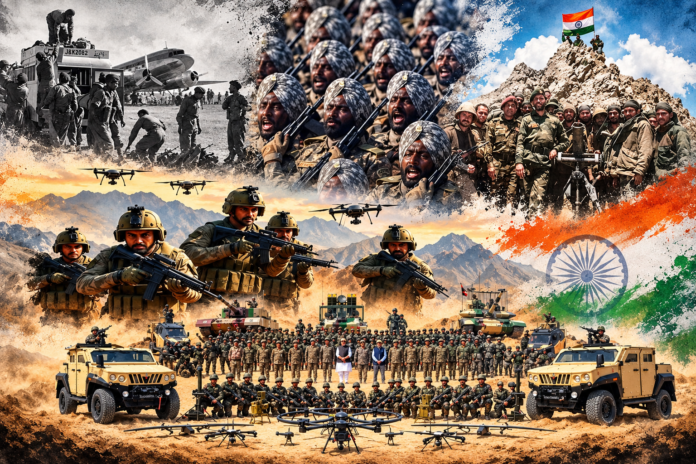
Dawn, October 27, 1947. A Dakota banks low over the airfield at Srinagar, its engines coughing in the thin autumn air. The door swings open and the men of 1 SIKH jump down onto Kashmiri soil. Rifles, a few hundred rounds each, and very little else. No artillery. No tanks. No reinforcements before tomorrow. Barely fifty kilometres away, the raiders have ravaged Baramulla and have their eyes on the capital.
Lieutenant Colonel Dewan Ranjit Rai does not wait for perfect information. He takes what he has and places his men squarely between the raiders and Srinagar. Before the day is out, he lies dead on the Baramulla Road, later honoured with the Maha Vir Chakra. Within a week, Major Somnath Sharma of 4 KUMAON stands at Badgam with his arm in plaster and fights to the last round, earning independent India its first Param Vir Chakra.

The line held. The Valley was saved. And the infantry of a young nation announced itself the only way it knows how: on foot, from the front, at a terrible price.
That is why we celebrate Infantry Day every October 27. Not merely to remember, but to ask an honest question. If those Dakotas landed today, what would step out of them?
The Smell of Gun Oil
Ask any old infantryman what he remembers, and he will not begin with tactics. He will tell you about the big pack biting into his shoulders on the last kilometre. Gun oil and wet wool. Langar tea that tasted like nectar at four in the morning, after an ambush that never sprung. The havildar’s low, steady voice at stand to, a voice that turned frightened boys into soldiers.
He will remember the counter insurgency grid, where one wrong call at a roadblock could cost a life or win a village; the high-altitude posts, where the weather was often deadlier than the enemy; and above all his men, the ones who came home and the ones who did not. Veterans reading this will feel that old ache in the knees. Good. Hold on to it. Everything new must stand on it.

Two Young Men in July
In the summer of 1999, two young officers climbed into legend on the Kargil heights.
Captain Vikram Batra of 13 JAK RIF captured Point 5140 and radioed back a message a whole generation still repeats: Yeh Dil Maange More. He went on to Point 4875, and there, while rescuing a wounded comrade, he fell. He was twenty-four.

Lieutenant Manoj Kumar Pandey of 1/11 GORKHA RIFLES led his men up the frozen slopes of Khalubar, clearing bunker after bunker though grievously wounded. His last words, Na chhodnu, told his Gorkhas not to let go. Years earlier, when his SSB interviewing officer asked why he wanted to join the Army, he had said he wanted to win the Param Vir Chakra. He won it, posthumously. He too was twenty-four.
The modern battlefield has become transparent. In Ukraine, soldiers learned that a trench is no longer a hiding place. It is an address. The first warning of an attack is often not a shell but a faint buzz overhead: a small drone carrying a grenade, flown by an operator kilometres away with goggles over his eyes. Drones now cause a staggering share of casualties on that front, and armies everywhere have taken notes
Both moved at night, on foot, up slopes no machine could climb, carrying everything on their backs. Their eyes were their sensors. A radio set was their network. Their courage was the one weapon the enemy could not match.
Now imagine those same slopes today.
The Battlefield Has Changed its Shape
The modern battlefield has become transparent. In Ukraine, soldiers learned that a trench is no longer a hiding place. It is an address. The first warning of an attack is often not a shell but a faint buzz overhead: a small drone carrying a grenade, flown by an operator kilometres away with goggles over his eyes. Drones now cause a staggering share of casualties on that front, and armies everywhere have taken notes.
Our own frontier has spoken too. Operation Sindoor saw drones and counter drone systems used at scale, against us and by us, and the Army has moved fast. Every infantry battalion, some 380 of them, now has an Ashni platoon of roughly two dozen drone soldiers for surveillance, precision strike and counter drone tasks. The new Bhairav light commando battalions, lean units of about 250 men, bridge the gap between regular infantry and Special Forces. Drone training centres have come up at the IMA, the Infantry School at Mhow and OTA Chennai.
The rifleman has not been replaced. He has been upgraded.
What Role Are We Looking At?
The infantryman of tomorrow will wear many hats at once.
- He will be a sensor and a shooter in one body. The section that once waited for an artillery observer will spot, decide and strike within minutes, with its own drones.
- He will fight dispersed and silent. Bunched groups are targets. Small teams spread wide, emitting no careless signal, will survive. Electronic discipline will matter as much as fire discipline once did.
- He will command machines as well as men. A section commander may soon lead eight soldiers, three drones and a robotic mule. Getting that mixed team to fight as one is a new kind of leadership.
- And he will remain the one who holds the ground. Drones can find, watch and strike. They cannot occupy a peak, reassure a frightened village or plant a flag. The last hundred metres will still be walked by a human being.
Operation Sindoor saw drones and counter drone systems used at scale, against us and by us, and the Army has moved fast. Every infantry battalion, some 380 of them, now has an Ashni platoon of roughly two dozen drone soldiers for surveillance, precision strike and counter drone tasks. The new Bhairav light commando battalions, lean units of about 250 men, bridge the gap between regular infantry and Special Forces
The Virtues of Tomorrow
Weapons will change every few years. The qualities of a great infantryman change far less, but their order of importance is shifting. Four rises to the top.
- Tolerance for Ambiguity. My generation was trained to seek certainty before acting: a confirmed enemy, clear orders, a reliable map. Tomorrow’s soldier will rarely get any of these. Feeds will contradict each other. The enemy will spoof, deceive and vanish. Orders will arrive incomplete, or not at all. The soldier who freezes until the picture is clear will be dead before it clears. The one who acts on his best judgment, and corrects course as the fog lifts, will win.
Uncertainty is not the fog before the battle. It is the battle.
- Imagination and Innovation. Some of the deadliest weapons in Ukraine were not designed in laboratories. They were dreamt up in trenches, by soldiers who strapped grenades to hobby drones and printed release clips on 3D printers. We have our own proud examples. At Kargil, gunners hauled Bofors guns forward to fire directly at enemy sangars, a role no manual had written for them. Tomorrow’s infantry needs this spirit of jugaad, disciplined and scaled up: every jawan a tinkerer, every unit a workshop of ideas.
- An adversary can now update his drone software in weeks. A tactic that works on Monday may fail by Friday. The decisive edge is no longer what you know, but how fast you learn and unlearn. The best units will debrief every patrol, pass lessons sideways to their neighbours and not just upwards to headquarters, and change their drills without waiting for a new manual.
- The one virtue that never moves. When a soldier can kill from kilometres away at the touch of a button, restraint becomes as precious as courage. Integrity, compassion and the moral sense to know when not to fire are what separate a professional army from a mob with gadgets.
None of this will flourish under commanders who demand certainty and punish honest mistakes. Mission command, telling a young leader what to achieve and trusting him with how, must leave the textbook and enter daily life. Courage to take risks is grown in units where it is safe to fail in training.
The Batra and Pandey of Tomorrow
Picture the scene. It is 0300 hours on a ridge in eastern Ladakh. A young lieutenant crouches in a nala, a rugged tablet glowing faintly under a poncho. A quadcopter two kilometres ahead streams images of the enemy position. Behind the officer, a havildar from the Ashni platoon readies a loitering munition. The plan is elegant.
Then the screen freezes. The enemy jammer has found them.
This is the moment that separates the technician from the warrior. No certainty, no clear picture, no time. The lieutenant pulls out a map and compass, the oldest tools in the pack, and looks at the faces of the men. Then come the two words every infantry officer has lived by: Follow me. And the climb begins, exactly as it began at Khalubar and Point 5140.
Seventy-nine years ago, a handful of men stepped off a Dakota with almost nothing and saved a state. Tomorrow’s soldier will step off with far more. But what will truly matter is exactly what mattered then
That is the Vikram Batra of tomorrow. Fluent in code, but never its prisoner. Hungry, as he was, for more: more learning, more ideas, more initiative. And that is the Manoj Pandey of tomorrow, who in an age of autonomous machines still refuses to leave a comrade behind, or his conscience. Na chhodnu will never go out of date.
To the Young and to the Old
To the youngsters preparing for NDA, CDS and AFCAT: the uniform is waiting for a new kind of soldier. You will need the lungs and legs of the old infantry, the curiosity of a gamer, the calm of a chess player and the judgment of a general. Learn the drone, but never forget that the machine only extends your will. It does not replace it.
To my fellow veterans: what we built has not been made obsolete. Every new technology rests on the bedrock we laid: trust between officer and jawan, the Paltan as family, and the refusal to quit. Our stories are not museum pieces. They are the software that runs inside every new soldier.
Seventy-nine years ago, a handful of men stepped off a Dakota with almost nothing and saved a state. Tomorrow’s soldier will step off with far more. But what will truly matter is exactly what mattered then.
The courage to go first. From Follow Me to Think, Adapt, Follow Me

The writer is an Indian Army veteran and expert in Operations Research and Systems Analysis





