


Paris: France’s push to enlist its car industry to produce military drones is moving to industrial implementation, as partnerships between automakers, car-part suppliers and defence firms turn lessons from the war in Ukraine into working assembly lines.
Since the start of the year, at least six defence-automotive tie-ups have been announced, as President Emmanuel Macron’s government seeks to combine the scale, automation and cost discipline of France’s car sector with one of the fastest-growing segments of military technology.

Ukraine and Russia’s use of drones has reshaped warfare, and that has prompted France and its European allies to prioritise drone production, as pressure from Washington on Europe to boost its military capabilities has added urgency.
The projects indicate France is building an industrial base capable of producing tens of thousands of drones a year — a scale difficult for defence startups to achieve alone, albeit one still dwarfed by Ukrainian and Russian efforts.
“Why now? Because the need is now, drones are now,” Christophe Périllat, chief executive of auto parts supplier Valeo, told reporters at the end of July. “And why in France? Because we’re being asked to guarantee our sovereignty.”
French defence officials do not anticipate a near-term need to deploy a large number of drones in the skies above France, but say it must be prepared for conflict.

The goal is to give France the ability to produce drones quickly and ramp up output should a crisis arise, they say. A July report by the French Senate’s defence committee described France’s stock of just a few thousand drones as “insufficient to achieve a critical mass.”
Valeo has said it will manufacture electric drone motors in France for defence technology firm Harmattan AI. Meanwhile, Forvia unveiled a partnership last week with a European defence company specialising in AI-powered counter-drone systems and is weighing plans to build capacity in France to manufacture 1,000 interceptor drones each month.

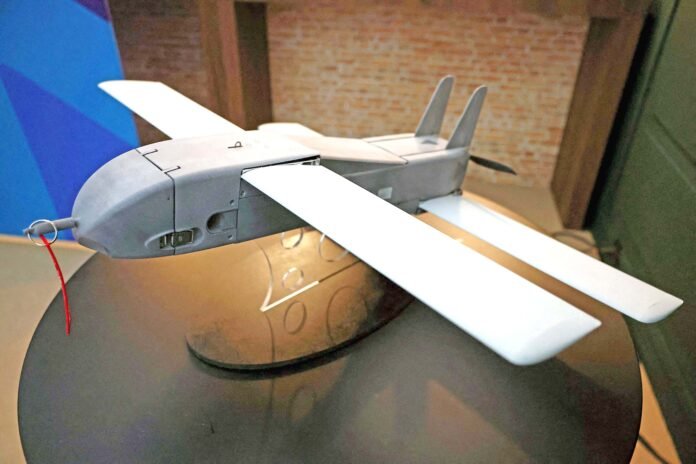
Renault, already working with Turgis & Gaillard to develop a long-range drone, partnered with Thales in June to industrialise production of the Toutatis kamikaze drone, targeting up to 1,000 units per month from 2027.
French drone maker Delair teamed up with German automotive supplier Schaeffler the same month to establish a French production line capable of producing around 100 drones per day by November.
If the plans announced by Renault, Schaeffler and Forvia are realised, combined output could reach 60,000 units per year. In a conflict, many more would be needed.
Drones have been used in warfare for decades, but the war in Ukraine has seen an explosion in scale. Drones now dictate the flow of the battlefield, notching up the vast majority of kills. The front line has turned into a “kill zone,” with soldiers hiding underground from the constant aerial threat.
After Russia’s full-scale invasion in 2022, Ukraine quickly accelerated its use of drones for reconnaissance, battlefield combat and long-range strikes. President Volodymyr Zelenskiy said in July that it will produce 10 million in 2026.
Ukraine now has hundreds of drone makers, big and small. Some even produce more than Ukraine’s military can buy, and the government has cautiously moved towards allowing them to export some excess production.
Patrick Pailloux, head of France’s defence procurement agency, said he was working in particular with auto subcontractors to design drones that France will be able to produce in large quantities.
“It’s not the same: producing a drone in a defence start-up and making something that can be reproduced in very large volumes using production-line robots,” he said.
Renault CEO François Provost said in June the Toutatis kamikaze drone was being redesigned with fewer components and from injection-moulded plastic, enabling cheaper, higher-volume production than the current 3D-printed model.
Defence officials say the challenge is scaling up production capacity while not building stockpiles that could soon become obsolete.
Patrice Caine, CEO of French defence technology group Thales, said this summer that drones were “objects that evolve quickly” under the impetus of technological advances.
Pailloux said France needed “enough so that we can train, and (the production capacity) to be able to withstand a shock”.
Prime Minister Sebastien Lecornu pledged a €150 million ($175 million) investment to develop a dedicated drone sector last December.
But Antoine Level, head of France’s drone industry association, said Germany was ahead of France in funding short-range drones, and that there were still “not enough orders to truly stimulate the industry.”






