


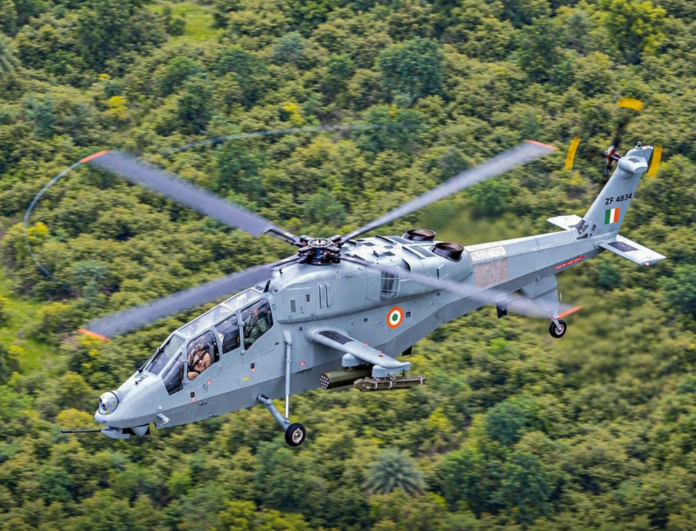
In a landmark development for India’s defence sector, the Armament Research and Development Establishment (ARDE) – a premier laboratory under the Defence Research and Development Organisation (DRDO) – has officially shortlisted private sector heavyweights SSS Defence and Kalyani Group. The two entities have been selected as Development-cum- Production Partners (DcPP) to spearhead the design and manufacturing of a native 20mm turret gun system.
A Milestone for Indigenous Aviation Armament
This ambitious project marks a historic first for the country. Never before has an aviation medium-calibre gun been completely conceptualised, designed and manufactured within India. By fostering private industry participation, the initiative aligns with New Delhi’s aggressive push toward Aatmanirbhar Bharat, aiming to break away from decades of total reliance on foreign military hardware suppliers.

Modernising the Rudra and Prachand Fleets
The newly commissioned indigenous 20mm weapon systems are tailor-made for India’s expanding fleet of home-grown combat helicopters, specifically the Hindustan Aeronautics Limited’s (HAL) Advanced Light Helicopter (ALH) Mk-IV-Rudra and the Light Combat Helicopter (LCH) Prachand. Currently, these attack platforms rely on the French-designed THL-20 turret system equipped with European M621 cannons.
Integrating a sovereign, locally manufactured alternative ensures complete operational autonomy. Combat helicopters depend heavily on these nose-mounted medium-calibre turret systems for close-air support, infantry protection, and precise suppression of ground targets during high-risk operations. Having a domestic pipeline for both the weapon systems and their ammunition guarantees uninterrupted logistical readiness, shielding the Indian Armed Forces from global supply chain disruptions and geopolitical export restrictions.
Structured Development and Production Strategy
According to programme blueprints, the comprehensive development phase is projected to span approximately two years. Following successful trials, prototype evaluations, and formal user acceptance, manufacturing duties will be divided between SSS Defence and the Kalyani Group.
To foster healthy competition and maintain cost efficiency, the industrial workload will be allocated based on financial bidding. The entity that emerges as the lowest bidder (L1) will capture 60 per cent of the production order, while the alternative partner will secure the remaining 40 per cent. This competitive yet collaborative production model is expected to accelerate output, drive down lifecycle costs, and establish a robust, resilient domestic ecosystem for advanced aerospace ordnance as India looks toward future export markets.







