


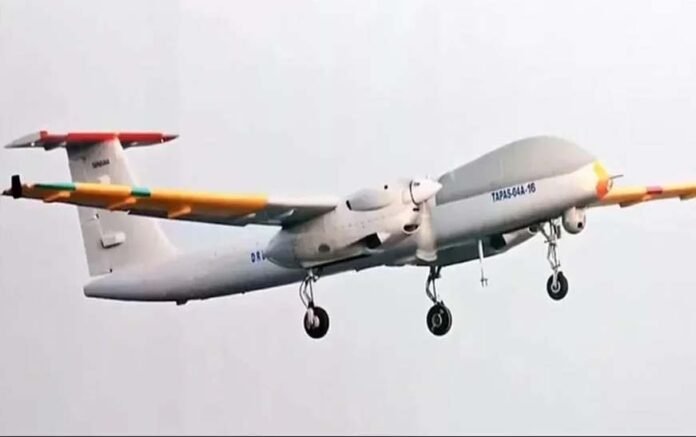
New Delhi: In a major push for India’s defence indigenisation programme, the Defence Research and Development Organisation (DRDO) has begun transferring critical technologies from its Tactical Advanced Platform for Aerial Surveillance (TAPAS) unmanned aerial vehicle programme to private sector companies, ahead of the Indian military’s upcoming mega tender for 87 Medium Altitude Long Endurance (MALE) drones.
The move is being seen as a strategic effort to build a robust domestic drone manufacturing ecosystem before one of India’s largest-ever UAV procurements, estimated to be worth over ₹25,000 crore. According to reports, nearly two dozen Indian companies are expected to compete for the tri-services contract, which aims to equip the armed forces with long-endurance surveillance and reconnaissance drones under the “Make in India” framework.

DRDO Chairman Dr Samir V Kamat has reportedly confirmed that technologies developed during the TAPAS programme—also known as TAPAS-BH-201, formerly Rustom-II—are now being shared with private players to accelerate indigenous capability development. The transfer marks a significant policy shift, with DRDO increasingly positioning itself not just as a platform developer, but as an enabler of India’s wider defence industrial base.
Among the technologies being transferred are crucial subsystems essential for MALE-class UAV operations. These include TAPAS’s tricycle landing gear system engineered for heavy autonomous aircraft, advanced autonomous take-off and landing (ATOL) software, and a digital flight control system featuring fly-by-wire architecture and control laws. Such systems are vital for maintaining flight stability and autonomous mission capability over long-duration sorties.
Private firms are also being granted access to engine control units (ECUs) designed for efficient performance across varying altitudes, alongside secure communication technologies such as Line-of-Sight (LoS) links, C-band and Ku-band satellite communication systems, and repeater payload technologies. These systems allow drones to maintain connectivity over distances of up to 250 kilometres directly and virtually an unlimited range through satellite links.
Another significant component is the Universal Ground Control Station (UGCS), a modular command-and-control architecture enabling operators to manage multiple UAV types from a standardised interface. This is expected to reduce training requirements and simplify operational deployment for the armed forces.

The TAPAS programme has had a mixed history, so far. Developed as India’s indigenous MALE drone solution, the platform completed over 200 test flights and demonstrated important milestones, including 18-plus hours endurance and operational capability for intelligence, surveillance and reconnaissance missions. However, the drone reportedly fell short of some military qualitative requirements, particularly altitude and endurance thresholds sought by the armed forces, leading to the project being removed from “mission mode” status in early 2024.
Despite these setbacks, DRDO has continued development work on TAPAS, with officials indicating that the platform remains technologically relevant and can still serve as a foundation for future UAV systems. The current technology transfer suggests that while TAPAS may not have fully matured into a direct military procurement success, its underlying innovations are now being repurposed to strengthen private industry participation in strategic drone manufacturing.

The forthcoming 87-drone procurement is expected to be split between two Indian manufacturers, ensuring dual production lines and reducing supply risks. Reports suggest the Ministry of Defence is keen to mandate significant indigenous content, potentially above 60 per cent, while also encouraging long-term export potential. Several Indian firms are believed to be exploring partnerships with foreign original equipment manufacturers from the United States and Israel to strengthen their bids.
The decision to share TAPAS technologies could prove decisive in giving Indian firms a technological head start in the competition, reducing development timelines and dependence on imported subsystems.
For India, which has long relied on imported UAVs such as Israel’s Heron series, the transfer represents a broader strategic effort to close capability gaps in the MALE drone segment. As drone warfare and persistent surveillance become central to modern military doctrine, the success of this ecosystem-building effort could shape the future of India’s unmanned aviation sector for decades.






