


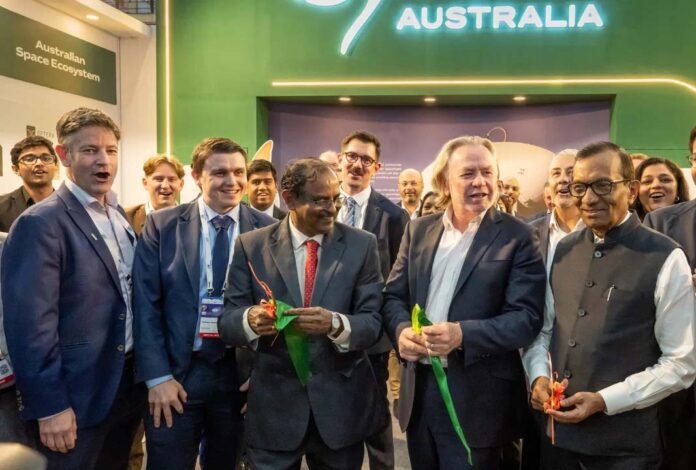
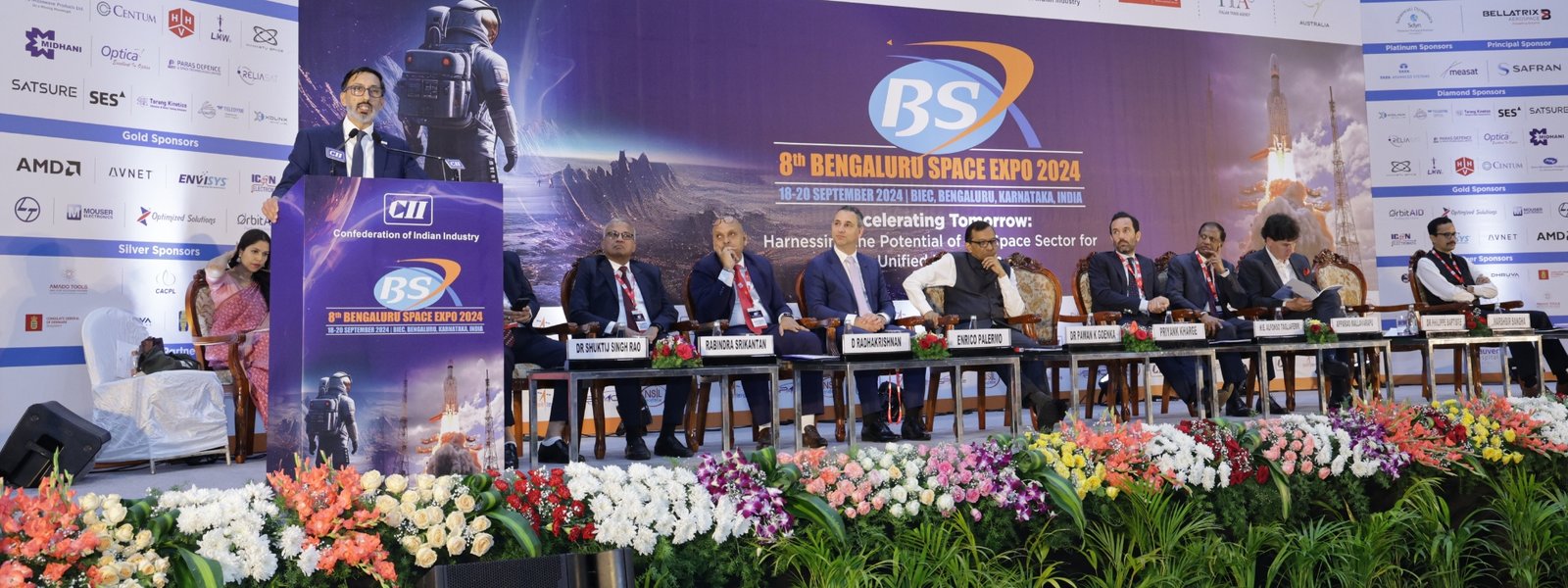
Bengaluru Space Expo 2026 placed India’s rapidly expanding private space sector at the centre of a broad international conversation, bringing together governments, space agencies, manufacturers, startups, investors and research institutions.
The event’s central message was clear: India’s space ambitions are moving beyond launch capability and government-led missions towards a commercially driven ecosystem built on international partnerships, private innovation and shared technology development.

Italy’s presence as the partner country gave the expo a strong diplomatic and industrial focus. Italian Ambassador to India Antonio Bartoli described India as a key space partner for Italy and presented the relationship as part of a wider strategic partnership between the two countries.
Italy arrived in Bengaluru with expertise spanning satellites, radar, synthetic-aperture radar, optical observation, space infrastructure, scientific research and orbital sustainability. Its delegation included companies and organisations associated with areas such as Earth observation, satellite systems, space technology and advanced industrial manufacturing.
Bartoli’s message was that Italy did not view BSX 2026 simply as an exhibition or a platform to display national capabilities. Instead, Italy sought to use its partner-country status to identify practical opportunities for joint projects, investments, research collaboration and market access.
The Bengaluru Space Expo (BSX) 2026 underscored a major evolution in India’s space strategy, pivoting from government-led missions to a commercial ecosystem powered by international co-development, private innovation and shared technology
The two countries are exploring cooperation under the India-Italy Special Strategic Partnership and the Joint Strategic Action Plan for 2025-2029. Space is emerging as an important component of that relationship, alongside defence, advanced manufacturing, science and technology.

Italian participation also reflected the complementary nature of the two industries. India brings scale, engineering talent, cost efficiency, launch experience and a growing startup base. Italy contributes expertise in high-end space systems, Earth observation, radar, optical instruments, satellite manufacturing and specialised industrial technologies.
The objective, according to the Italian side, is to move from a buyer-seller relationship towards co-development. Jointly built technologies could serve Indian and Italian users as well as wider international markets. Italian small and medium-sized enterprises and startups are also looking for stronger links with Indian companies, universities and public institutions.

The United States added another layer to the partnership discussion. US Ambassador Sergio Gor told the gathering that India-US space relations were moving from cooperation towards co-creation.
The distinction is important. Cooperation generally involves working together on defined projects, while co-creation suggests joint design, shared intellectual property, integrated supply chains and commercial products developed by companies and institutions in both countries.
Partnering for the expo, Italy brought key expertise across satellite platforms, synthetic-aperture radar (SAR), optical observation and orbital sustainability, aiming to establish direct joint ventures and research projects under the India-Italy Special Strategic Partnership
Gor’s remarks underlined the expanding scope of India-US engagement in space. The relationship now extends beyond traditional government programmes to include commercial Earth observation, satellite communications, space science, human spaceflight, launch services and advanced technologies.
For Indian startups, closer cooperation with the United States could provide access to global customers, research networks, venture capital and advanced manufacturing partnerships. It could also help Indian companies integrate their technologies into international missions and supply chains.
Australia’s participation offered a different but equally significant model. Australian High Commissioner to India Philip Green said the two countries’ space industries were complementary, arguing that each possessed capabilities the other needed.
Green highlighted Australia’s geographic position, including its access to equatorial and polar launch profiles and its location in the eastern Indian Ocean. Australia already supports the tracking of Indian spacecraft and has a role in activities connected with maritime and space operations.
He also pointed to Australian expertise in operating across vast distances with limited populations. Technologies developed for remote mining, autonomous vehicles, remote operations and communications can have direct relevance to space missions, Earth observation and lunar exploration.
US Ambassador Sergio Gor emphasised that US-India space relations are entering a co-creation phase, opening pathways for Indian startups to integrate into global supply chains, joint IP ventures, commercial satellite networks and deep-space missions
Green said Australian and Indian governments were increasingly aligned on space and critical technologies. He cited the two countries’ growing strategic relationship, including cooperation through the Quad and the Partnership for Cyber, Critical Technologies and Supply Chains.
The Australian presence at BSX 2026, included companies from Adelaide, Brisbane, Perth, Sydney, Melbourne and Canberra. Many are relatively young firms, making them natural partners for India’s emerging private space industry. Green said Australia’s space sector was growing rapidly and that government support was helping attract additional private investment.
Indian officials used the expo to stress that international partnerships must be supported by a strong domestic ecosystem. Pawan Goenka, Chairman of the Indian National Space Promotion and Authorisation Centre, or IN-SPACe, highlighted the organisation’s role in enabling private participation in space activities.
Goenka further said that IN-SPACe is expected to remain central to the development of India’s commercial space sector by facilitating authorisations, connecting private companies with public infrastructure and encouraging collaboration between startups, industry and government agencies.
V Narayanan, Chairman of ISRO (Indian Space Research Organisation) emphasised the continuing importance of national space capabilities. ISRO remains critical to India’s launch programmes, space science missions, satellite development, testing facilities and technical expertise. The growing private sector is expected to complement ISRO rather than replace it, allowing the agency to focus on advanced and strategic missions while companies develop commercial products.
Indian space agencies reaffirmed their unified approach: IN-SPACe lowers barriers for startups, NSIL bridges public research with international markets, and ISRO focuses on advanced scientific frontiers while private enterprises scale commercial manufacturing
NewSpace India Limited also featured prominently in discussions about India’s transition from a launchpad to a marketplace. NSIL is responsible for commercialising ISRO’s technologies, launch services and satellite capabilities. Its work is helping connect public-sector research and infrastructure with customers, manufacturers and service providers.
That bridge is becoming increasingly important as India’s private space sector expands. Startups are developing launch vehicles, satellite platforms, Earth-observation systems, propulsion technologies, communication terminals, debris-monitoring systems and data-analytics services.
Industry associations at BSX 2026 called for deeper coordination across this ecosystem. They highlighted the need for predictable regulations, financing, export support, access to testing facilities, insurance mechanisms, skilled talent and government procurement.
The participation of Indian companies demonstrated the breadth of the sector. Skyroot Aerospace, represented by co-founder Pawan Kumar Chandana, showcased the ambitions of a startup seeking to build rockets and develop a long-term launch business from India.
The company’s journey reflects the larger transformation of India’s space industry, where private firms are now pursuing end-to-end capabilities rather than isolated components.
Samtel Avionics also announced collaboration with South Korea’s BULL Co Ltd on space-debris mitigation solutions. The initiative highlighted a growing concern for orbital sustainability as the number of satellites and commercial missions increases. Technologies that help track, avoid, manage or remove space debris will become increasingly important for safe and reliable access to orbit.
Other Indian companies at the expo presented products and services in satellite manufacturing, propulsion, ground systems, Earth observation, communications and space data. Their presence reinforced the message that India’s space economy is becoming more diverse, competitive and commercially oriented.
Highlighting domestic commercial capabilities, Skyroot Aerospace showcased its end-to-end launch systems, while Samtel Avionics announced a joint initiative with South Korea’s BULL Co Ltd to tackle growing space-debris mitigation challenges
The diplomatic addresses at BSX 2026 therefore had a practical purpose. The US Ambassador’s call for co-creation, the Australian High Commissioner’s emphasis on complementary strengths and the Italian Ambassador’s focus on joint industrial opportunities all pointed towards the same outcome: partnerships that produce technology, investment and market access.
For Italy, the partner-country role provided a platform to deepen a strategic relationship with India. For the United States, it demonstrated the expansion of cooperation into commercial and advanced technologies. For Australia, it opened opportunities for companies with niche capabilities to work with India at scale.
For India, BSX 2026 was an opportunity to present itself not merely as a low-cost launch provider, but as a complete space ecosystem with manufacturers, startups, research institutions, regulators and commercial operators.
The next test will be whether the discussions translate into contracts, joint ventures, technology transfers, research programmes and repeat business. If they do, Bengaluru Space Expo 2026 could mark an important point in India’s transition from participating in the global space economy to helping shape it.

-The writer is a New Delhi-based senior commentator on international and strategic affairs, environmental issues, an interfaith practitioner, and a media consultant. The views expressed are personal and do not necessarily carry the views of Raksha Anirveda





