
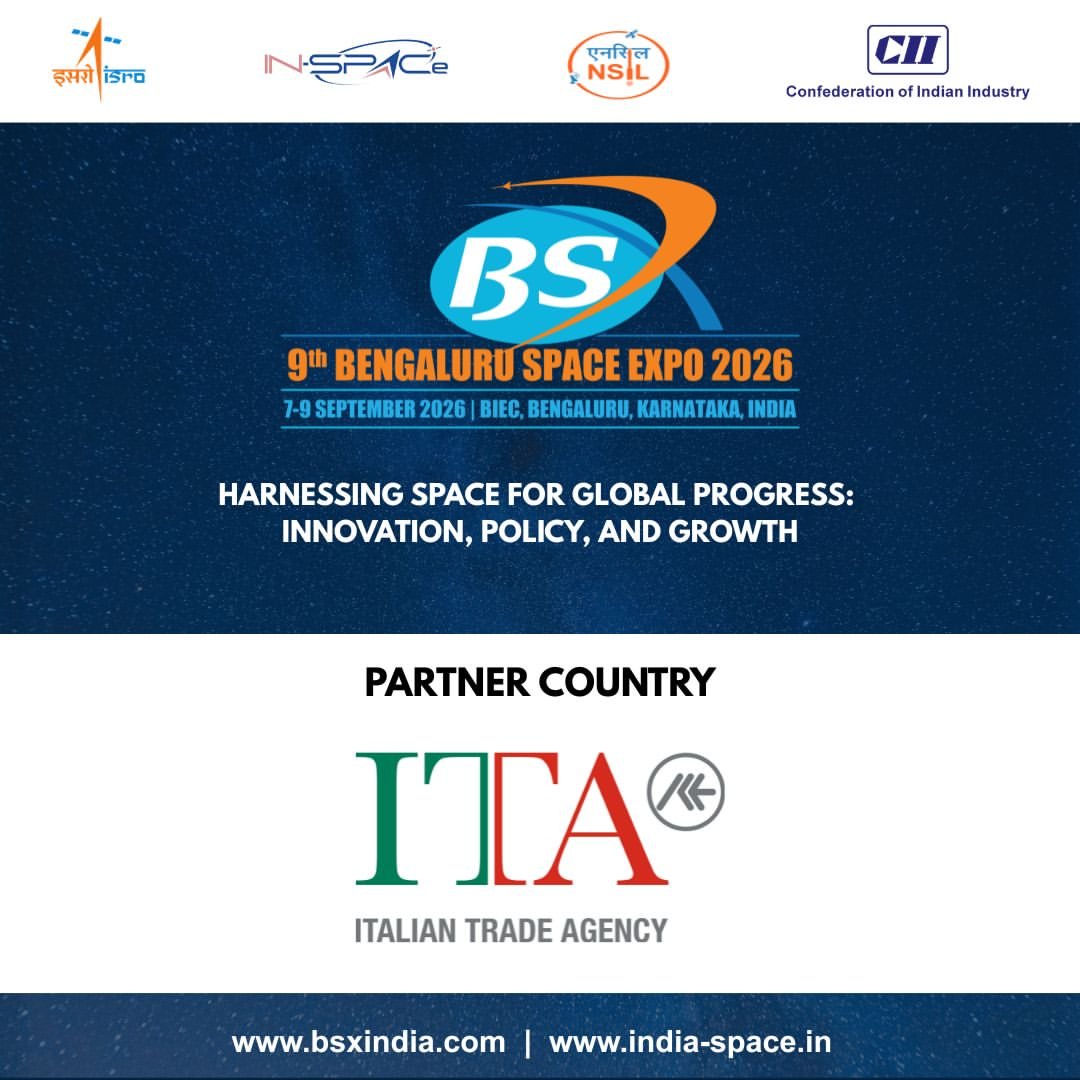
As Italy makes its debut as Partner Country at the Bengaluru Space Expo 2026, the India-Italy relationship is entering a decisive new phase – one defined less by trade volumes and more by co-development, technology transfer and integrated supply chains. From Leonardo Space to agile New Space startups, Italy’s Trade Promotion Section outlines how BSX 2026 could translate high-level MoUs into lasting industrial partnerships across defence, aerospace and space. Ajit Thakur, Editor of Raksha Anirveda spoke to Ms Antonietta Baccanari, Director and Trade Commissioner, Italian Trade Agency (ICE) in India on the eve of BSX2026, and discussed with her various aspects of India-Italy partnership, Italian companies participating at the expo and how this bilateral friendship will evolve further during the next three to five years.
RA: In recent years, the India-Italy Strategic Partnership has gained significant momentum across economic, defence and technological domains. From a trade and industrial standpoint, how does the Trade Promotion Section view the convergence between Italy’s manufacturing excellence and India’s ‘Make in India’ and ‘Aatmanirbhar Bharat’ frameworks—particularly in capital-intensive, high-tech sectors like defence and aerospace?

AB: The India–Italy Strategic Partnership has entered a new phase where trade, technology and industrial collaboration are becoming increasingly interconnected and expanding bilateral trade to a target of 20 billion Euros by 2029, leveraging the EU-India Free Trade Agreement. Italy’s strength in advanced manufacturing, precision engineering, aerospace, defence systems, automation and high-value industrial technologies complements India’s ambitions under ‘Make in India’ and ‘Aatmanirbhar Bharat’ initiatives.
Rather than a traditional buyer-seller relationship, we are witnessing a transition towards co-development, technology partnerships, local manufacturing and resilient supply chains. Italian companies are increasingly looking at India not only as a growing market, but also as a strategic manufacturing and innovation partner capable of serving both domestic and global markets.
The Italian Trade Agency supports this transformation by facilitating business partnerships, technology collaborations, investment opportunities and institutional dialogue that connect Italian industrial excellence with India’s rapidly expanding manufacturing and innovation ecosystem. Defence, aerospace, advanced manufacturing and space are among the sectors where we see particularly strong long-term potential.
RA: Italy is taking centre stage as the Partner Country at the 9th edition of the Bengaluru Space Expo (BSX 2026) in September. What strategic priorities and overarching themes will define Italy’s participation at BSX 2026, and what message does this elevated status send regarding Italy’s commitment to the Indian space ecosystem?

AB: The 2026 edition of Bengaluru Space Expo is particularly significant as it marks Italy’s first-ever national pavilion at the event. As the Partner Country, our objective extends beyond showcasing Italian technologies, we aim to strengthen the Made in Italy brand, foster long-term industrial partnerships and create new opportunities for collaboration across the rapidly evolving global space economy.
India has set an ambitious goal of capturing around 10% of the global space economy by 2035, making it one of the world’s most dynamic space markets.

For Italian companies, BSX 2026 offers direct access to key stakeholders including ISRO, IN-SPACe, NSIL, private space companies, research institutions and investors, creating opportunities for technology partnerships, commercial collaborations and market expansion. Early engagement allows Italian companies to establish lasting relationships and position themselves as trusted partners in India’s remarkable space growth story.
BSX 2026 marks Italy’s first-ever national pavilion at the expo – signalling a shift from participant to strategic Partner Country in India’s space story
RA: Italy boasts a world-class space ecosystem—from global industrial leaders down to agile space-tech SMEs and research institutions. Could you highlight the profile of Italian companies exhibiting within the Italian Pavilion at BSX 2026, and what specific domains (e.g., Earth observation, satellite communications, launch systems or component manufacturing) offer the strongest synergies with Indian space agencies (ISRO, IN-SPACe, NSIL) and private startups?
AB: Italy’s space ecosystem is built on a unique combination of globally recognised aerospace leaders, highly specialised SMEs, and innovation-driven technology companies. The Italian Pavilion at Bangalore Space Expo 2026 reflects this diversity, showcasing companies that span the entire value chain; from satellite platforms and mission-critical components to ground infrastructure, Earth observation services, space communications and in-orbit technologies.
Among the highlights, Leonardo Space showcases end-to-end capabilities in Earth observation, geospatial intelligence, space surveillance, secure satellite connectivity, robotics and in-orbit services, supporting both institutional and commercial missions.
Complementing this are several innovative Italian SMEs: Officina Stellare develops mission-critical optical and electro-optical technologies for space and defence; Zoppas Industries specialises in space-qualified thermal management systems for satellites and spacecraft.
On the infrastructure side, Leaf Space provides Ground Segment-as-a-Service for satellite mission operations, Sicilsat Communications delivers advanced satellite communication systems across multiple frequency bands and EIE Group designs and manufactures precision ground support equipment, testing systems and engineering solutions for space missions.
Representing the dynamism of Italy’s New Space sector, 2ND Space develops nano-satellites, satellite sub-systems, separation systems and end-to-end mission solutions for rapid in-orbit demonstrations and commercial space missions, and SOCIETÀ AEROSPAZIALE MEDITERRANEA (SAM) brings expertise across upstream satellite payloads and components as well as downstream Earth observation, telecommunications, navigation and monitoring services.
The Italian Pavilion at BSX 2026 spans the full value chain – Leonardo Space’s Earth observation and satellite platforms alongside nimble SMEs like Officina Stellare, Leaf Space and 2ND Space
Together, these capabilities align strongly with India’s priorities in Earth observation, satellite manufacturing, communications, ground infrastructure, New Space technologies and future exploration, creating significant opportunities for collaboration with ISRO, IN-SPACe, NSIL and India’s fast-growing private space ecosystem.
RA: The boundaries between space and defence are increasingly intersecting through dual-use technologies, Earth observation, and satellite-based communication networks. How are Italian defence and aerospace majors exploring co-development, technology transfer and joint ventures with Indian defence enterprises to build resilient, integrated supply chains?
AB: Defence and Space have become strategic pillars of the India–Italy partnership, driven by a shared vision for technological innovation, industrial resilience and secure supply chains. Supported by the India–Italy Joint Strategic Action Plan and the Defence Industrial Roadmap, cooperation is expanding from institutional engagement to industry-led partnerships and joint innovation.
Strategic collaboration: The convergence of defence and space technologies is creating a new dimension in the India–Italy Strategic Partnership. Both countries are moving beyond conventional procurement towards long-term industrial collaboration, technology partnerships, and resilient supply chains.
Industrial Co-development: Italian companies are increasingly pursuing co-development and localised manufacturing with Indian partners. Collaborations such as the Leonardo–Adani partnership illustrate how the focus is shifting towards manufacturing, maintenance, technology transfer and integrating Indian suppliers into global aerospace value chains, fully aligned with the objectives of ‘Make in India’ and ‘Aatmanirbhar Bharat’.
Space and Dual-use Collaboration: Space has emerged as another key pillar of the India–Italy partnership, with collaboration expanding beyond institutional programmes to commercial and industrial initiatives.
Backed by the EU-India Free Trade Agreement, bilateral trade eyes a 2029 target of €20 billion – with space and defence as key growth pillars
The IN-SPACe delegation’s participation at Space Meetings Veneto 2026 reflected this shift, bringing together Italian and Indian companies to explore partnerships in Earth observation, secure satellite communications, ground infrastructure and space domain awareness. Two examples illustrate this growing momentum.
First, discussions focused on ground segment interoperability, enabling Italian and Indian operators to collaborate on ground station networks that can enhance satellite mission support while reducing infrastructure costs.
Second, there is increasing interest in downstream Earth observation applications, where Italian satellite capabilities and Indian expertise in spatial analytics can jointly address sectors such as precision agriculture, maritime surveillance and environmental monitoring.
These initiatives demonstrate how complementary strengths are creating new opportunities for innovation, commercial partnerships and resilient space ecosystems.
RA: Navigating regulatory landscapes, joint venture structuring and market access can be challenging for both Italian SMEs entering India and Indian firms looking toward Europe. What tailored initiatives, B2B matchmaking programmes or institutional bridges is the Italian Trade Agency in New Delhi providing to turn high-level MoUs into concrete commercial contracts before and after BSX 2026?
AB: Over the past few years, the Italian Trade Agency has consistently supported Italian companies through participation in major Indian aerospace and space exhibitions (India Space Congress 2024, Aeromart Hyderabad 2024, Bengaluru Space Expo 2024, India Space Congress 2025, Aeromart Hyderabad 2026, Bengaluru Space Expo 2026) and has organised business delegations to leading events in Italy (Space Meeting Veneto 2023, ADM Torino 2023, Space Meeting Veneto 2026), and facilitated dedicated B2B matchmaking programmes connecting Italian companies with Indian industry, research institutions and government stakeholders.
Beyond exhibitions, the Italian Trade Agency is driving B2B matchmaking, regulatory briefings and industrial visits to convert dialogue into concrete commercial contracts
Beyond exhibitions, we organise sector-specific webinars, market intelligence sessions, legal and regulatory briefings, intellectual property workshops and interactions with Italian financial institutions that support international expansion. We also facilitate industrial visits, engagements with state governments and meetings across the broader aerospace supply chain to help companies identify concrete business opportunities.
Our objective is to accompany companies throughout their market entry journey—from initial introductions and partner identification to supporting long-term commercial relationships—ensuring that discussions initiated during events such as BSX 2026 translate into sustainable business partnerships and investments.
RA: Looking ahead, how do you see the Indo-Italian trade and technological relationship evolving over the next 3 to 5 years? Beyond event-based participation, what key milestones must both nations achieve to establish a lasting, sustainable and self-reliant defence and space alliance?
AB: Looking ahead, I believe the India–Italy partnership will evolve from one centred primarily on trade to one driven by joint innovation, industrial cooperation and technology development. Both countries possess complementary strengths; Italy in advanced manufacturing, aerospace engineering and specialised technologies, and India in scale, engineering talent, cost competitiveness and an increasingly dynamic innovation ecosystem.
Over the next three to five years, success will be measured not simply by increased trade volumes, but by the establishment of long-term industrial partnerships, joint R&D programmes, co-developed technologies, localised manufacturing and greater integration of Italian and Indian companies into each other’s supply chains.
We also expect stronger collaboration between startups, research institutions and established industries in emerging areas such as space technologies, defence electronics, artificial intelligence, advanced materials and dual-use applications.
The role of institutions will be to continue creating the right environment for business through policy dialogue, industry engagement and platforms that bring companies together. Events such as Bengaluru Space Expo are important milestones, but the true measure of success will be the partnerships, investments and innovations that continue long after the exhibition concludes.