


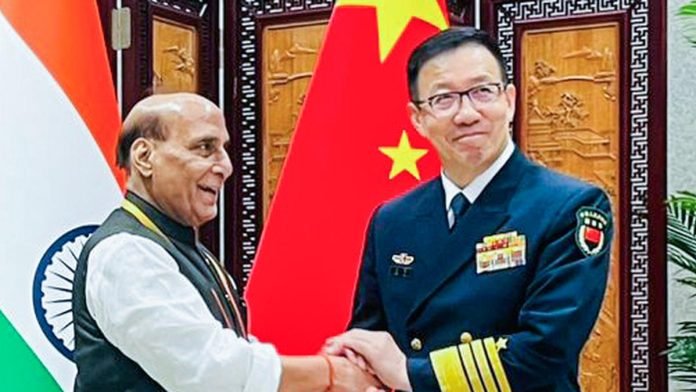
New Delhi: On June 30, China signalled its willingness to engage in discussions with India to manage and delimit their disputed border, following a significant meeting between Indian Defence Minister Rajnath Singh and his Chinese counterpart, Admiral Dong Jun.
The statement, made by Chinese foreign ministry spokesperson Mao Ning, reflects a cautious yet positive shift in the ongoing dialogue aimed at resolving one of Asia’s most complex territorial disputes. This development comes just days after Rajnath Singh, during the Shanghai Cooperation Organisation (SCO) defence ministers’ meeting in Qingdao on June 26, underscored the urgent need for a permanent solution to the border demarcation issue.

Singh advocated for a structured roadmap involving permanent engagement and de-escalation, emphasising the importance of bridging the trust deficit created by the violent Galwan Valley clash in June 2020, which resulted in the deaths of 20 Indian soldiers and at least four Chinese troops. That incident marked the lowest point in bilateral relations in six decades, casting a long shadow over subsequent diplomatic efforts.
Mao Ning acknowledged the complexity of the boundary question, noting that its resolution would require time and sustained engagement. She highlighted the existence of multiple communication mechanisms, including the Special Representatives’ dialogue and the Agreement on the Political Parameters and Guiding Principles for the Settlement of the China-India Boundary Question.
These frameworks, along with ongoing diplomatic and military dialogues, have facilitated a series of meetings since the two countries reached an understanding in October last year to end the four-year military standoff in the Ladakh sector of the Line of Actual Control (LAC).
China’s latest statement reiterates its readiness to maintain communication with India on delimitation negotiations and border management, aiming to keep the border areas peaceful and promote cross-border cooperation. Mao expressed hope that India would reciprocate by working collaboratively to maintain tranquility and stability along the border, leveraging the established mechanisms for thorough communication.

The Indian Defence Ministry’s readout from the recent meeting highlighted mutual agreement on continuing consultations to achieve progress on troop disengagement, de-escalation, and eventual border delimitation. Both sides also agreed to rejuvenate existing mechanisms to address complex issues and foster good neighbourly relations, which are seen as essential for broader stability in Asia and beyond.
As part of the normalisation process, India and China have recently resumed the pilgrimage to Kailash Mansarovar in Tibet and are in talks to restart direct flights, signalling incremental progress in confidence-building measures.

While the boundary dispute remains unresolved, the renewed commitment to dialogue and practical cooperation offers a cautiously optimistic outlook for future India-China relations. The coming months will be crucial in determining whether these diplomatic overtures can translate into lasting peace and clarity along one of the world’s most sensitive borders.






