
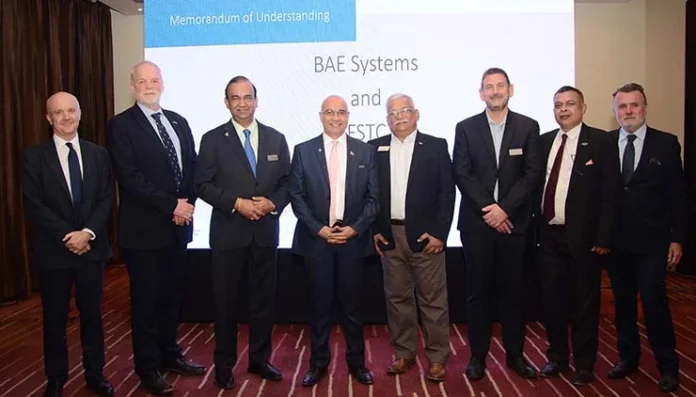
Bangalore. BAE Systems and FSTC have announced plans to design, build and supply world-leading simulators to train pilots of the Indian Armed Forces.
Under a Memorandum of Understanding (MoU) announced at AeroIndia, the companies will work together to develop a Twin Dome Full Mission Simulator for BAE Systems’ Hawk Mk132 fast jet trainer aircraft, which will use a realistic synthetic environment to help pilots train at a higher standard than ever before.

The Hawk Mk132 has supported the training of highly-trained pilots to the Indian Air Force for more than two decades, with many aircraft built in India by Hindustan Aeronautics Limited (HAL) under licence from BAE Systems.
There are now 650 Hawks operating worldwide and BAE Systems has decades of experience working with armed forces across the globe to deliver and evolve training to prepare pilots for life in fast jet cockpits.
FSTC is India’s leading flight simulation training company. It will integrate the cockpit, motion and visual display system, along with model designated military bases as part of the new agreement.
Ravi Nirgudkar, Managing Director, BAE Systems – India, Bangladesh, Sri Lanka, said: “BAE Systems has decades of experience working with armed forces across the globe to deliver and evolve training to meet current and future operational requirements, so we’re delighted to collaborate with FSTC to enhance capabilities for the Indian Armed Forces. Having worked with the Indian Air Force to support training of highly-trained pilots through Hawk, we can bring our knowledge of the world’s most proven fast jet trainer with our expertise in delivering training from the classroom to the frontline – and everything in between.”

Capt D S Basraon, Managing Director, FSTC said: “We are elated to partner with BAE Systems for delivery of a fully functional indigenously developed Twin Dome Hawk Mk132 Simulator to assist our defence forces train their pilots under various real world scenarios. Having delivered state of the art training infrastructure and curriculum to commercial pilots over the past one decade, this momentous tie-up will allow us extend similar capability to our defence forces under rationalised usage terms.”
The new collaboration will strengthen indigenous skills and capabilities across the Indian aerospace and defence sector, helping to support the “Make in India” initiative. The full mission simulator is due to be installed within 24 months.