


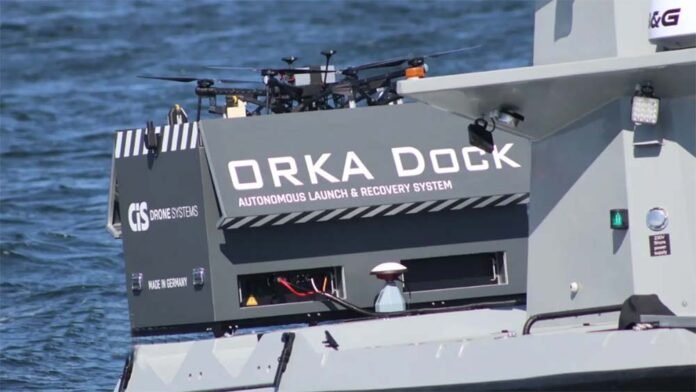
While stationary “drone-in-a-box” systems have grown common atop warehouses and power stations, maritime operations have historically faced a far harder challenge: landing a multi-rotor on a deck that is constantly rolling, pitching and moving forward. The ORKA Dock overcomes this friction by integrating custom landing tech directly onto uncrewed surface vessels (USVs), removing the need for onboard human operators or remote manual intervention.
Redefining Maritime Reconnaissance
Built to mount on the rear deck of a boat, the sealed, weatherproof hangar opens in under 30 seconds. Once activated, it launches an aerial drone on demand, catches it upon return and recharges its battery for the next patrol cycle.

During two weeks of continuous field testing in the Baltic Sea as part of the SeaSEC 2026 (Seabed Security Experimentation Centre) exercises, the ORKA Dock demonstrated fully autonomous deployment and recovery while mounted to a FLANQ Q-RECON 24 vessel travelling at 15 knots (about 17 mph).
Key Milestones:
- Launch Speed: Fully opens and launches in under 30 seconds.
- Recovery Precision: Precision Landing System with LiDAR altimetry accurate to 5 millimetres.
- Host Platform: Operates seamlessly on crewless vessels pitching in open-sea swells.
During two weeks of continuous field testing in the Baltic Sea as part of the SeaSEC 2026 (Seabed Security Experimentation Centre) exercises, the ORKA Dock demonstrated fully autonomous deployment and recovery while mounted to a FLANQ Q-RECON 24 vessel travelling at 15 knots (about 17 mph)
Sub-Centimeter Precision in Rough Seas
Landing an aerial vehicle on a moving target requires millimeter-level spatial tracking. To ensure accurate touchdown within a box barely larger than the aircraft itself, CiS paired its proprietary Precision Landing System with BEACON deck-recognition technology. Rather than relying purely on fixed GPS coordinates, BEACON dynamically calculates and compensates for the vessel’s motion in real time.
Complementing this is an onboard LiDAR altimeter featuring a 20-metre detection range and an accuracy of 5 millimetres – roughly the thickness of three stacked pennies. This high precision prevents the drone from colliding with a deck that is suddenly dropping or rising due to wave action.
Critical Infrastructure Protection
The system’s capabilities were tested against real-world scenarios during the Baltic trials, hosted off Rostock, Germany. Six European defence ministries – representing Germany, the Netherlands, Denmark, Finland, Norway and Sweden – designed exercises targeting harbour security, offshore platform monitoring and undersea cable protection.

In one scenario, the system was tasked with safeguarding a live high-voltage power cable connecting Germany and Denmark. Operating alongside industry partners including HENSOLDT, Rheinmetall and Systematic, the drone streamed real-time reconnaissance data via CiS’s MissionControl software into the Bundeswehr’s situational-awareness network (MESE).
The ORKA aircraft itself weighs roughly 26 pounds (12 kg), flies in winds up to 31 mph and achieves top speeds of 62 mph with an IP55 weather rating. For communications, it supports secure encrypted links from global suppliers alongside a 394-foot fibre tether option for indefinite station-keeping
Miniature Aircraft Carrier Logic
The paired hardware creates a continuous surveillance loop. The host boat – a 24-foot FLANQ Q-RECON 24 capable of speeds up to 56 mph and a range of 3,000 nautical miles – acts as a mobile base station. Although the ORKA drone itself carries a 75-minute flight endurance per charge, the boat’s ability to loiter for thousands of miles turns the system into an enduring offshore sensor array.

The ORKA aircraft itself weighs roughly 26 pounds (12 kg), flies in winds up to 31 mph and achieves top speeds of 62 mph with an IP55 weather rating. For communications, it supports secure encrypted links from global suppliers alongside a 394-foot fibre tether option for indefinite station-keeping.
As European defence initiatives prioritise sovereign maritime technology and infrastructure defence, automated deck systems like the ORKA Dock signal a shift toward persistent, completely uncrewed naval operations.






