


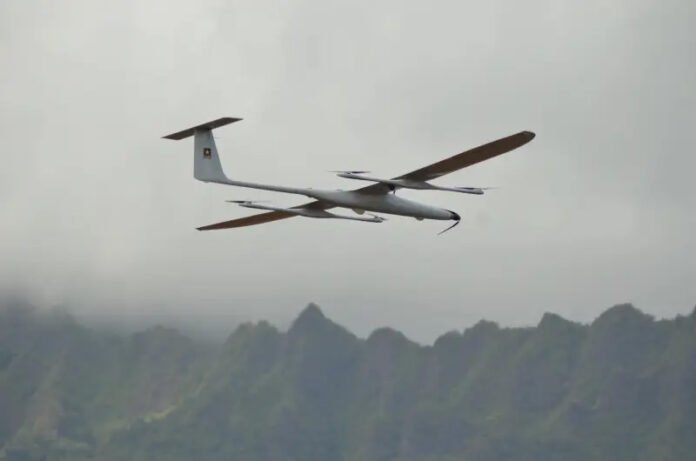
Washington: The US Army’s 1st Multi-Domain Task Force has used a small number of Kraus Hamdani Aerospace K1000 Ultra Long-Endurance, solar-powered unmanned aircraft system across the Pacific theatre in places like the Philippines and Guam in recent years. Now the Pentagon has ordered $20 million worth of the systems for the unit as well as special operators.
The Pentagon made the award through the Accelerate the Procurement and Fielding of Innovative Technologies (APFIT) program, one of the largest awards since the fund’s 2022 creation.

The K1000ULE is designed to “mimic nature by utilising onboard artificial intelligence to silently glide through the air like a bird and generate clean onboard energy,” an October 30 company statement reads. “The K1000ULE is the longest-endurance, fully electric, zero-emissions autonomous aircraft in its size and weight category.”
The K1000 will provide Aerial Tier Network Extension for communications, Electronic Warfare and Intelligence, Surveillance and Reconnaissance capabilities, the statement lists.
“Over time, we have matured our technology in line with the requirements of the US Army and continue to align the K1000ULE to meet the needs of the warfighter in a dynamically changing environment,” Fatema Hamdani, Kraus Hamdani Aerospace CEO and co-founder, said.
The Army has also been using the aircraft in a variety of other experiments over the past several years like the Edge exercise and Project Convergence.

The lightweight K1000, which features solar panels on its wings, previously broke the endurance record for class 2 unmanned aerial systems by flying for 76 hours. That category currently applies to drones weighing between 21 and 55 lbs.
The aircraft does not have landing gear and relies on 3D-printed skids that can be swapped out after they wear down.

The K1000 is difficult to detect, with most sensors and radars mistaking it for a bird, according to Kraus engineers on site in the Philippines.
The aircraft fits inside a standard case, and it takes users roughly 10 minutes to unload, assemble and launch. The drone takes off from a moving vehicle as it catches the wind. In the Philippines, it took off from the roof of a black SUV.
The Army is retiring its Shadow UAS program, and Kraus believes the K1000 is a good candidate to fill both small and large UAS capabilities with a logistics footprint of smaller drones, the statement notes.

Raksha Anirveda's editorial desk team brings in the collective experience of creative professionals - a fine mix of senior copy editors, writers, proofreaders and designers. Working as a team, they continuously create, manage, and curate content to sustain the magazine's profile and reputation in line with market trends and achieve magazine's goal.





