

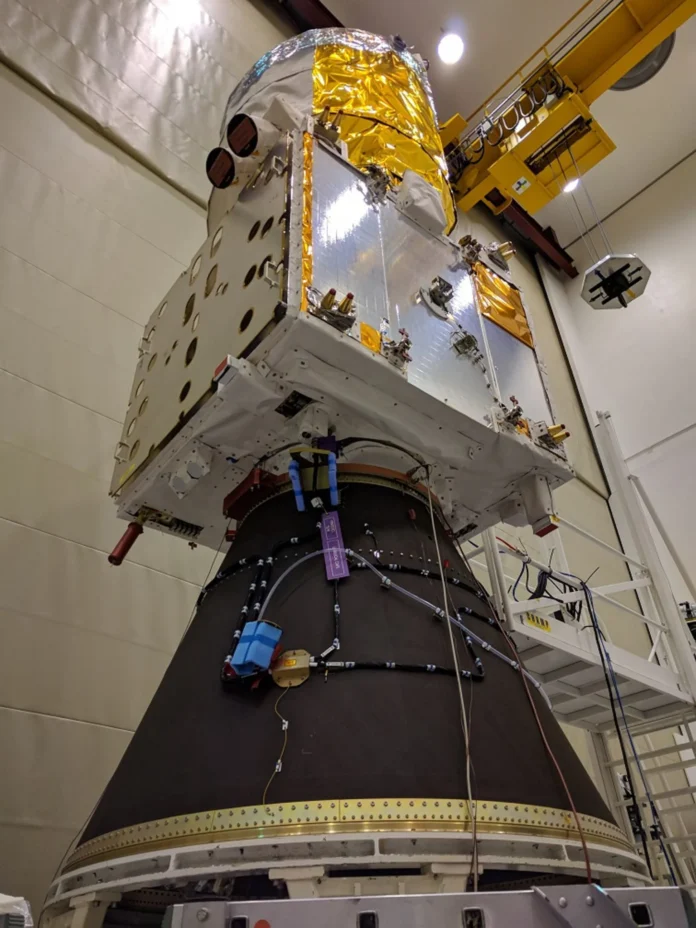
Airbus-built Aeolus wind sensor satellite ready for shipment

  • First ever satellite able to perform global wind component profile observation
  • ESA’s Aeolus will provide measurements on a daily basis in near real-time to improve the accuracy of weather forecasts
  •  

    Toulouse, Aeolus, the European Space Agency’s wind sensing satellite, is now ready for its upcoming launch. It will be shipped across the Atlantic on the Airbus vessel “Ciudad de Cádiz” to Kourou, French Guiana, where a Vega launcher will send it to orbit on August 21. The instrument is so sensitive that it could be damaged by a sudden loss of pressure. For this reason, air transportation has to be avoided and for the first time Airbus will transport one of its satellites on-board its own vessel.

    ads

    The 1.33-tonne spacecraft, primed by Airbus, features the first ever space-borne LIDAR (LIght Detection And Ranging) instrument called Aladin, which uses the Doppler effect to determine the wind speed at varying altitudes.

    Aladin fires a powerful ultraviolet laser pulse down through the atmosphere and collects backscattered light, using a large 1.5m diameter telescope, which is then analysed on-board by highly sensitive receivers to determine the Doppler shift of the signal from layers at different heights in the atmosphere.

    “Aeolus is a world first with break-through technology that will make a huge contribution to weather forecasting on a global scale. Pioneering a LIDAR instrument in Space is quite a challenge – but a great example of what Europeans can achieve when we work together!”, said Nicolas Chamussy, Head of Space Systems at Airbus.

    “Aeolus is a world first with break-through technology that will make a huge contribution to weather forecasting on a global scale. Pioneering a LIDAR instrument in Space is quite a challenge – but a great example of what Europeans can achieve when we work together!”, said Nicolas Chamussy, Head of Space Systems at Airbus.

    The data from Aeolus will provide reliable wind-profile data on a global scale and is needed by meteorologists to further improve the accuracy of weather forecasts and by climatologists to better understand the global dynamics of Earth’s atmosphere.

    big bang

    Aeolus will orbit the Earth 15 times a day with data delivery to users within 120 minutes of the oldest measurement in each orbit. The orbit repeat cycle is 7 days (every 111 orbits) and the spacecraft will fly in a 320 km orbit for three years.


    More like this

    Blocking The Straits

    One of Trump’s stated objectives in his current conflict...

    ideaForge Receives TDB Nod for Financial Assistance of Rs 151 Crore Under RDI Scheme to Advance Heavy-Lift UAV Platform ‘YETI’

    Mumbai: ideaForge Technology Limited, India’s leading manufacturer of unmanned...

    India’s Quantum Future Needed Teachers Before It Needed Students. QNu Labs and SRM Just Trained Them

    Bengaluru: India's quantum skilling model just changed. Instead of training...

    IAF Chief Urges Rapid Indigenous Drone Push

    New Delhi. Speaking at a workshop organised by the...

    Fifth Ship of Diving Support Craft Project – DSC A24 Launched

    Kolkata: The fifth ship (DSC A24) of five Diving Support Craft...

    Beijing’s Taiwan Clock: Ticking Faster Than Its Economy

    on July 1, 2026, Xi Jinping stood before the...

    India Must Rapidly Develop Deep-Tech Capability to Maintain Air Superiority: IAF Chief

    NEW DELHI. In a resounding call for indigenous defence...

    Advancing Defence Capabilities: Chinese Military Researchers Tap US AI Models

    Washington: Chinese military researchers have used outputs from leading...
    Indian Navy Special Edition 2025spot_img




