


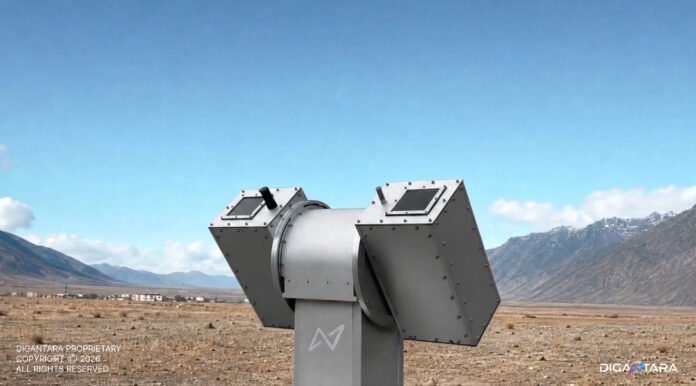
Bengaluru: Digantara, a space domain awareness and defence intelligence company, on August 18 unveiled MOSAIC, an AI-powered, distributed optical sensor network that gives a nation continuous, real-time custody of objects in Low Earth Orbit (LEO). Where space surveillance has long depended on a handful of foreign-owned, fixed sensors, MOSAIC introduces a new class of sovereign capability, built from the ground up in India, in step with the country’s push toward Aatmanirbhar Bharat in strategically critical technologies.
During Operation Sindoor, India’s strikes on nine terror camps were backed by both domestic assets (ISRO’s Cartosat and RISAT satellites) and widely reported to have included commercial imagery from Maxar Technologies, a US firm, used for target validation and post-strike damage assessment. The combination of domestic and commercial data enabled repeatable, layered imaging that proved critical to high-value target validation. It also underscored a broader reality about how India’s national security decisions still depend, in part, on data India does not own.

Digantara’s MOSAIC is what owning it looks like. Domestically built and continuously operating, it reduces India’s reliance on foreign commercial providers for time-critical orbital tracking.
Why this matters now: Space has become as contested a domain as land, sea, and air. From satellite-enabled targeting in the Russia-Ukraine war to counterspace posturing among major powers in the Indo-Pacific, modern militaries increasingly operate with one eye in orbit. Operation Sindoor was India’s own preview of that reality; it was a reminder that whoever owns the imagery pipeline holds a share of the decision-making that follows from it.
MOSAIC is built to close that gap. The initial deployment comprises five nodes operating as a single coordinated surveillance network. Each node is a self-contained electro-optical sensor system, an Optical Head Unit for precision sky imaging, paired with an Electronics Head Unit for onboard processing, timing, communications, and autonomy, running independently on solar power with battery backup, engineered to survive in the summers of the Thar desert and in the winters of the Himalayas.
MOSAIC’s hardware architecture strikes a balance between sensitivity and a large field of view, enabling it to catch faint RSOs across a wide swath of sky. The detection runs on an AI/ML-based technique that identifies stars and Resident Space Objects (RSOs), including the faintest targets, followed by a Lost-in-Space attitude estimation approach that determines RSO position with no prior information or cueing. This will be also be extended to alternative navigation use cases, primarily celestial navigation in GPS denied environments.

Anirudh Sharma, Founder and CEO, Digantara, said, “Every big infrastructure problem eventually stops being about having one perfect system and starts being about having many resilient ones. That’s true of the power grid, it’s true of the internet, and it’s now true of space. In our early days, we started by asking a simple question of what’s actually up there. Now, we are answering what you should know about it, and how fast can you know? Every capability we build, MOSAIC included, is really one more piece of that same answer. We aim to proliferate these sensors across the world to maintain custody and have independent catalogue maintenance.”
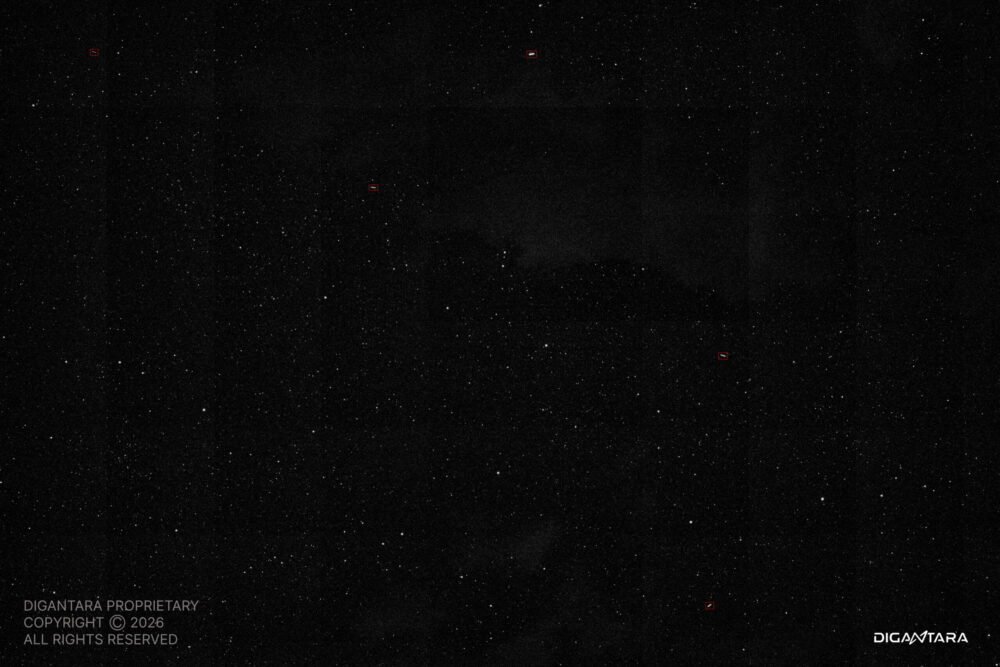

MOSAIC extends Digantara’s existing Space Domain Awareness infrastructure, which spans space-based tracking and data fusion through the in-house processing engine. MOSAIC is designed to serve as the wide-area detection and custody layer feeding both, which extends Digantara’s ability to detect, characterise, and maintain track of objects across the full range of orbital regimes, from LEO to GEO.
Digantara is a space domain awareness and defence intelligence company dedicated to protecting and defending sovereign and allied interests across operational domains from emerging threats, while ensuring the safety, security, and long-term sustainability of the space environment. By integrating advanced space-based sensors, proprietary optics, and AI-driven analytics into a unified space-intelligence infrastructure, Digantara delivers the comprehensive domain awareness required to safeguard critical assets and maintain strategic superiority in an increasingly contested orbital domain.
What distinguishes this infrastructure is its reach across the full value chain, right from raw sensing to strategic decision-making. Digantara owns and operates proprietary space and ground-based sensors that detect and track objects across all orbital regimes, a fused data architecture that identifies and characterises threats in real time, and predictive analytics that inform decision-makers and operators.
As global reliance on space accelerates, Digantara is building the intelligence layer that will define future deterrence, operational readiness, and strategic superiority.






