


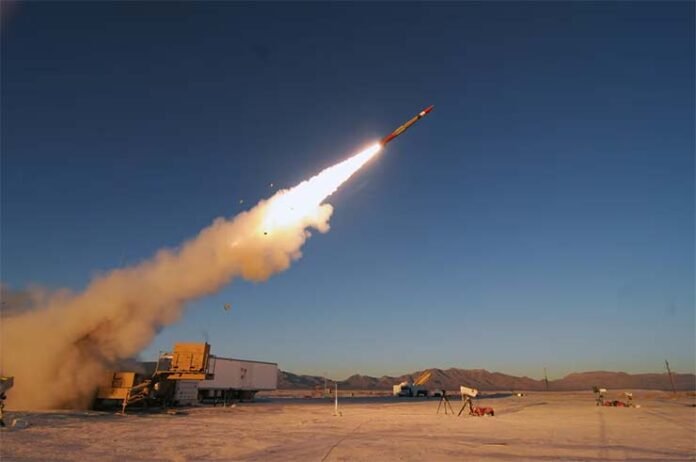
Washington: The most advanced version of the Patriot missile defeated a tactical ballistic missile threat target while fully integrated with a new radar in development with the US Army in a test over the weekend, marking a significant step toward the service’s transition to a modernised missile defence capability.
The test conducted at White Sands Missile Range, New Mexico, used both the Patriot Advanced Capability-3 Missile Segment Enhancement (PAC-3 MSE) and the Cost Reduction Interceptor (CRI).

“The interceptors were shot in a ripple configuration and successfully engaged and intercepted the TBM target,” Lockheed Martin, the maker of the Patriot family of missiles, said in a statement.
The test integrating the Raytheon-developed Lower-Tier Air and Missile Defence Sensor (LTAMDS) radar and PAC-3 missiles was built upon previous efforts to demonstrate PAC-3 integration with the Army’s Integrated Battle Command Systems (IBCS) and LTAMDS, according to Lockheed.
The Northrop Grumman-made IBCS is a fielded system that links any sensor to any shooter on the battlefield and is seen as the brain of the Army’s future air and missile defence architecture. LTAMDS is intended to replace the legacy Patriot radar with a capability that provides 360-degree protection.
The Army also had nascent plans to one day replace the PAC-3 MSE interceptor with a next-generation missile, but has since decided not to pursue development at this time, Maj Gen Frank Lozano, program executive officer for Army missiles and space, said.

The LTAMDS radar’s success in recent tests has prompted Army Chief of Staff Gen. Randy George to consider deploying the new radar early to operational units for further evaluation and testing.
The test is part of a larger Integrated Fires Test Campaign that has been running since mid-September and will continue through December, Lozano said.

The Army’s LTAMDS radar, which began testing using just its front array, is now also demonstrating the functionality of its two rear arrays that provide the 360-degree level of protection, he said.
This year, the service is also bringing in the Indirect Fire Protection Capability (IFPC) system, which can defeat a range of threats, including drones, cruise missiles, rockets, artillery and mortars from fixed and semi-fixed sites.
The Army wrapped up a development test for IFPC with three successful missile flight tests in late summer defeating two manoeuvring unmanned aircraft systems, a Group 3 UAS — which can weigh up to roughly 1,300 pounds — and a manoeuvring cruise missile.
The Army will incorporate a new version of its Sentinel radar (Version 4) next year and add additional elements the following year, all of which are expected to be part of the Pentagon’s missile defence of Guam architecture currently in development, Lozano said.

Raksha Anirveda's editorial desk team brings in the collective experience of creative professionals - a fine mix of senior copy editors, writers, proofreaders and designers. Working as a team, they continuously create, manage, and curate content to sustain the magazine's profile and reputation in line with market trends and achieve magazine's goal.





