


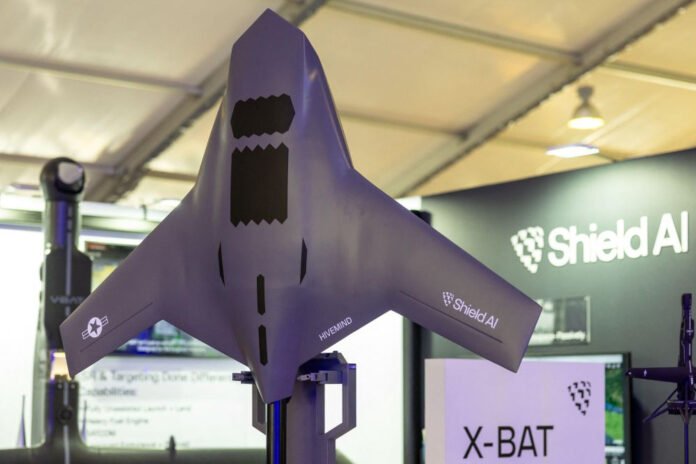
The US Navy is backing development of a fighter-sized uncrewed aircraft designed to take- off and land vertically, potentially operating from ships, islands and other locations without conventional runways. Shield AI says the first full-scale prototype of its X-BAT could be completed within weeks, with flight testing planned for later this year. That would mark a major construction milestone, not the aircraft’s entry into service.
The company’s programme has received a new $150 million Navy contract modification, matched by $150 million of Shield AI funding. Combined with a separate $50 million government investment and an equal company contribution announced in August, total public and private commitments now stand at $400 million. The latest Navy funding comes through the Defence Exportability Features programme, which supports work to make systems suitable for export to allies.

The headline figure differs from the $200 million in external funding highlighted in the TechRadar report: that figure refers to the initial matched government-and-company contributions. The additional agreement announced in October adds another $300 million in combined Navy and Shield AI funding. The amounts are commitments to development, not evidence that the aircraft has been purchased in production quantities or delivered to the fleet.
X-BAT is a tail-sitting design: it is intended to rise vertically and transition to forward flight, then return to a vertical landing. That could reduce reliance on long runways, catapults and large flight decks. Shield AI is positioning the aircraft for dispersed operations, including from maritime platforms and austere forward sites, where conventional fighter operations may be difficult.
The aircraft’s advertised performance remains developmental. Shield AI lists a maximum range of more than 2,000 nautical miles and a ceiling above 50,000 feet; TechRadar reports a projected combat radius of around 1,340 nautical miles. These are design goals, not results from flight testing. The aircraft has not yet flown, and its defining vertical take-off and landing capability has not been demonstrated in the air.
The system is planned around a General Electric F110 engine and a thrust-vectoring exhaust nozzle to help control the aircraft during vertical flight. Shield AI’s Hivemind software is intended to act as its AI pilot, enabling operations when GPS or communications are disrupted. The company and its suppliers have completed engine light-off and nozzle-integration work, along with wind-tunnel testing of the weapons bay, according to reports and company statements.

The Navy’s interest reflects a wider push to extend strike options beyond aircraft carriers and established air bases. The Defence Innovation Unit’s Runway Independent Maritime Expeditionary Strike initiative seeks long-range uncrewed aircraft that can launch from ships or expeditionary locations with limited infrastructure. A runway-independent aircraft could give naval forces more flexibility, but practical use would depend on safe ship operations, maintenance, communications and the ability to recover and rearm the drone.
Shield AI has identified Newton City-County Airport in Kansas as the X-BAT flight-test and sustainment site, while production is planned for Des Moines, Washington. The company says a team of about 500 engineers across Shield AI and suppliers is working on the test aircraft. Company plans point to flight tests later in 2026, with a mission-equipped aircraft and early operational capability targeted for 2028-29; these schedules depend on testing and Navy assessment.

The immediate test is whether X-BAT can make the transition from a ground-tested design to a flying aircraft-particularly in vertical flight. Until that happens, its advertised range, autonomy and runway-free operations remain promises to be validated. For the Navy, the funding buys development progress and technical risk reduction; it does not yet deliver a new combat capability.






