


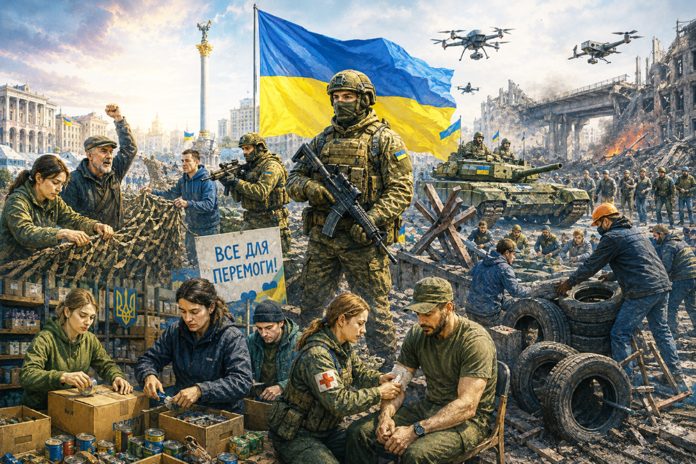
The prolonged war in Ukraine has generated an extraordinary volume of analysis on large-scale industrial warfare, disruptive technologies, and the use of trench systems. What has not received particular attention, however, is the remarkable resilience of Ukrainian society, which holds several important lessons for other threatened regions, such as India.
Foundations of Ukrainian resistance were laid in 2014 when Russian operations in Crimea and Donbas exposed weaknesses within a Ukrainian military still struggling with its Cold War legacy. As the overstretched army pivoted eastwards hurriedly, it was greatly aided by civic mobilisation; battalions of reservists and volunteers — teachers, engineers, students, shopkeepers, and office workers — built around regular cores formed what grew into the Territorial Defence Forces (TDF). With 110,000 volunteers in the first few months, local communities and businesses also funded equipment, organising support networks for soldiers and displaced civilians, and filling gaps that state institutions could not immediately address.

A group of motorcycle enthusiasts dramatically borrowed explosives from the Engineer unit and breached the dam on the Irpin River, bogging the Russian advance. In a more sober reality, civilian engineers, mechanics, technicians, dam personnel, and military specialists worked together to rapidly inundate the region, contributing significantly to the defence of Kyiv
Citizen Soldiers and Territorial Defence
By the time the war renewed in 2022, Ukraine had evolved a national ecosystem of resistance, with the TDF incorporated as a branch of the army, surrounded by other volunteer battalions such as the Azov, Aidar, or Dnipro-I units, and general civic mobilisation. These units were not only manning checkpoints or protecting infrastructure, but also actively engaging in combat — hastily formed and trained antitank, anti-aircraft, or drone teams, their value multiplied by local knowledge and connections, put up strong and distributed resistance to advancing forces, while ordinary civilians armed with smartphones used social media and encrypted digital mapping and messaging applications extended by the West to morph into sensors distributed through the battlespace, reporting troop movement and identifying military equipment.
As deadly missile ambushes became a regular feature, also driving airplanes from the skies in what is termed mutual air denial, a revealing episode of civic participation occurred in the defence of Kyiv in February 2022. In popular lore, a group of motorcycle enthusiasts dramatically borrowed explosives from the Engineer unit and breached the dam on the Irpin River, bogging the Russian advance. In a more sober reality, civilian engineers, mechanics, technicians, dam personnel, and military specialists worked together to rapidly inundate the region, contributing significantly to the defence of Kyiv. More than the physical obstacle, the episode showed motivation compensating for shortages of equipment or formal training, and defence transforming from a military to a societal responsibility.
While Indian social institutions demonstrated remarkable resilience during the COVID pandemic, they need to be further strengthened for such eventualities beyond what the legacy institution of the Territorial Army is capable of in view of the sheer size of India’s transportation, communications, energy, or information infrastructures
Identity and Symbolism
Identity played a part in the Ukrainian resistance. Ukraine was never culturally uniform; its western regions were historically part of the Polish-Lithuanian and Austro-Hungarian spheres, while its eastern and southern regions were closely linked to Russia, and later the Soviet Union. Before 2014, outside observers viewed such cultural differences, which were apparently supported by electoral maps, as paramount. However, the war belied these assumptions as primarily Russian-speaking cities of Kharkiv, Odesa, and Mykolaiv became centres of resistance rather than collaboration. Ukrainians seem to have defined their political identity not on historical, ethnic, or linguistic memory; rather, the invasion, launched partly in the name of historical unity, accelerated the emergence of a stronger Ukrainian identity based on an independent Ukrainian state. The complexity is best illustrated through the idea of the Cossacks, whose legacy of military self-organisation, local autonomy, and resistance to external domination is claimed by both sides.
Identities have been used at fundamental levels. The Vovky Da Vinchi (Da Vinci’s Wolves) of the local commander Dmytro Kotsiubailo, whose radio call sign was Da Vinci, used the trope of the wolf as a coming-of-age allegory, depicting determination, endurance, teamwork, and resilience, harking back to the Cossacks and earlier times. Such Ukrainian volunteer militia units are fundamentally different from other forms of irregular military — state-supported private groups of professional fighters, such as Russia’s Wagner Group, or the US-affiliated Blackwater and DynCorp in Iraq or Afghanistan or Silvercorp of the infamous botched regime change attempt in Venezuela in 2020. Such groups of commercially contracted professional soldiers, capable of expeditionary operations while providing political deniability, do not resemble societal mobilisation as seen in the irregular battalions of Ukraine.

The 2014 hybrid Russian deployment of ‘Little Green Men’ had failed to stimulate societal participation. At the same time, volunteer formations reveal the complexities of national identity, as they attract disturbing political and ideological beliefs. The Azov movement’s early leadership and symbolism had attracted considerable international scrutiny for its ultranationalist and far-right affiliations.
All response mechanisms, including the Home Guards, need to be strengthened. However, the vast pool of talent — engineers, software developers, drone operators, railway personnel, logistics specialists, and communications experts — may also require psychological conditioning for co-option into war efforts, which presents deeper challenges
Lessons for India
Ukrainian volunteer resistance, integrated with the regular army and supported by a mobilised society, phenomenally complicated Russian expectations of rapid collapse. This is the first time in recent years that such a whole-of-society defence appears in an industrialised backdrop, Vietnam or Afghanistan being pre-industrial societies, challenging assumptions that shaped military thought since the end of the Cold War. The realisation that, notwithstanding the continued importance of precision strike and professional military forces, and growing emphasis on new technologies, including AI or drones, greater combat power can be generated through societal learning and adaptation, also rendering intelligence no longer a function of specialised surveillance infrastructure. The realisation that nothing may survive the intensely complex adaptive system of modern warfare, which occurs no longer at remote corners of the frontier but across everyone’s backyard, without societal resilience, makes Ukraine a compelling case study.

Though Indian circumstances prima facie differ considerably from those of Ukraine, the civil resistance holds relevant lessons for India as well. Not only conflict on India’s frontiers, but any prolonged state of unrest triggered by inimical proxies and political ideologies, exacerbated by digital tampering, is likely to impact social services and public morale across the nation. While Indian social institutions demonstrated remarkable resilience during the COVID pandemic, they need to be further strengthened for such eventualities beyond what the legacy institution of the Territorial Army (TA) is capable of in view of the sheer size of India’s transportation, communications, energy, or information infrastructures. Not only do the TA and other response mechanisms, such as the Home Guards, need to be strengthened, but the vast pool of talent — engineers, software developers, drone operators, railway personnel, logistics specialists, and communications experts — may also require psychological conditioning for co-option into war efforts, which presents deeper challenges.
The whole-of-society approach obliges military training and planning to adapt. For example, wargames and exercises must represent not only units, weapons, and logistics, but also militia and volunteer formations, civilian information ecosystems, and civilian logistic resources, while also considering effects of operations on national morale and social resilience
The whole-of-society approach also obliges military training and planning to adapt — for example, wargames and exercises must represent not only units, weapons, and logistics, but also militia and volunteer formations (with lower training but higher motivation levels than regulars), civilian information ecosystems, and civilian logistic resources, while also considering effects of operations on national morale and social resilience. Military procurement processes may require more flexibility during emergencies to enable effective innovations established on inexpensive technologies. Also, corresponding societal resilience encountered across the frontiers may require war plans to be more pragmatic than optimistic.
The differences from Ukraine notwithstanding, societal resilience will nevertheless be critical, and strengthening it calls for what some may liken to Total Defence of countries such as Finland or Sweden. This would require operationalisation of the concerns through suitable protocols and standard operating procedures to be incorporated in national mobilisation schemes once adequately wargamed. At the same time, cautionary lessons from Ukraine, such as the need for effective command structures for volunteer formations, and the possibility of ideological radicalism that exploits identity and legitimacy, need to be kept in mind so that efforts remain within constitutional and military propriety.

The writer is an Indian Army veteran with three decades of experience in the Indian infantry. He is also a military historian and an avid wargamer. The views expressed are of the writer and do not necessarily reflect the views of Raksha Anirveda





