


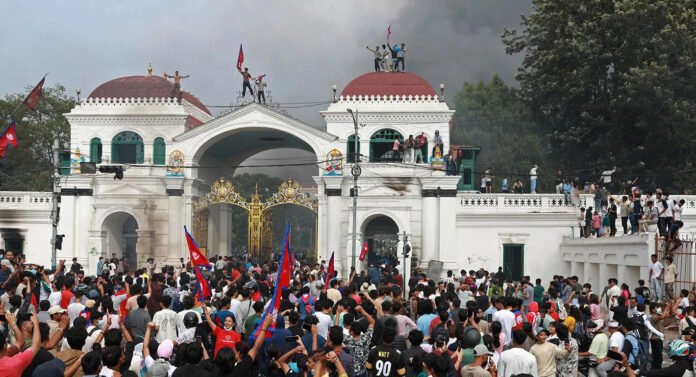
there is an old aphorism within India’s intelligence establishment: Nepal is not merely a neighbour; it is a corridor. A corridor for commerce, for culture, for labour and, when state capacity frays, for threats. The Gen-Z political revolution that swept Kathmandu in late 2025, installing Prime Minister Balen Shah and the Rastriya Swatantra Party atop the ruins of Nepal’s communist establishment, has reopened this corridor question with fresh urgency. New Delhi is watching, cautiously optimistic, with a calibrated sense of anxiety and a keen strategic interest.
The 1,850-kilometre open border between India and Nepal is one of the most porous international frontiers in the world. People move across without visas. Ethnic groups reside on both sides of the border, and it is not unusual to see trade, family ties and even pilgrimage routes operating in both directions with minimal friction. This integration is a civilisational bond. It is also, for India’s security planners, a permanent operational vulnerability.

The Terror Financing Threat
Prior to Nepal’s political upheaval, Indian security agencies had long monitored Kathmandu’s financial system as a soft node in South Asia’s terrorism-financing architecture. Hawala networks operating through the Tarai, Nepal’s plains belt abutting Bihar and Uttar Pradesh, have historically helped move illicit funds linked to proscribed organisations based in Pakistan. Fake Indian currency notes, a well-known tool of Pakistan’s state-backed economic disruption, have from time to time passed through Kathmandu on their way into Indian markets. The 2016 demonetisation drive slowed these networks, but it did not eliminate them entirely.
The new administration’s governance mandate, built on anti-corruption and institutional reform, has created an opening that New Delhi is now deliberately exploiting. In agreements formalised around mid-2026, India and Nepal are strengthening their anti-money laundering and counter-terrorism financing (AML/CFT) frameworks. Both countries are members of the Asia/Pacific Group on Money Laundering, and Kathmandu’s compliance with Financial Action Task Force standards is now viewed as a direct security interest for India. A financially transparent Nepal is less susceptible to financing networks that ultimately target Indian soil.
Sleeper Cells and the Open Border
The collapse of governance during Nepal’s September 2025 uprising, which saw thousands of prisoners escape from Nepali jails during days of political violence, triggered alarm within India’s Intelligence Bureau and Research and Analysis Wing. Among the escapees, Indian agencies assessed, were individuals linked to criminal networks operating across Bihar and Uttar Pradesh. The episode served as a reminder that internal security in Nepal and internal security in India’s heartland states are not separable challenges.
Pakistan’s Inter-Services Intelligence has, over several decades, attempted to exploit the Nepal corridor for the infiltration of operatives into India. Following the tightening of traditional infiltration routes after the 26/11 Mumbai attacks, Nepal’s open border assumed greater operational significance in the ISI’s playbook. Sleeper cells, forged-documentation rackets and sympathiser networks in Nepal’s urban centres—Kathmandu, Pokhara and border townships—have periodically featured in Indian counter-intelligence assessments.

The resumption of India-Nepal Home Secretary-level talks in 2025, after a nine-year hiatus, and the finalisation of a Mutual Legal Assistance Treaty in criminal matters represent the most institutionally significant countermeasure in a decade.
Intelligence Architecture and the RAW-NID Relationship
At the heart of India’s security engagement with Nepal lies a largely invisible but operationally critical intelligence architecture. The Research and Analysis Wing (RAW), the Intelligence Bureau (IB), and Nepal’s National Investigation Department (NID) have maintained back-channel coordination across successive governments in Kathmandu. This relationship has weathered considerable diplomatic turbulence, including the 2015 blockade, disputes over Kalapani-Limpiyadhura and periodic episodes of anti-India nationalism deployed for domestic political consumption.

The Gen-Z administration’s relative absence of ideological baggage vis-à-vis India is, paradoxically, an intelligence asset for New Delhi. Whereas some earlier communist-aligned governments occasionally played the “China card” to extract concessions from India, or tolerated anti-India rhetoric for domestic political purposes, the new leadership appears more pragmatic and economically focused. Foreign Minister Shisir Khanal’s engagement with National Security Advisor Ajit Doval in June 2026 on intelligence-sharing, border management and counter-radicalisation suggests that the administration is prepared to intensify day-to-day operational cooperation that had previously stagnated.
Radicalisation and the Digital Threat Vector
A less-discussed but rapidly growing dimension of India-Nepal security cooperation concerns online radicalisation monitoring. Nepal’s youthful demographic, relatively high social media penetration, and sizeable Muslim minority population in the Tarai have made the country an area of interest for Indian counter-radicalisation agencies. At the same time, Islamist extremist networks, primarily linked to organisations rooted in South Asian jihadist ecosystems, have attempted to establish digital recruitment pipelines that exploit Nepal’s governance gaps. This trend has been noted in several security assessments. Additionally, Maoist revivalist cells, residual remnants of the decade-long insurgency that formally ended in 2006, continue to possess organisational memory and, in certain documented instances, have intersected with cross-border criminal economies.
A financially transparent Nepal is less susceptible to financing networks that ultimately target Indian soil
India is now offering Nepal technical support in cyber-threat monitoring, digital infrastructure protection and counter-radicalisation analytical frameworks. This is not an act of altruism; rather, it is a direct upstream security investment. Radicalisation in Nepal’s Tarai districts can translate, with relative speed, into operational threats within India’s border states.
The Narcotics Corridor
Nepal’s position in South Asia’s narcotics landscape is seldom discussed in diplomatic circles, yet it remains a persistent concern in India’s security assessments. Cannabis cultivation has historically been embedded in parts of Nepal’s rural economy. More troubling, however, is Nepal’s growing role as a transit hub for synthetic drugs and precursor chemicals originating from China’s manufacturing ecosystem and destined for Indian markets.
Narcotics revenues frequently intersect with criminal-financing networks that, in turn, bankroll political violence and organised crime. For India’s Narcotics Control Bureau and border-security agencies, enhanced cooperation with Nepal’s Department of Narcotics Control is therefore a counterterrorism imperative, not merely a law-enforcement requirement.
The China-Pakistan Angle and Beijing’s Disrupted Networks
Nepal’s strategic geography compels it to maintain a delicate balance between India and China, a reality that no administration in Kathmandu, however youthful or reform-oriented, can ignore. What has changed under the new leadership is the disruption of entrenched political networks that Beijing had cultivated within Nepal’s communist establishment over nearly two decades of sustained engagement.
Chinese party-to-party ties, elite cultivation, media influence operations, academic partnerships and digital infrastructure investments had created a web of quiet dependency in Kathmandu. The Gen-Z revolution did not merely replace a government; it disrupted these networks and created a period of uncertainty for Beijing, one that India has moved swiftly to exploit.
The decline of entrenched communist networks has created the most favourable strategic environment for India in nearly a decade
China’s strategic interests in Nepal extend far beyond economics. Beijing views Kathmandu as critical to controlling Tibetan refugee flows, curbing cross-border anti-China activism and gradually integrating telecommunications and digital infrastructure that could provide long-term strategic leverage. The new administration has adopted a cautious approach, maintaining selective engagement with China while continuing to accept certain Belt and Road Initiative (BRI) investments and avoiding any overt rupture in bilateral ties.
However, there appears to be a discernible inclination towards India on matters of security cooperation. This balance presents a significant opportunity for New Delhi, although such windows rarely remain open indefinitely. Pakistan’s intelligence services, which have historically coordinated with Chinese counterparts on anti-India activities using Nepal as a geographic facilitator, are monitoring Kathmandu’s evolving trajectory with evident concern.
Gorkha Regiments: The Alliance Forged in Blood
Few aspects of India-Nepal security cooperation possess the historical resonance of the Gorkha military connection. For decades, thousands of Nepali citizens have served in the Indian Army’s Gorkha regiments, creating one of the world’s most distinctive military-to-military relationships. This bond has been forged not only through shared service but also through wars, peacekeeping operations and counter-insurgency campaigns.
The significance of the Gorkha connection extends beyond military utility. It continues to generate remittances for Nepal’s economy while fostering a community of veterans with deep institutional familiarity with India’s security establishment. More importantly, it sustains a constituency within Nepal that remains genuinely invested in the bilateral relationship, even during periods of political tension.
The annual Surya Kiran joint military exercise, officer-training exchanges and extensive Himalayan disaster-response cooperation between the two armies provide institutional depth to what might otherwise be viewed as a purely historical legacy. The new government has shown little inclination to alter these arrangements, which deliver practical benefits at minimal political cost.
India’s defence-cooperation outreach has built upon this foundation, layering newer areas of collaboration such as cybersecurity, forensic capabilities and financial intelligence on top of the longstanding martial partnership.
The Strategic Assessment
Nepal’s Gen-Z revolution presents India with what security analysts might cautiously describe as a structural opportunity. The decline of ideologically anti-India communist networks, the pragmatic economic orientation of a youth-led government and the disruption of Beijing’s cultivated political architecture in Kathmandu have combined to create conditions more favourable to Indian security interests than at any point during the past decade.
For New Delhi, investing in Nepal’s institutional resilience is now as important as managing the bilateral relationship itself
India’s response—accelerating hydropower partnerships, reviving dormant institutional mechanisms and investing in Nepal’s regulatory and security capacities—reflects a mature strategic understanding that economic engagement has increasingly replaced coercive influence as New Delhi’s primary instrument of statecraft.
Yet the risks remain equally structural. Governance failure in Nepal, the recurring cycle of coalition fragmentation, public disillusionment and institutional paralysis continues to represent the single greatest threat to India’s security interests. A weak Nepal does not merely complicate bilateral relations; it creates operational vacuums that Pakistan’s intelligence services, Chinese influence networks, narcotics syndicates and radicalisation ecosystems are well positioned to exploit.
For New Delhi, the strategic imperative is therefore not merely to engage with the new administration but also to invest sufficiently in Nepal’s institutional resilience to ensure that future political cycles do not undo the gains achieved during the present one.
The Himalayan corridor has always been India’s most complex security frontier. What has changed in Kathmandu is the political generation responsible for managing it. Whether this generational shift produces a durable strategic alignment or merely another cycle of hope and instability may ultimately depend less on Nepal’s domestic politics than on the depth, consistency and patience of India’s engagement in the years ahead.

The writer is an expert on geopolitics, national security, and counter-terrorism; and he regularly contributes his subject thought-leadership and academic commentary with several publications in newspapers, journals, and periodicals. He works with investigative agencies, regulatory bodies, financial institutions and enterprises, providing strategic and regulatory advisory. The views expressed are personal and do not necessarily carry the views of Raksha Anirveda





