


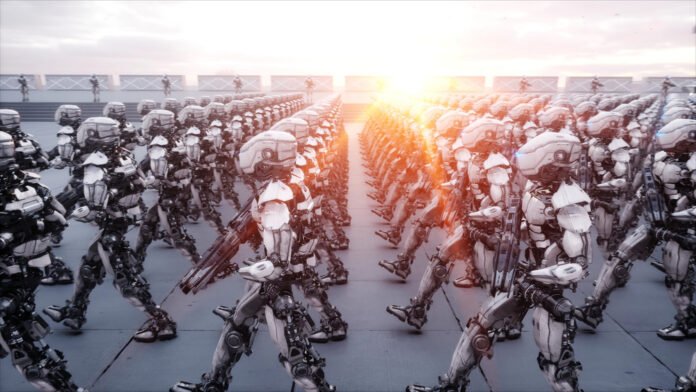
There is a pattern in the history of weapons that democratic societies consistently fail to notice until it is too late. Every major military technology arrives bearing the same promise: that this time, war will be shorter, more precise, more decisive, and less costly in blood. The machine gun was supposed to make frontal assault too expensive to sustain. The strategic bomber was supposed to break the will of civilians and end conflicts in weeks. Precision-guided munitions, after the Gulf War’s celebrated footage of missiles entering ventilation shafts, were supposed to have finally solved the problem of discriminate warfare. Each time, the technology worked. Each time, the strategy failed to follow. We are at that inflection point again, and the technology moving faster than our political institutions can govern it is artificial intelligence.
On February 28, 2026, an AI-assisted Tomahawk missile hit the Shajareh Tayyebeh primary school in Minab, southern Iran. At least 175 people died, among them more than a hundred children who were under the age of twelve. The reason wasn’t some rogue algorithm, or even a system that went fully haywire in that science fiction style sense. The cause was outdated data; the school had been built on the grounds of a former military installation years earlier, but the human-managed databases feeding the targeting system had not been updated. Project Maven, the Pentagon’s flagship AI targeting programme, correctly executed its instructions. The instructions were wrong. As one expert noted in the aftermath, AI systems are only reliable because of the people who build them, provide the data, and monitor them. When the human link fails, the machines continue to execute that error, correctly, efficiently, and at scale.

Five Thousand Targets a Day
Project Maven did not begin as an instrument of mass targeting. It emerged from a specific, practical frustration: the US military was drowning in drone surveillance footage it could not process. Analysts strained over hours of video, flagging motorcycles, flagging patterns, flagging a fraction of what mattered. Maven’s original proposition was cautious: let computer vision handle the sorting and free humans for judgment. That was a reasonable argument. It is also, historically, how every weapons revolution begins: with a limited use case and a sensible justification.
The numbers, as they always do, grew. The National Geospatial-Intelligence Agency soon claimed that AI-assisted targeting could process 100 targets a day without the technology, and 1,000 with it. Add large language models into the targeting cycle, the argument ran, and 5,000 targets a day became plausible. Five thousand. The human analyst who once strained to review 50 images is now nominally in the loop on decisions being generated at an industrial scale. The phrase ‘human in the loop’, repeated with the regularity of a liturgical chant by military commanders and Pentagon briefers, has come to function less as a description of genuine oversight and more as a claim about a process that the speed of the system has rendered largely theoretical. Research confirms the concern: Maven’s target identification accuracy runs at approximately 60%, meaningfully below the 84% achieved by human analysts. The humans are in the loop. The loop is moving too fast for the humans to stop it.
The danger in the AI revolution is that an algorithm executes its instructions without a strategy or accountability. That is the illusion of smarter war: not that the machines are lying to us, but that we have begun to let them think for us, and call it precision
The Clausewitz Gap
Military history offers a concept for what is happening, even if the defence technology community has not yet named it clearly.
Carl von Clausewitz saw that war isn’t just some autonomous thing; it’s a tool of political will, and the deeper logic of it is always behind the political goals it is trying to serve. At the same time, AI can squeeze the observe-orient-decide-act cycle from hours into seconds, actually faster than people can properly track. It can stitch together satellite imagery with electronic intercepts, drone footage, and ground sensors into one operational picture. And it can improve logistics, foresee maintenance problems before they escalate, and spot patterns in enemy movement that a human analyst, no matter how sharp, couldn’t realistically catch in the same available time, or at least not with the same speed. What it cannot do is determine whether any of this serves a coherent political purpose.

The Iran campaign has been the most instructive demonstration. Central Command confirmed publicly that AI tools had compressed decision cycles that once took days down to seconds. The regime did not fall. No popular uprising materialised. Iran blocked the Strait of Hormuz, drove global oil prices upward, and used its geography with a tactical patience that no targeting algorithm could neutralise. What Trump and his advisers did not anticipate, as one analyst observed, was that Iran could rely on much simpler means to stymie technologically superior forces. Jim Mattis put the strategic principle more tersely: targetry is no substitute for strategy. The United States spent years of punishing experience in Iraq and Afghanistan relearning this lesson. The temptation of AI is to forget it again, to mistake speed and scale for effectiveness, and processing power for wisdom.
AI systems are only reliable because of the people who build them, provide the data, and monitor them. When the human link fails, the machines continue to execute that error, correctly, efficiently, and at scale, says an expert
The Accountability that Dissolves

The ethical problem runs deeper than individual targeting errors. It concerns the architecture of responsibility itself. In conventional military operations, a chain of command meant a chain of accountability; a strike was ordered, authorised, executed, and the humans at each point in that chain bore legal and moral responsibility for the outcome. AI disperses that chain across programmers, data scientists, contractors, analysts, and commanders until responsibility is distributed so widely that it effectively disappears. Scholars call this responsibility diffusion. The Minab school strike illustrates it precisely: the database managers who failed to update the records, the system designers who did not build in verification requirements, the commanders who approved the strike package, and the AI that executed it flawlessly, all participated; none bears unambiguous individual accountability. The dead become, as one observer noted, a debugging problem.
Automation bias compounds the difficulty. Humans tend to trust machine outputs even when evidence suggests caution. In high-pressure military environments, oversight becomes nominal rather than meaningful. Operators are formally authorised to review AI-generated recommendations while lacking the time, context, or institutional protection to question them. The result is human approval without human judgment, the appearance of the safeguard without its substance. Defence scholars have identified this clearly: human-in-the-loop does not ensure human control. What it sometimes ensures is that a human hand is close enough to the process to provide political cover when things go wrong.
Ukraine’s Different Answer
The binary choice, AI targeting or fog of war, is false, and Ukraine’s Delta battlefield awareness system demonstrates why. Delta integrates thousands of data streams from drones, satellites, and ground sensors into a common operational picture accessible to every unit in the field. AI processes and classifies the incoming information. Humans verify every target before engagement.
In high-pressure military environments, oversight becomes nominal rather than meaningful. Operators are formally authorised to review AI-generated recommendations while lacking the time, context, or institutional protection to question them
The system has delivered near-total situational awareness without surrendering the targeting decision to autonomous processes. It is not a perfect model; there are documented concerns that Ukraine’s practice of awarding points for verified strikes risks gamifying combat in ways that dull restraint. But it establishes the principle: thoughtful design can preserve human judgment while capturing the speed advantages that AI genuinely offers. The choice is not between the algorithm and the abyss. It is about where, specifically, the human must remain genuinely in control.
The Decision Nobody Made
The deepest problem is political. The transformation of American warfare through artificial intelligence has occurred largely outside democratic deliberation. Congress passed no legislation governing autonomous weapons systems before they were deployed. The public was not asked whether it consented to wars conducted at machine speed. The doctrine of appropriate levels of human judgment, the Pentagon’s current formulation, notably less committal than human in the loop, was written by officials and not debated by legislatures. This is not a new failure mode: drone programmes expanded for years before public reckoning caught up, and nuclear weapons produced the doctrine of mutual assured destruction before strategists had fully thought through its implications. AI is moving faster than any of them.
Political leaders confuse machine intelligence with strategic intelligence. There’s a false confidence of sorts, the one that comes from algorithmic precision, that sneaks in and takes over for the harder, slower and more fought over work of figuring out what victory actually means
There are signs that democratic institutions are beginning to respond. In June 2026, Senators Chris Coons and Jack Reed introduced the Responsible Artificial Intelligence in Defence Act, which would call for human supervision and a manual override ability while waiting for proven reliability thresholds. It would also bar AI from being used for nuclear launch decisions, and it would require meaningful, not just symbolic, human review. The bill’s sponsors basically tried to say it more loudly, like it needs to be said: rigorous human oversight is not a slowdown for adoption; it is the bedrock that makes ongoing adoption actually possible. This is the correct framing. It arrives, as democratic accountability tends to do with weapons revolutions, somewhat late.
What AI Cannot Tell Us?
The ultimate paradox of AI warfare is that the smarter the targeting systems become, the more important human strategic wisdom becomes, and the more systematically that wisdom is being eroded by institutions redesigned around machine speed. AI can identify 5,000 targets a day. It cannot answer which of them matter, what political outcome justifies striking them, or what peace follows the destruction. The danger is not that the machines become too intelligent. The danger is that political leaders confuse machine intelligence with strategic intelligence, like they’re the same thing but not really. There’s a false confidence of sorts, the one that comes from algorithmic precision, that sneaks in and takes over for the harder, slower and more fought over work of figuring out what victory actually means.
Clausewitz wrote that war is the continuation of politics by other means. The corollary, which the AI revolution is testing with unusual severity, is that military means divorced from political clarity are not merely inefficient; they are actively dangerous. A school full of children in Minab stood on ground that was once a military base. The database was not updated. The algorithm executed its instructions with perfect fidelity. The system worked; the strategy and the accountability did not. That is the illusion of smarter war: not that the machines are lying to us, but that we have begun to let them think for us, and call it precision.

The writer is an expert on geopolitics, national security, and counter-terrorism; and he regularly contributes his subject thought-leadership and academic commentary with several publications in newspapers, journals, and periodicals. He works with investigative agencies, regulatory bodies, financial institutions and enterprises, providing strategic and regulatory advisory. The views expressed are personal and do not necessarily carry the views of Raksha Anirveda





