


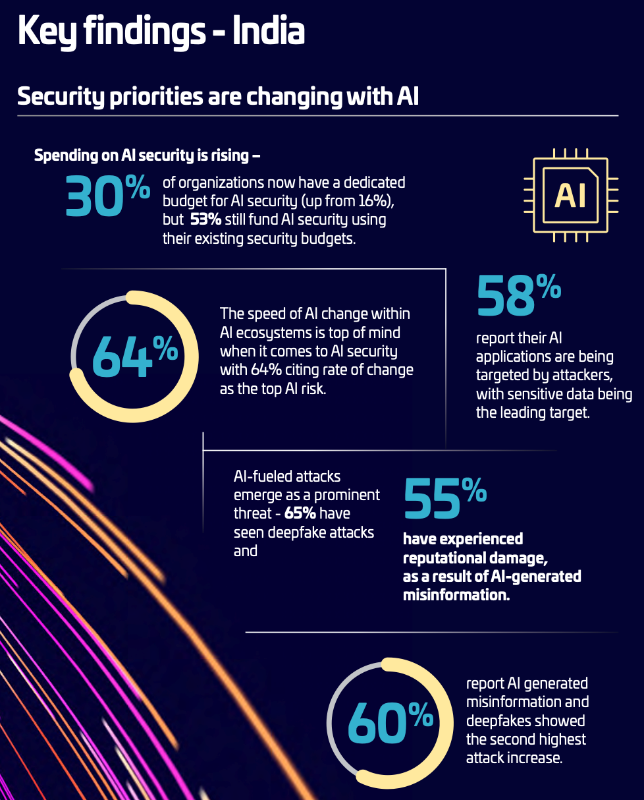
New Delhi: According to the Thales 2026 Data Threat Report, organisations across various markets including automotive, energy, finance and retail say the rapid pace of AI-driven transformation is now their biggest security challenge. Based on the report’s research, conducted by S&P Global 451 Research, 64% of organisations in India and 70% globally who responded to the survey cite AI as their top data security risk. The concern is not only about malicious AI, but about the access it is being granted as it shifts from a tool to a trusted insider.
As enterprises embed AI into workflows, analytics, customer service, and development pipelines, these systems are being granted broad, automated access to enterprise data, often with fewer controls than those applied to human users in a corporate environment.

“The rapid adoption of AI is driving a surge in next-gen cyber threats, particularly deepfakes. This is corroborated by the 2026 Thales Data Threat Report, which reveals 65% of organisations in India have already experienced deepfake-driven attacks. We appreciate India’s efforts to strengthen its legal framework and counter these risks,” says Ankur Kanaglekar, Vice President – India, Thales. “When identity governance, access policies, or encryption frameworks are weak, AI can amplify those weaknesses across corporate environments far faster than any human ever could.
Visibility Gaps Are Widening as AI Expands Data Reach
The report reveals a troubling disconnect between AI adoption and data control. Only 34% of organisations worldwide, and 35% in India, know where all their data resides, regardless of its level of criticality. Just 39% worldwide and 36% in India can fully classify their data. Meanwhile, nearly half (47%) of sensitive cloud data remains unencrypted globally.
As AI systems ingest and act on data across cloud and SaaS environments, limited visibility makes enforcing least-privilege access increasingly difficult, that is granting only the strictly necessary access rights. This increases the extent of exposure if credentials are compromised.

Identity infrastructure is now the primary attack surface. Credential theft remains the leading attack technique against cloud management infrastructure, cited by 68% of organisations in India experiencing cloud attacks. At the same time, 44% rank secrets management among their top application security challenges in India, reflecting the growing complexity of governing machine identities, API (application programming interface) keys, and tokens at scale.
AI Is Powering More Convincing Attacks

While organisations race to adopt AI, attackers are doing the same. Nearly 65% of companies in India (60% worldwide) report experiencing deepfake-driven attacks, and 55% in India (48% globally) report reputational damage tied to AI-generated misinformation or impersonation campaigns.
As AI introduces new risks, it also increases existing ones. Human error already contributes to 26% of breaches in India, and with automation layered on top, small mistakes can scale faster and spread wider.
Security Investment Is Shifting, But Not at the Pace of the New Risks
While organisations recognise the need to adapt, investment is not keeping pace with the rapid expansion of AI-driven access and automation. 30% of organisations in India and globally now dedicate specific budgets to AI security, reflecting growing awareness. However, the majority (53%) in India still depend on traditional security programs built primarily for human users and perimeter-based controls. As machines increasingly authenticate, access, and act autonomously, many security strategies have yet to adjust to this shift in operating models.
“As AI becomes deeply embedded into enterprise operations, continuous data visibility and protection are no longer optional,” said Eric Hanselman, Chief Analyst at S&P Global 451 Research. “Organisations must treat data security strategy as foundational to innovation, not separate from it.”
Trust Must Evolve as Machines Gain Access
AI is not replacing traditional threats; rather, it is intensifying them by increasing their speed, scale, and reach. As automated systems gain broader access to enterprise data, organisations must rethink identity, encryption, and data visibility as core infrastructure. The organisations that embed strong governance into their AI strategies will be better positioned to innovate securely and avoid turning AI into their newest insider threat.






