


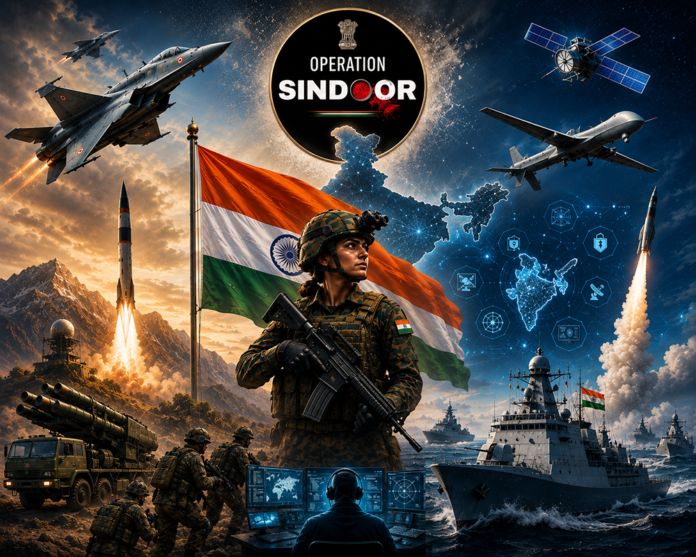
more than a year after the guns fell silent following Operation Sindoor, India and Pakistan are apparently talking again. London, Muscat, Bangkok, Doha, and now reportedly Colombo, a quiet circuit of Track 1.5 and Track 2 meetings has been steadily unfolding in the margins of international conference rooms. Retired officials, former diplomats, strategic experts, and military officers from both sides have been meeting, conversing, and, presumably, sounding each other out.
The question that sections of India’s strategic establishment are now asking, with growing urgency, is a deceptively simple one: to what end?

The answer, if the sceptics within the Indian security community are to be believed, is deeply unflattering, at least from New Delhi’s perspective. The core of their argument is not that dialogue is inherently wrong. It is that the current process of engagement is strategically asymmetric in ways that disproportionately serve Pakistan’s interests while asking nothing of Islamabad that it is either willing or able to deliver.
Pakistan’s calculus is straightforward. Any movement towards normalisation offers Islamabad a package of tangible, immediate dividends: the revival of bilateral trade, a reduced military and economic burden from sustained confrontation, relief from diplomatic isolation, and potential leverage over long-suspended frameworks such as the Indus Waters Treaty. For a country whose economy has lurched from crisis to an IMF bailout with numbing regularity, restoring economic relations with India is not just a diplomatic nicety; it is a strategic lifeline.
Pakistan’s calculus is straightforward. Any movement towards normalisation offers Islamabad a package of tangible, immediate dividends: the revival of bilateral trade, a reduced military and economic burden from sustained confrontation, relief from diplomatic isolation, and potential leverage over long-suspended frameworks such as the Indus Waters Treaty
India, by contrast, seeks outcomes that are neither economic nor easily measurable. New Delhi’s demands are well known and unchanged, and have been at the centre of every engagement with Pakistan for decades now. India is pushing for the extradition of certain individuals such as Masood Azhar, Hafiz Saeed, and Dawood Ibrahim. India also seeks to break down terrorist infrastructure that is operating from Pakistani soil, as if that point never really moves. It wants a credible, irreversible end to cross-border terrorism. These are not peripheral demands; they are existential ones. And, they are the demands that Pakistan’s civilian government, even if well-intentioned, does not have the authority to fulfil, because the individuals in question are assets of an establishment that civilian structures in Islamabad have never fully controlled.
This is what one source quoted in recent reportage captured with uncommon precision: “India has many things it can offer, but what India actually wants, Pakistan is either unwilling or incapable of delivering.”

It is a formulation that deserves careful unpacking, because it reveals not merely a diplomatic impasse but a structural impossibility. India’s concessions, trade, water cooperation, connectivity, and normalisation are well within the authority of the Indian state to extend. Pakistan’s concessions – dismantling the Lashkar-e-Taiba network, handing over Masood Azhar, permanently shutting down the infrastructure of jihadist violence – lie beyond the reach of any Pakistani prime minister or foreign secretary who has ever sat across the table from their Indian counterparts. The asymmetry is not merely of interest. It is of agency.
The argument for talks is not without merit. During the most hostile phases of the Cold War, back-channel communications between the US and Russia were not premised on ideological convergence; they were premised on the shared interest in preventing miscalculation. Crisis management, not conflict resolution, is often the real function of informal diplomacy. Intelligence gathering is another
This is why the sceptics ask the question that cuts through the diplomatic pleasantries: “What has fundamentally changed?”

Nothing in the security environment along the border has materially improved. Pakistan’s official rhetoric towards India remains unchanged. The terrorist infrastructure that produced attacks from Mumbai in 2008 to Uri in 2016 to Pahalgam in 2025 has not been dismantled. If the conditions that made previous dialogue processes fruitless remain intact, on what basis does the current process claim a different prognosis?
There is, of course, a counterargument, and it is not without merit. Track 2 diplomacy has historically served purposes beyond the extraction of immediate concessions. During the most hostile phases of the Cold War, back-channel communications between Washington and Moscow were not premised on ideological convergence. They were premised on the shared interest in preventing miscalculation. Crisis management, not conflict resolution, is often the real function of informal diplomacy. Intelligence gathering is another. Understanding elite thinking, gauging internal debates, and identifying quiet shifts in adversary positions are all legitimate strategic activities that do not require any concession from either side.
When Marco Rubio announced that India and Pakistan had agreed to “start talks on a broad set of issues at a neutral site,” India immediately rejected that characterisation, saying that the ceasefire understanding between the Directors General of Military Operations was strictly military, confined to the cessation of hostilities, and that no deal existed on broader talks or even third-party mediation
The problem arises when the process itself becomes the product; when the act of talking is mistaken by participants, facilitators, or international observers for substantive progress. The May 2025 episode is instructive here. When the US Secretary of State, Marco Rubio, announced that India and Pakistan had agreed to “start talks on a broad set of issues at a neutral site,” New Delhi moved with unusual speed to publicly reject that characterisation. The government clarified that the ceasefire understanding between the Directors General of Military Operations was strictly military, confined to the cessation of hostilities, and that no agreement existed on broader talks or even third-party mediation.
India’s emphasis on that point was not diplomatic hair-splitting. It was a doctrinal stand. Since Shimla in 1972, India has consistently refused to internationalise the bilateral dispute. The fear among sceptics is that Track 2 activity, however informal, provides external actors and Pakistan with a narrative of ‘ongoing dialogue’ that can then be leveraged to generate international pressure for Indian concessions that were never part of any actual understanding.
The remarks of RSS General Secretary Dattatreya Hosabale, suggesting that India ‘should not close the doors’ for dialogue, add political texture to the debate. There is clearly a school of thought within India’s broader strategic-political establishment that believes engagement and deterrence are not mutually exclusive, that India can maintain military pressure while selectively communicating through informal channels. That is a defensible position. Engagement as a tool of signalling and information-gathering is not the same as engagement as a concession.
RSS General Secretary Dattatreya Hosabale’s remarks, suggesting that India ‘should not close the doors’ for dialogue, add political texture to the debate. There is a school of thought in India’s broader strategic-political establishment that believes engagement and deterrence are not mutually exclusive, that India can maintain military pressure while communicating through informal channels
But it requires discipline of a kind that has not always characterised Indian diplomacy with Pakistan. The risk is not that India talks. The risk is that the talking eventually creates its own momentum, that process generates pressure, pressure generates expectations, and expectations generate demands for concessions that India has not offered and should not offer in the absence of irreversible Pakistani action on terrorism.
India currently holds leverage. Operation Sindoor demonstrated both capability and resolve. The suspension of the Indus Waters Treaty imposed real costs. Pakistan needs normalisation more than India does. This is precisely the moment to hold terms, not to dilute them.
Dialogue, if it serves India’s intelligence or signalling requirements, need not be foreclosed. But it must not be allowed to become a substitute for the strategic clarity that the moment demands: no normalisation without accountability, no restoration without dismantlement of the terror network, and no peace process that rewards the infrastructure of war.

The writer is an expert on geopolitics, national security, and counter-terrorism; and he regularly contributes his subject thought-leadership and academic commentary with several publications in newspapers, journals, and periodicals. He works with investigative agencies, regulatory bodies, financial institutions and enterprises, providing strategic and regulatory advisory. The views expressed are personal and do not necessarily carry the views of Raksha Anirveda





