


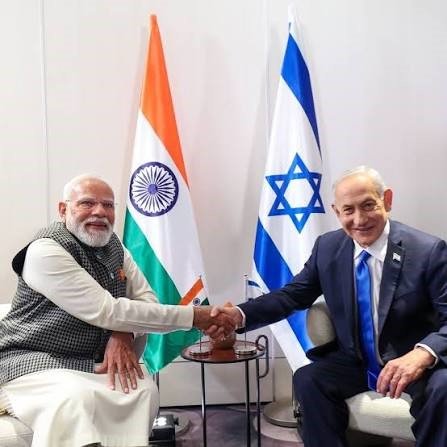
Speaking as the chief guest at the diplomatic reception in New Delhi, India’s Union Minister of State (MoS) for External Affairs, Kirti Vardhan Singh, extended warm greetings to the people and government of Israel. He praised Israel’s extraordinary resilience, determination, and technological innovation since its founding in 1948.
A Shared Stance Against Global Terrorism
The core focus of Singh’s address centered on the shared security challenges both democracies face, “India and Israel are united in their firm opposition to terrorism. Both our nations have suffered from this scourge, and we unequivocally condemn terrorism in all its forms and manifestations,” he said.

Minister Singh recalled the deep solidarity the people of India extended to Israel following the October 7, 2023 attacks. He also expressed profound appreciation for Israel’s reciprocal diplomatic support following the recent terrorist attack targeting civilians and security infrastructure in Pahalgam, Jammu & Kashmir. He stressed that combating global radicalism remains a “shared responsibility of all nations committed to democracy and the rule of law.”
Israel’s “Finest Hour” and Civilizational Commonalities
The reception, hosted by the Israeli Ambassador to India, Reuven Azar, brought together an influential gathering of political leaders, ambassadors, military attachés, and corporate investors.
The modern India-Israel framework is rapidly diversifying beyond its foundational military and defence architecture. Despite complex political undercurrents in West Asia, bilateral cooperation is now shifting seamlessly into critical infrastructure projects, including high-capacity manufacturing, port management, and communications logistics.
Additionally, the two nations are scaling water-management networks and semi-arid farming technologies across Indian agricultural states to drive agricultural innovation. Finally, future-focused collaborative research and development is expanding rapidly into emerging technologies, specifically targeting artificial intelligence hardware, quantum communication safeguards, and next-generation software development.

Reflecting on nearly three years of intense military, economic, and geopolitical trials since 2023, Ambassador Azar struck a tone of absolute defiance. He categorised the current period of immense pressure not as a point of weakness, but as an era of ultimate societal strength. “This is our finest hour,” Azar stated, pointing to how the country’s warriors are systematically dismantling regional threats while its citizens maintain a robust, innovation-driven domestic economy.
Ambassador Azar framed the relationship between New Delhi and Tel Aviv as a natural pairing of two ancient Asian civilisations undergoing simultaneous national and economic revivals:

- Democratic Resilience: Both nations have proven that democratic societies can sustain high-velocity economic growth while aggressively confronting hybrid security threats.
- Doctrinal Milestones: He noted that Prime Minister Narendra Modi’s high-profile bilateral visit to Israel in February 2026 served as a watershed moment that solidified the emotional and strategic connection between the two peoples.
Expanding Beyond Traditional Defense Architecture
While military equipment and technology transfer remain foundational pillars of the bilateral relationship, the modern India-Israel framework is rapidly diversifying. Despite complex political undercurrents in West Asia, bilateral cooperation is shifting seamlessly into:
- Critical Infrastructure: Joint ventures in high-capacity manufacturing, port management, and communications logistics.
- Agricultural Innovation: Scaling water-management networks and semi-arid farming technologies across Indian agricultural states.
- Emerging Technologies: Collaborative R&D in artificial intelligence hardware, quantum communication safeguards, and next-generation software development.
The event concluded with traditional symbols of cultural unity and hope. Guests were invited to write prayers and messages of peace to be placed inside a temporary replica of Jerusalem’s sacred Western Wall, highlighting a joint vision for long-term stability and security across both regions.






