


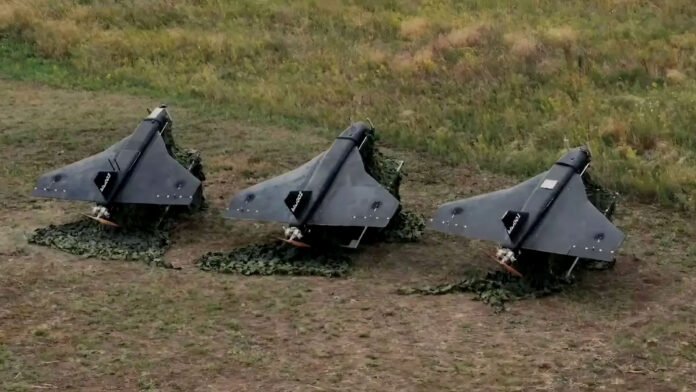
Tel Aviv: Russia has developed a decoy UAV, known as Gerbera, whose shape and signatures resemble those of the Geran, but is much cheaper, according to Dr Uzi Rubin, a former founder and director of the Israeli Arrow air defence project, in the Israeli Defence Minisry and an expert on missile defence systems.
In an analysis for the Jerusalem Institute for Strategy and Security (JISS), Rubin writes that Russia built a dedicated UAV production plant in Yelabuga, about 1,000 kilometres east of Moscow.

According to media sources, Russian production of Shahed-136 UAVs, known locally as Geran, now exceeds 5,000 units per month.
Uzi Rubin in his analysis mentions that Russia has also developed a decoy UAV, known as Gerbera, whose shape and signatures resemble those of the Geran, but is much cheaper. Russian strikes on the Ukrainian rear now come in waves of hundreds of these UAVs. A typical wave consists of roughly 60 percent attack UAVs and 40 percent decoys, and its purpose is not only to destroy Ukrainian infrastructure but also—and perhaps above all—to drain Ukraine’s stockpile of interceptor missiles.
These attacks inflict heavy damage on Ukrainian infrastructure and cause civilian casualties, but so far, they do not appear to have significantly weakened Ukraine’s combat capability or its will to resist. Russia nevertheless continues to launch massive UAV attacks on Ukrainian infrastructure, even though Ukraine usually manages to shoot down about 80 percent of them before impact, he pointed out.
The Russian attacks are illustrative of modern warfare: “Moscow is substituting cheap unmanned weapons in place of expensive cruise missiles and manned bombers, using them in massive quantities that nevertheless do not impose an unreasonable burden on the economy and also do not expose attacking personnel to risk.”

According to Rubin, Ukraine has responded to the Russian UAV threat with layered defences, from electronic warfare systems that interfere with navigation to ground-based and airborne interception. In the electronic-warfare sphere, the contest is continuous: one side tries to harden UAV systems against disruption, while the other develops more sophisticated means of jamming them. Interception proved to be a more complicated problem.
“Ukraine first tried to use fighter aircraft armed with air-to-air missiles to destroy Russian UAVs in flight, but the economics quickly proved unfavourable. An air-to-air missile can cost hundreds of thousands of dollars, while a Russian UAV costs only tens of thousands. Ukraine also faced the problem of “magazine depth”—the number of air-to-air missiles still available in storage. Production of such missiles is too slow to sustain the interception of hundreds of Russian UAVs every night, and stocks eventually run down. The method also exposed the intercepting aircraft to the debris of the UAV it destroyed. In at least one known case, a Ukrainian fighter jet successfully intercepted a Russian UAV, but debris struck the aircraft and killed the pilot,” elaborated Rubin in his analysis.


-The writer is an Israel-based freelance journalist. The views expressed are of the writer and do not necessarily reflect the views of Raksha Anirveda





