


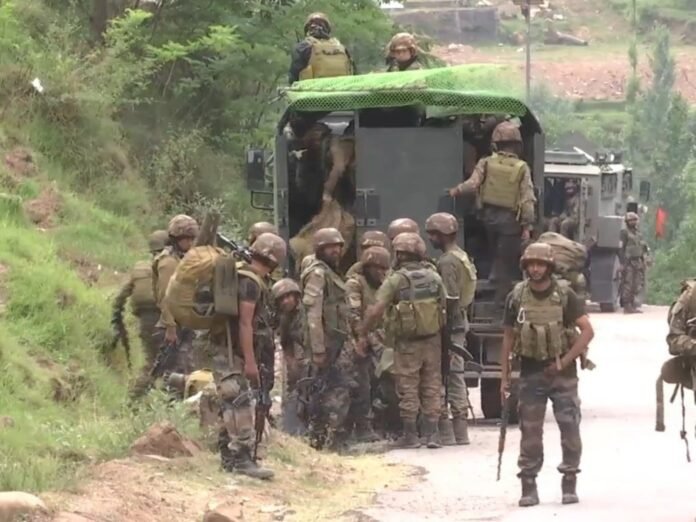
As of July 1, 2026 Operation Sheruwali entered its 40th day, with security forces continuing an extensive search operation in the forested areas of Dorimal in the Gambir Mughlan area of the Manjakote sector of Rajouri district.
The Siege of Dorimal
In the arithmetic of counter-terrorism, forty days is not a footnote. It is a statement. Somewhere in that dense, unforgiving belt of the Pir Panjal, a small number of militants have managed to do what large insurgent formations rarely achieve anymore in Jammu and Kashmir: they have forced the state’s security apparatus to work for every square kilometre, day after day, for nearly six weeks.

The operation’s origins are instructive. It did not begin as a routine combing exercise but as a response to hard contact. The cordon and search operation jointly launched by the Indian Army, Jammu and Kashmir Police, and the Central Reserve Police Force in the forest areas of Gambhir Mughlan and Dorimal was launched following specific intelligence inputs regarding the presence of suspected terrorists hiding in the area.
Within days, that combing operation turned into something closer to a siege. Heavy firing and shelling erupted in the dense terrain as security forces tightened their cordon around the trapped militants, prompting a massive deployment of security forces, along with additional reinforcements and logistical support, to ensure a strong and impenetrable cordon.
That the operation has now stretched from an intense early engagement into a month-plus war of attrition tells us something about both the terrain and the adversary.
Anatomy of a 40-Day Standoff
Prolonged operations of this kind are the exception, not the rule, in J&K’s contemporary counter-terrorism landscape. When such operations do stretch on, three things are usually true.

Operation Sheruwali trades rapid frontal assaults for a deliberate containment doctrine. By prioritising area domination and the slow exhaustion of militant logistics, security forces accept an extended timeline to minimise personnel casualties and extract deeper operational intelligence
First, security forces are pursuing a small, mobile group rather than a large static formation, an adversary that can be cordoned but not always caught.
Second, the terrain itself is doing work for the militants: the Dorimal-Gambhir Mughlan forest belt offers concealment, multiple escape routes, and the kind of vertical, wooded terrain that neutralises the technological and numerical advantages security forces typically enjoy.

Third, and most tellingly, intelligence continues to place the militants within the cordon, which is precisely why the operation has not been declared over. Forces are not searching blindly; they are maintaining pressure on a target they believe remains inside the net.
This is the strategic signature of the Rajouri-Poonch belt since 2021, a resurgence built not on large infiltrating columns but on small, resilient cells operating with local familiarity and cross-border facilitation.
Unlike the historically urban militancy of the Kashmir Valley, this is forest warfare: survival-oriented, patient, and designed to exhaust the state’s will rather than confront its strength.
Forest Warfare: A New Strategic Signature
What is notable about Operation Sheruwali is what it is not.
It is not really a rapid, high-casualty frontal assault, more like a pattern that has emerged, area domination, denial of movement corridors, sustained surveillance, and then this slow exhaustion of militant logistics, all of it reads as a deliberate containment doctrine.
The Rajouri standoff does not exist in a vacuum. As top police brass review border security in neighboring Poonch and forces conduct extensive Amarnath Yatra mock drills, the state is actively demonstrating its multi-agency bandwidth to handle simultaneous, complex security fronts
This strategy trades speed for control, it accepts a longer timeline in exchange for fewer casualties among security personnel and tighter operational discipline. It also signals that whoever is inside that cordon is considered operationally significant enough to justify six weeks of sustained deployment, possibly connected to prior attacks, or to a broader infiltration network that security agencies are keen to untangle rather than just neutralise.
Poonch, the Border, and the Wider Picture
Operation Sheruwali has not unfolded in isolation. In the middle of the operations’ extended run, the Inspector General of Police made a visit to the Poonch district, to look over the security scenario and chair a discussion on counter terrorism measures, border security, intelligence collection, and inter agency coordination, all part of the usual language a force uses when it wants to stay ahead of infiltration rather than only reply to it.
That such a review coincided with an active, unresolved operation next door in Rajouri is unlikely to be incidental. The Jammu frontier, Rajouri and Poonch together, has become the theatre where India’s internal security establishment is testing its ability to sustain pressure across an entire border belt, not just at the site of contact.
Layered onto this is the Amarnath Yatra. Security forces have, in tandem, carried out extensive mock drills… simulating terrorist strikes, hostage scenarios, convoy protection, and quick reaction runs along the pilgrimage’s key routes and transit points.
While J&K is not returning to peak insurgency levels, the current challenge is far more demanding. Operation Sheruwali serves as a stark reminder that patience and terrain remain potent equalisers, forcing India to adopt sustained, unglamorous containment strategies
The fact that the state can keep a 40-day cordon-and-search operation going in one district while rehearsing large-scale pilgrimage security in another, is in itself a bandwidth proof, i.e. multi-agency coordination among the Army, J&K Police, CRPF, SOG and intelligence agencies working on more than one front, simultaneously.
The Long, Quiet War
None of this suggests J&K is returning to the peak insurgency years. It suggests something more durable and, in some ways, more demanding: a security challenge that has evolved rather than disappeared.
The adversary is smaller, more dispersed, and harder to finish decisively, but also harder to dismiss. Operation Sheruwali’s forty days are a reminder that terrain and patience remain potent equalisers even against a vastly better-resourced state, and that sustained, intelligence-led containment, however unglamorous compared to a swift encounter, is likely to remain the primary instrument through which India manages the Rajouri-Poonch belt for the foreseeable future.
The story of Operation Sheruwali, then, is not simply about a search operation in a forest. It is about what a resilient, adaptive militancy in the Jammu region now looks like, and about a security establishment recalibrating itself to fight a longer, quieter war.

The writer is an expert on geopolitics, national security, and counter-terrorism; and he regularly contributes his subject thought-leadership and academic commentary with several publications in newspapers, journals, and periodicals. He works with investigative agencies, regulatory bodies, financial institutions and enterprises, providing strategic and regulatory advisory. The views expressed are personal and do not necessarily carry the views of Raksha Anirveda





