


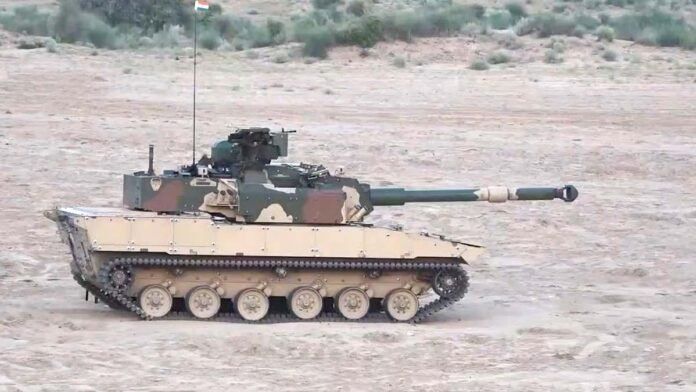
New Delhi. India’s indigenous light tank programme is entering a decisive phase as Larsen & Toubro (L&T) and DRDO push their Zorawar prototypes into advanced user trials while TATA Advanced Systems and Mahindra Defence fast-track rival models.
The competition has intensified with the Ministry of Defence (MoD) signalling plans for a wider acquisition that could exceed the initial order of 59 tanks earmarked under Zorawar Phase I.

L&T’s Zorawar, jointly developed with DRDO’s CVRDE and designed for high-altitude warfare, is undergoing endurance and mobility testing in Ladakh-like simulated terrains. The second prototype introduces refined suspension geometry, improved amphibious sealing systems, and optimised weight distribution to enhance performance above 16,000 feet.
Equipped with a 105 mm gun, integrated ATGM launcher, and modular protection suite, the Zorawar is also being evaluated with an indigenous power pack as a replacement for the imported Cummins–Allison engine-transmission combination.
TATA Advanced Systems is working on a lighter modular chassis designed to meet both Himalayan and amphibious operational requirements. Its design emphasises high mobility, digital battle management, and composite armour integration, with scope for drone-assisted target acquisition.
Meanwhile, Mahindra Defence’s contender is focused on incorporating an active protection system (APS) compatible with both kinetic and top-attack anti-tank munitions. Mahindra is reportedly partnering with foreign OEMs for sensor-fusion and soft-kill technologies to meet the Army’s next-generation survivability goals.

The Army’s key evaluation metrics include low ground pressure for snow operations, rapid air transportability by C-17 and C-130J aircraft, and long-range precision engagement using ATGMs.
The tanks are also expected to maintain amphibious capability for Eastern theatre deployment. These requirements mirror the shift in operational doctrine towards agile, dispersed manoeuvre formations capable of confronting both northern and eastern threats.

The indigenous power-pack effort, led by DRDO’s Engine Research & Development Establishment (ERDE) and private partners, aims to deliver a 750–1000 hp class compact unit optimised for cold-start reliability and high-altitude torque.
PTC Industries’ involvement in critical casting and machining of single-crystal turbine blades indicates a maturing domestic supply chain geared toward high-performance armour mobility systems.
The MoD’s “competitive trial” model could see dual-induction where both Zorawar and a private-developed variant enter limited production before full-scale induction. This approach encourages innovation, diversifies supply sources, and aligns with India’s Aatmanirbhar Bharat thrust in defence manufacturing.






