


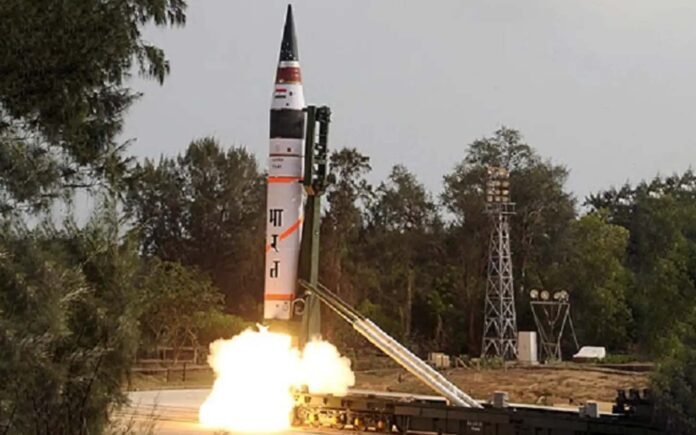
New Delhi: India is developing a powerful conventional bunker-buster missile based on its Agni-V ballistic missile platform, which weighs about 7,500 kg and is designed to penetrate deeply fortified underground targets up to 80 to 100 meters beneath the surface. Unlike the nuclear version of the Agni-V, this missile carries a massive conventional warhead intended to neutralise hardened enemy command centres, missile silos, and other strategic military assets concealed deep underground.
This missile reportedly has a reduced range of about 2,500 km due to the heavy payload, but offers significant destructive power and comes in two variants: one detonating above ground for surface targets, and another functioning as a deep earth penetrator similar to the American GBU-57 Massive Ordnance Penetrator.

This missile is seen by Indian defence experts as a tool for strategic deterrence that can pre-emptively disable critical enemy infrastructure without crossing the nuclear threshold, thereby providing a conventional option to counter regional threats. Its deployment would mark India’s acquisition of one of the world’s most powerful conventional bunker-busting ballistic missiles, capable of quickly striking heavily protected underground facilities with precision and surprise.
However, the development of this missile has caused alarm in Pakistan. Rabia Akhtar, a prominent Pakistani strategic affairs expert and Dean of the Faculty of Social Sciences at the University of Lahore, warned that such a weapon introduces a dangerous ambiguity between conventional and nuclear warfare doctrines. Because the missile is launched from a platform traditionally associated with nuclear weapons, Pakistan’s early-warning systems might not distinguish a conventional Agni missile from a nuclear one. This uncertainty could provoke an inadvertent nuclear escalation during a crisis, as Pakistan may interpret a conventional strike on strategic targets—especially nuclear command posts or storage bunkers—as a nuclear first strike.
Akhtar argues this development upends South Asia’s fragile strategic stability by blurring the lines of conflict escalation and undermining the confidence of nuclear deterrence. Despite India’s declared No First Use (NFU) nuclear policy, the strike’s target and delivery mode contribute more to perceived intent than warhead type. Conventional missile attacks on nuclear sites risk triggering rapid and uncontrollable escalation cycles, which Pakistan fears could lead to devastating retaliation or wider conflict.
Additionally, this Indian initiative appears inspired partly by recent US military operations in June 2025, where bunker-busting munitions were used against Iranian underground nuclear facilities. The US demonstrated how advanced conventional strike capabilities can significantly degrade nuclear infrastructure, prompting India to develop a missile with similar operational effects to maintain strategic advantage in the region.

In response, Pakistan perceives these developments not only as a threat to its strategic deterrent but as an invitation to a destabilising arms race. Akhtar contends that Pakistan may be compelled to enhance its nuclear forces’ survivability, disperse its assets more widely, or adopt lower nuclear thresholds, all of which exacerbate regional insecurity. She advocates for Pakistan to study historical deterrence doctrines prudently and pursue diplomatic and technological measures to mitigate the risks posed by India’s evolving missile capabilities.
India’s 7,500-kg conventional Agni-V bunker-buster missile represents a significant leap in its conventional strike capability with the potential to neutralize deeply buried strategic targets. Nonetheless, it introduces serious risks of miscalculation and escalation in South Asia by blurring conventional and nuclear boundaries, a concern voiced strongly by Pakistani experts like Rabia Akhtar who fear that “nothing’s safe anymore” in the region’s security landscape.







