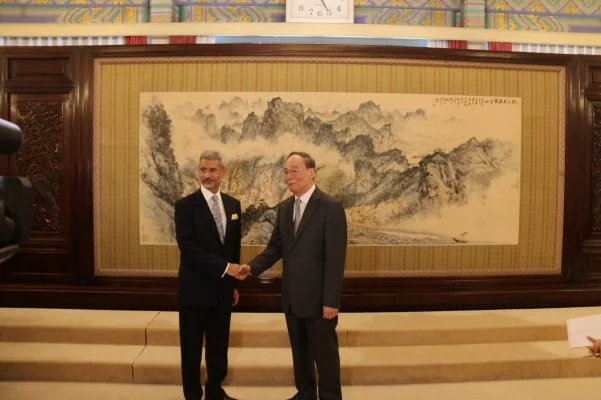
New Delhi: Taking a tough line on the Sino-Indian border faceoff, External Affairs Minister S Jaishankar told his Chinese counterpart Wang Yi that India would not de-escalate until there is a complete and verifiable disengagement at all points on the Line of Actual Control (LAC).
During the talks in Moscow, some of which got a little heated, Jaishankar laid out India’s bottomlines — first, that the overall India-China relationship would suffer if there was no peace on the border.

Second, the “root cause” of the current crisis lay in the fact that it was Chinese forces which breached existing agreements with their massive build-up in April and May and transgressions that forced India to mirror positions and deployments.
According to highly placed sources, the Indian mantra on the LAC would be “verifying” Chinese disengagement promises. In recent weeks, Chinese troops have repeatedly gone back on their commitments.
Interestingly, the Chinese readout of the meeting has Jaishankar saying that, “the Indian side did not consider the development of India-China relations to be dependent on the settlement of the boundary question and India does not want to go backwards.” Indian officials at the meeting said, India had emphasised that the relationship was dependent on a peaceful border. The Chinese side has been pushing the idea that the overall relationship can be insulated from the boundary crisis.
In Moscow, Wang Yi was quoted as saying India and China had reached a “consensus”, and were willing to “meet each other halfway”.

Indian sources said Jaishankar told Wang Yi the recent incidents in eastern Ladakh had impacted the development of the bilateral relationship. An urgent resolution was in everyone’s interest.
India’s actions over the past few months — taking aim at Chinese apps, technology, investments and projects and visas, India has signalled clearly that the overall relationship would be deeply impacted by the goings-on at the LAC.

In his interventions, Jaishankar stressed that since 1981 India-China relations had been on a “positive trajectory” but that maintenance of peace and tranquility on the border areas was essential to the forward development of ties.
The Indian side pressed the Chinese on why they had amassed troops and equipment along the LAC in April and May, but did not receive a credible explanation. This was a direct contravention of the 1993 and 1996 agreements, exacerbated by “provocative” behaviour of Chinese troops, leading to the Galwan clash of June 15.
This has bred suspicion among Indian policymakers that the Chinese were not to be taken at their word. The Indian side believes the Chinese may well repeat this behaviour even after an agreement on disengagement so New Delhi will carefully monitor coming actions.
Jaishankar also conveyed that India wanted a return to status quo — which meant troops had to go back to their permanent posts. But how this process was to be achieved in phases (the deployments are so large it will take weeks), would be determined by the military leaderships.
But the immediate task is to make sure the disengagement is comprehensive and verifiable, sources said. “That is necessary to prevent any untoward incident in the future. The final disposition of the troop deployment to their permanent posts and the phasing of the process is to be worked out by the military commanders.”