


New Delhi: The Quad foreign ministers’ meeting here marked a decisive evolution in the grouping’s role, shifting from dialogue to operational cooperation.
The ministers unveiled five major initiatives designed to strengthen collective action across maritime surveillance, port infrastructure, energy security, critical minerals, and regional maritime coordination. This comprehensive push reflects the Quad’s determination to address shared strategic priorities in the Indo-Pacific region.

The first initiative focused on maritime surveillance and domain awareness. The United States announced the Indo-Pacific Maritime Surveillance Cooperation programme, which will integrate surveillance capabilities of Quad members and enhance real-time information sharing. This builds upon the existing Indo-Pacific Maritime Domain Awareness initiative, which provides near real-time commercial maritime tracking data to regional countries.
Secretary of State Marco Rubio emphasised the strategic importance of maritime security, noting that sixty per cent of global maritime trade passes through the Indo-Pacific, making it a vital interest for dozens of nations.
The second initiative centred on port infrastructure cooperation. The Quad launched the “Ports of the Future” partnership, aimed at strengthening port infrastructure across the Indo-Pacific.
Australian Foreign Minister Penny Wong highlighted that the partnership includes a pilot project in Fiji, marking the first time Quad partners will jointly undertake a port infrastructure projects.

Marco Rubio added that the initiative is expected to be highly successful. India will also host the next Quad-at-Sea Mission, bringing together the coast guards of the four countries for coordinated maritime operations.
Energy security formed the third pillar of the Quad’s new agenda. A dedicated Indo-Pacific energy security initiative was announced to bolster resilience in fuel and energy supply chains. The framework will encompass technology cooperation, policy alignment, market analysis, and emergency response exercises.

Rubio confirmed that the initiative will be detailed further through a standalone statement and a fuel security forum hosted by the US Department of Energy later this year. Wong stressed that recent disruptions, such as the Iranian closure of the Strait of Hormuz, underscored the need for coordinated action to safeguard energy security and freedom of navigation.
The fourth initiative addressed critical minerals and supply chains. Japanese Foreign Minister Toshimitsu Motegi flagged vulnerabilities in supply chains, particularly concerning critical minerals essential for advanced manufacturing and defence technologies. He noted that global conditions necessitate stronger cooperation on economic security, urging resilience-building measures against export restrictions and supply disruptions.
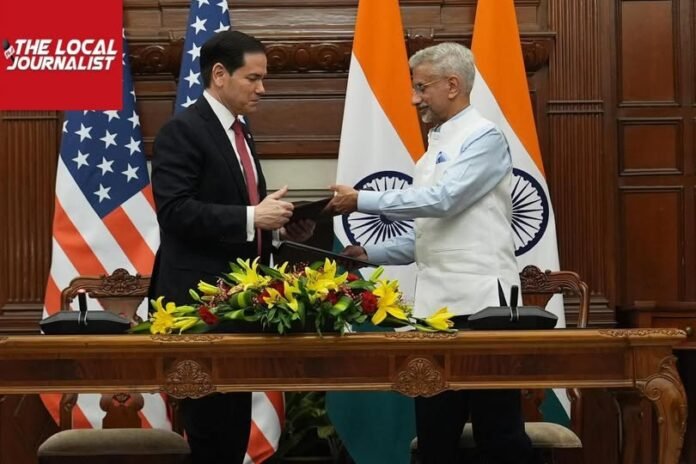
India and the United States signed an agreement on cooperation in critical minerals and rare earths, a step towards strengthening supply chain resilience in strategic sectors.
The fifth initiative reaffirmed the Quad’s commitment to maritime security and Indo-Pacific stability. External Affairs Minister S Jaishankar underscored the value of exchanging perspectives among four maritime democracies located at different ends of the Indo-Pacific. He highlighted expanding cooperation across maritime surveillance, logistics networks, undersea cables, capacity building, and humanitarian assistance. The ministers reaffirmed the importance of safe and unimpeded maritime commerce and adherence to international law.
Australian Foreign Minister Penny Wong described the Quad as a platform for action, emphasising alignment among four sovereign nations with a shared vision for a free and open Indo-Pacific. She stressed the importance of ensuring regional countries retain freedom of choice in security and sovereignty decisions. Wong noted that Quad cooperation has already delivered results in disaster response, maritime security, critical infrastructure, and undersea cables, demonstrating the grouping’s capacity to produce tangible outcomes.
The meeting took place against a backdrop of heightened geopolitical uncertainty, with tensions across key maritime chokepoints and concerns over concentrated supply chains. Officials stated that the initiatives announced in New Delhi are intended to convert Quad coordination into structured, operational cooperation, particularly in maritime security, energy resilience, and critical technologies.
This marks a significant step in the Quad’s evolution from a consultative forum to a mechanism for coordinated strategic action.






