


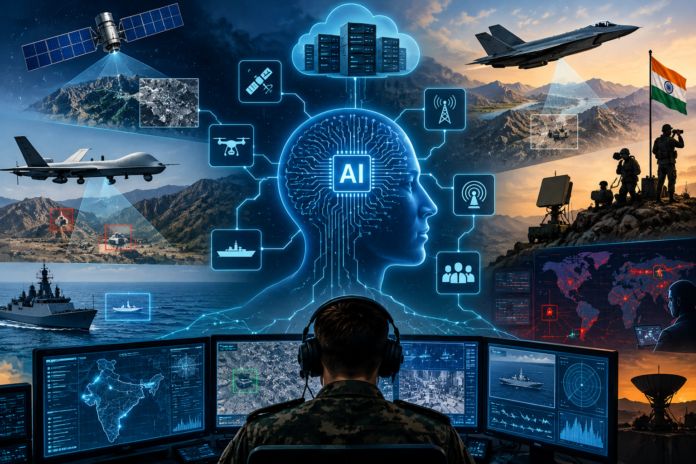
Information scarcity no longer constrains the modern battlefield. Instead, today’s defence forces face the opposite challenge — an overwhelming abundance of data generated by satellites, unmanned aerial systems, radar networks, electro-optical sensors, communication intercepts, cyber monitoring platforms, and field personnel. Every mission produces an unprecedented volume of information, yet operational success increasingly depends not on collecting more data, but on identifying the one critical signal that demands immediate action.
Industry Shift: Defence model data analysis by humans to analysis by AI
This shift marks a defining moment in the evolution of defence intelligence. Artificial Intelligence (AI) is no longer simply automating surveillance; it is transforming fragmented streams of information into timely, contextual, and actionable intelligence that enhances decision-making across the operational spectrum.

Traditionally, surveillance systems were designed to observe. Cameras recorded footage, sensors generated alerts, and analysts manually pieced together disparate information to build an operational picture. While effective in simpler environments, these approaches struggle to keep pace with the speed, complexity, and scale of modern security challenges. Today’s multi-domain operations require military leaders to interpret vast quantities of data in real time while making critical decisions under immense pressure.
Rather than replacing human judgement, AI acts as an intelligent force multiplier — continuously processing information, identifying anomalies, recognising behavioural patterns, correlating events across multiple sources, and highlighting developments that require immediate human attention. This enables commanders to focus their expertise where it matters most: making informed operational decisions
Surveillance to Situational Understanding: AI detecting threats to reducing cognitive overload
The true value of AI lies in its ability to reduce this cognitive burden. Rather than replacing human judgement, AI acts as an intelligent force multiplier — continuously processing information, identifying anomalies, recognising behavioural patterns, correlating events across multiple sources, and highlighting only those developments that require immediate human attention. This enables commanders to focus their expertise where it matters most: making informed operational decisions.
AI as Decision Support
Situational awareness has consequently evolved beyond simply knowing what is happening. It now involves understanding why events are occurring, how they are connected, and what they are likely to mean for mission outcomes. AI enables this transition by fusing data from diverse sensors into a coherent operational picture, allowing commanders to move from reactive responses towards proactive decision-making.
AI’s contribution extends beyond accelerating existing processes. It enables a fundamental shift from event detection to predictive intelligence. Instead of merely reporting that an incident has occurred, AI systems can recognise emerging behavioural indicators, identify abnormal movement patterns, detect deviations from established operational baselines, and anticipate potential threats before they fully materialise
This capability is becoming increasingly important as defence operations grow more interconnected. Border security, critical infrastructure protection, counter-terrorism, maritime surveillance, disaster response, and military operations all depend upon the rapid interpretation of information originating from multiple domains. Individually, these systems provide valuable observations. Collectively, when analysed through AI, they become a unified intelligence ecosystem capable of identifying subtle patterns that would otherwise remain hidden.

Predictive Intelligence
Importantly, AI’s contribution extends beyond accelerating existing processes. It enables a fundamental shift from event detection to predictive intelligence. Instead of merely reporting that an incident has occurred, AI systems can recognise emerging behavioural indicators, identify abnormal movement patterns, detect deviations from established operational baselines, and anticipate potential threats before they fully materialise. Such predictive capabilities provide valuable time for commanders to assess options, deploy resources effectively, and reduce operational risk.
Human + AI
Equally significant is AI’s role in enhancing force protection. Many reconnaissance, surveillance, and verification activities traditionally required personnel to operate in hazardous environments. Intelligent autonomous systems, supported by edge computing and resilient communications, now enable continuous monitoring of sensitive locations while reducing unnecessary human exposure. Human operators remain firmly in command, but increasingly rely on AI to extend their operational reach and improve response speed.

As AI becomes deeply integrated into defence operations, technological advancement must be accompanied by responsible implementation. Trust, transparency, cybersecurity, data integrity, and human oversight must remain central to every AI-enabled defence ecosystem. Military decisions should always remain under human authority. AI should enhance professional military judgement — not replace it
However, as AI becomes more deeply integrated into defence operations, technological advancement must be accompanied by responsible implementation. Trust, transparency, cybersecurity, data integrity, and human oversight must remain central to every AI-enabled defence ecosystem. Military decisions carry profound consequences and should always remain under human authority. AI should enhance professional military judgement — not replace it.
The future
Future defence capabilities will therefore be defined not solely by advances in autonomous platforms or increasingly sophisticated sensors, but by the ability to transform dispersed information into trusted operational intelligence. Nations capable of integrating AI responsibly across command, surveillance, logistics, and intelligence functions will strengthen decision superiority while maintaining accountability and operational resilience.
In an era where information travels faster than before, every signal carries potential operational significance. The challenge is no longer capturing more information; it is recognising which signal matters first. Artificial Intelligence is reshaping defence intelligence by enabling that distinction — turning complexity into clarity, accelerating informed decision-making, and helping military leaders maintain strategic advantage in an increasingly dynamic security environment.
As defence ecosystems continue to evolve, the greatest competitive advantage will belong not to those with the most sensors, but to those who can convert information into intelligence faster, more accurately, and with greater confidence. Ultimately, every signal counts — but only when it leads to better decisions.

The writer is the Chief Executive Officer of Blue Cloud Softech Solutions Limited. The views expressed are personal and do not necessarily carry the views of Raksha Anirveda





