


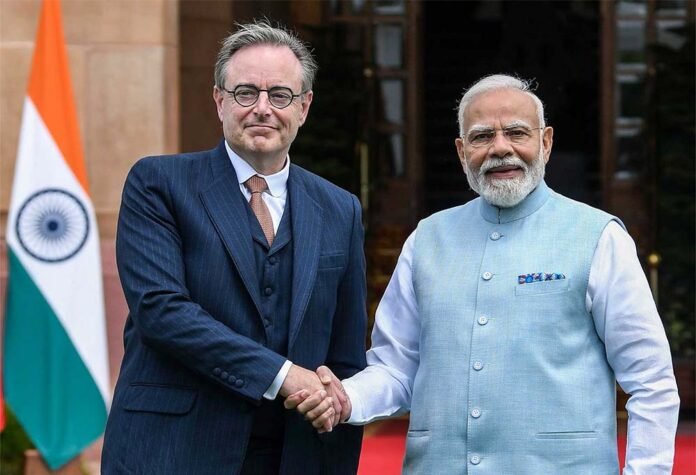
India and Belgium have signed 10 defence-industrial agreements covering ammunition production, rocket assembly, naval mine-countermeasure systems, counter-drone technology, electro-optics and armoured-vehicle systems. The agreements were concluded in New Delhi on September 3 during Belgian Prime Minister Bart De Wever’s visit, with Defence and Foreign Trade Minister Theo Francken and representatives of 15 Belgian defence companies accompanying the Belgian PM.
The agreement is significant because it goes beyond conventional arms sales. Instead of positioning Belgium only as a technology supplier and India as a buyer, the agreements create a framework for local manufacture, joint development, technology cooperation and possible access to export markets. That structure is closely aligned with India’s Make in India policy and its broader effort to build a self-reliant defence-industrial base.

Rockets, Ammunition and Production Depth
One of the most visible agreements involves Thales Belgium and Kalyani Strategic Systems. The companies will cooperate to assemble Thales Belgium’s 70mm rockets in India, with the first rocket produced entirely on Indian soil expected in early 2027.
The agreements seek to combine Belgian technology with India’s manufacturing scale
The arrangement has a dual advantage. India will gain domestic production capacity for a weapon system already associated with its armed forces, while Thales will acquire an additional manufacturing base for international orders. The rockets are used on Indian platforms including the Light Combat Helicopter Prachand and armed versions of the Dhruv helicopter.
The rocket agreement also illustrates the changing nature of defence supply chains. For India, local assembly can reduce dependence on overseas deliveries and create opportunities for Indian suppliers. For Belgium, the partnership offers access to India’s large defence market and its growing manufacturing ecosystem. The commercial logic is therefore as important as the military dimension.
The ammunition agreement is even more ambitious in industrial terms. Belgian machinery manufacturer New Lachaussée will supply Tembo Classic Engineering with a complete production line for two ammunition calibres, along with tooling for two additional calibres. The project is valued at approximately €50 million and is expected to create annual production capacity of around 100 million rounds. Equipment deliveries and installation are scheduled for 2028 and 2029.

Such capacity could support India’s armed forces while also strengthening its ability to maintain ammunition reserves during prolonged military contingencies. The project’s value, however, will depend on whether it includes meaningful local engineering, maintenance and upgrade capabilities rather than simply the import and installation of production equipment.
Maritime Security Becomes a Central Pillar
The most strategically consequential agreement may be the partnership between Exail Belgium and Larsen & Toubro. Exail will supply autonomous systems, described as “toolboxes”, for the detection, identification and neutralisation of naval mines.

Thales Belgium and Kalyani Strategic Systems will assemble 70mm rockets in India
L&T is bidding for India’s mine-countermeasure vessel programme, whose first phase involves 12 vessels. The requirement could eventually grow to as many as 59 ships. If the programme expands, the agreement could become one of the largest and most durable industrial partnerships emerging from the Belgian delegation’s visit.
Mine warfare is a specialised capability with direct relevance to India’s maritime security. Mines can threaten naval vessels, commercial shipping and access to ports, while their detection and removal expose sailors and divers to considerable danger. Autonomous mine-countermeasure systems can reduce that risk by using unmanned platforms, sensors and remote operations.
The partnership also fits Belgium’s expertise. Belgium and the Netherlands are cooperating with Exail on mine-countermeasure vessels, and Brussels has identified maritime security, underwater robotics, advanced sensors and protection of critical infrastructure as promising areas for future cooperation with India.
A €50-million production line could manufacture nearly 100 million rounds annually
For New Delhi, the partnership could help develop an indigenous ecosystem around underwater surveillance and autonomous maritime operations. It could also prove useful beyond naval warfare, particularly in monitoring ports, subsea cables, pipelines and other critical infrastructure.
A Broader Technology Portfolio
The agreements extend beyond rockets and mines. FN Herstal has signed an agreement with Kalyani Strategic Systems to explore a joint production centre in India. The proposed facility could manufacture FN weapons, integrated weapon systems and counter-drone systems.
Belgian company Sol.One and India’s DGVK Enterprises are also working to introduce the Saboteur armed quadplane and the Buzzkill and Hitchhiker drone interceptors to the Indian market. The armed forces have requested information on the systems and are expected to conduct trials. Larger orders would depend on operational performance and military requirements.
These agreements reflect the growing importance of unmanned systems in modern warfare. India’s armed forces are seeking affordable drones, loitering systems and counter-drone capabilities that can be deployed in large numbers. Belgium’s companies, meanwhile, are looking for partners capable of adapting their products to Indian requirements and producing them at scale.
The armoured-vehicle component is equally important. OIP Sensor Systems has signed an agreement with India Optel Limited on electro-optical systems for the Arjun main battle tank. OIP has previously supplied more than 130 sights for the Arjun Mk I and has developed a fire-control system for the Mk II capable of supporting laser-guided missile launches.
Exail and Larsen & Toubro will cooperate on autonomous naval mine-countermeasure systems
John Cockerill Defense and Larsen & Toubro have separately agreed on the supply of a turret for India’s Zorawar light tank, which is being developed for high-altitude operations. The arrangement could give the Belgian company a role in one of India’s important new armoured-vehicle programmes.
Political Reassurance and Strategic Calculations
Reportedly the industrial agreements were accompanied by a political assurance from Brussels. According to Indian defence and security sources, Belgium assured India that it would not provide Pakistan with military equipment or technology.
That assurance is politically important in New Delhi, particularly as India remains sensitive to defence cooperation between European countries and Pakistan. It also indicates that the bilateral relationship is being shaped by wider strategic calculations, not solely by commercial opportunity.
At the institutional level, India and Belgium signed a Letter of Intent covering structured military cooperation. It includes officer exchanges, training, research and development, seminars, joint exercises and maritime security. The two sides also plan to prepare an industrial roadmap for defence cooperation, while the Belgian Defence College is expected to organise a World Study Trip to India in 2027.
Brussels has assured New Delhi that it will not provide military equipment or technology to Pakistan
A separate agreement between the Belgian Security & Defence Industry and the Society of Indian Defence Manufacturers is designed to help companies participate in co-development and co-production under India’s ‘Make in India’ initiative. India’s defence ministry has also highlighted its liberalised foreign direct investment rules and defence industrial corridors as incentives for foreign companies.
What Comes Next
The 10 agreements represent a promising shift, but they are not all equivalent to firm acquisition contracts. Some are exploratory partnerships, while others depend on trials, production approvals, future tenders or the expansion of existing programmes.
The immediate benchmarks will be clear: whether the first Indian-made 70mm rocket is delivered in early 2027; whether the ammunition line is installed on schedule; whether Exail’s systems are selected for India’s mine-countermeasure vessels, and whether the drone and counter-drone platforms pass military evaluations.
The big question is whether the partnerships will generate durable Indian capability. Genuine technology transfer should include design knowledge, testing expertise, maintenance support and opportunities for Indian suppliers to move up the value chain.
Implementation, technology transfer and production timelines will determine whether the agreements become strategic assets
If implemented effectively, the agreements could give Belgium a stronger position in India’s defence market while helping New Delhi diversify its technology partnerships beyond traditional suppliers.
They could also link Indian production with global supply chains, making the relationship commercially valuable to both sides.
The agreements therefore matter less for their headline number than for the industrial model they represent.
India is seeking technology, local production and strategic autonomy. Belgium is seeking market access, contracts and a larger role in European and Indo-Pacific security.
The success of the partnership will depend on whether those objectives can be converted into working factories, tested systems and delivered military capability.






