


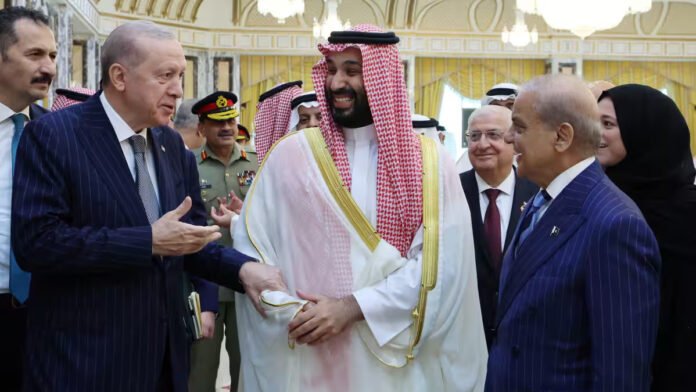
The Makkah Pact’s early significance lies less in the institutions it has already created than in the strategic questions it has raised. Is it a collective-defence arrangement, a platform for regional crisis management, an instrument of Saudi diplomacy or the beginning of a broader security architecture outside traditional Western alliances?
Russia has urged India not to rush to conclusions.

Speaking to Indian media ahead of Russian President Vladimir Putin’s visit to New Delhi for the 18th BRICS Summit, Kremlin press secretary Dmitry Peskov said the Makkah Pact was “new and yet to be developed”. He advised India to be patient before assessing the grouping’s future direction.
Peskov nevertheless described the agreement as a possible “key pillar of regional stability”. Russia, he said, would welcome the participation of important regional players, including Iran, if the pact made a genuine contribution to regional security.
The pact was announced by Saudi Arabia, Pakistan and Türkiye on August 7. Its central security provision reportedly treats an attack on one member as an attack on all, giving it the outline of a mutual-defence arrangement. The three countries have also discussed military coordination, counterterrorism, defence-industrial cooperation and stronger interoperability among their armed forces.
Ahead of Vladimir Putin’s visit to New Delhi for the 18th BRICS Summit, Kremlin spokesman Dmitry Peskov urged India not to jump to conclusions about the emerging trio. Describing the pact as “new and yet to be developed”, Peskov suggested it could become a key pillar of West Asian stability, particularly if expanded to include regional powers like Iran
The first institutional test came with the creation of a Strategic Political and Defence Committee. Its inaugural meeting in Istanbul was expected to bring together the foreign and defence ministers and military chiefs of the three countries. The committee’s tasks included establishing a secretariat, preparing an implementation roadmap and identifying areas for joint production, research and development.

These steps suggest that the Makkah Pact is not yet a fully operational alliance. It lacks the mature command structures, agreed force commitments and detailed response mechanisms associated with established collective-defence organisations. That is the context behind Peskov’s appeal for patience.
For India, however, the question is not merely whether the pact is institutionally ready. New Delhi must assess how it may affect the balance of power in the Gulf, South Asia and the wider Muslim world.

Saudi Arabia’s role is central. Riyadh appears to be using the pact to strengthen its strategic autonomy while preserving flexibility in its relationships with the United States, China, Russia, Pakistan, Türkiye and other regional powers.
Saudi Arabia’s core motivation is the pursuit of multi-alignment and enhanced bargaining leverage rather than an anti-Western pivot. By deepening defence-industrial ties and military coordination with Ankara and Islamabad, Riyadh strengthens its deterrence and strategic flexibility while preserving critical partnerships with Washington, Beijing and Moscow
The arrangement can serve several Saudi objectives simultaneously. It can improve deterrence, create alternative sources of defence equipment, strengthen political coordination and demonstrate that Riyadh is capable of shaping regional security rather than simply relying on external guarantees.
The pact also fits into Saudi Arabia’s broader strategy of diversification. Riyadh has sought to reduce excessive dependence on any single great power while maintaining its security relationship with Washington. It has strengthened ties with China, expanded engagement with Russia and pursued diplomatic accommodation with regional rivals, including Iran.
The Makkah Pact should therefore not automatically be interpreted as an anti-American alliance. Saudi Arabia may see it as an additional security instrument that increases its bargaining power. By widening its defence partnerships, Riyadh can seek better technology access, more favourable terms and greater room for manoeuvre during regional crises.
The inclusion of Türkiye is especially significant. Ankara is a NATO member but has also expanded its relations with Russia, China, the Gulf states and the wider Global South. Türkiye’s participation allows the pact to connect the Gulf with the eastern Mediterranean and the broader Muslim world. It also gives Ankara a platform to project influence beyond its immediate neighbourhood.
For India, an operational security pact bridging South Asia, Türkiye and the Gulf – especially one involving Pakistan – presents a complex balance-of-power challenge across the Arabian Sea. New Delhi must closely monitor whether the agreement develops formal military command structures or remains a consultative framework, all while protecting its own robust security ties with Saudi Arabia and Iran
Pakistan brings a different set of advantages. It has close military and political ties with Saudi Arabia and longstanding defence cooperation with Türkiye. Islamabad may gain from training, financial support, defence-industrial projects and a stronger diplomatic role in regional security. At the same time, its participation makes the pact particularly sensitive for India.
New Delhi will be watching whether the agreement develops into a formal military arrangement or remains a flexible consultative framework. An operational pact involving Pakistan, Türkiye and Saudi Arabia could complicate India’s strategic calculations. It could affect defence cooperation, military exercises, arms transfers and diplomatic alignments across the Arabian Sea and the Gulf.
Peskov’s remarks offered India reassurance without dismissing the pact. Russia appears interested in the possible inclusion of Iran, which could alter the grouping’s strategic character. If Tehran joins, the pact could become a rare platform bringing together countries with competing interests but shared concerns over instability, external intervention and regional security.
Iran’s participation, however, would be politically complicated. Saudi-Iranian relations have improved through diplomatic engagement, but distrust remains. Tehran’s inclusion could broaden the pact’s regional legitimacy while simultaneously making agreement on military and political priorities more difficult.
Russia’s push to bring Tehran into the fold could fundamentally alter the pact’s strategic character. While diplomatic accommodation between Saudi Arabia and Iran has improved, historical distrust remains high; integrating Tehran could boost the grouping’s regional legitimacy while simultaneously making consensus on joint military priorities vastly more difficult
Russia’s support for the participation of “important regional players” reflects Moscow’s broader interest in a multipolar security order. The Kremlin has sought to expand its diplomatic influence in West Asia and reduce the role of Western-led institutions. Yet, Russia has stopped short of defining the pact’s agenda, again suggesting that its final structure is still unclear.
Modi-Putin Meeting
Peskov’s comments also came as Putin prepared for a bilateral meeting with Prime Minister Narendra Modi before the BRICS Summit in New Delhi. The India-Russia agenda is expected to include defence, Su-57 fighter-jet cooperation, nuclear power, BrahMos missile production and the delayed delivery of S-400 systems.
The timing of Putin’s visit gives the Makkah Pact an additional diplomatic dimension. Russia is engaging India as a major BRICS power while also signalling openness to a wider West Asian security process. India, meanwhile, is attempting to maintain relations with Russia, Saudi Arabia, Iran, the United States and other competing partners without being drawn into rigid blocs.
China’s President Xi Jinping’s participation in the BRICS Summit adds another major variable. Beijing has expanded its political and economic presence in the Gulf and played a role in encouraging Saudi-Iranian diplomatic rapprochement. Xi’s presence in New Delhi would place the Makkah Pact within a wider discussion about changing global alignments, regional connectivity and the future of institutions dominated by the West.
For India, Xi’s participation may sharpen the diplomatic challenge. New Delhi and Beijing compete strategically across Asia, yet both are members of BRICS and major partners of Gulf states. India will want BRICS to remain focused on economic cooperation and development rather than becoming an overtly anti-Western political bloc.
The United States views the pact with quiet concern, wary of any emerging arrangement that could dilute American security influence in the Gulf or accelerate parallel regional structures. Ultimately, whether the Makkah Pact evolves into a cohesive security architecture or remains symbolic depends on the founding members’ ability to align their distinct national interests
Washington is watching these developments with concern. The United States has traditionally been the principal external security partner for Saudi Arabia and remains a major military power in the Gulf. A new defence pact involving Saudi Arabia, Pakistan and Türkiye could complicate US influence, especially if it expands to include Iran or develops independent military structures.
The deeper US concern is the possibility that the Makkah Pact, BRICS and other emerging groupings could gradually create parallel institutions for security, finance and diplomacy.
Washington is wary of any arrangement that weakens the dollar-based system, reduces reliance on US defence guarantees or strengthens Russia and China’s regional influence.
Yet, the pact’s future is not predetermined. Its success will depend on whether the three founding members can reconcile different priorities, establish clear procedures and convert political symbolism into practical cooperation.
For now, Peskov’s message is the most accurate assessment: the Makkah Pact is important, but unfinished. Its strategic meaning will emerge through membership decisions, institutional development and the choices Saudi Arabia makes as it balances deterrence, autonomy and diplomacy.

-The writer is a New Delhi-based senior commentator on international and strategic affairs, environmental issues, an interfaith practitioner, and a media consultant. The views expressed are personal and do not necessarily carry the views of Raksha Anirveda





