


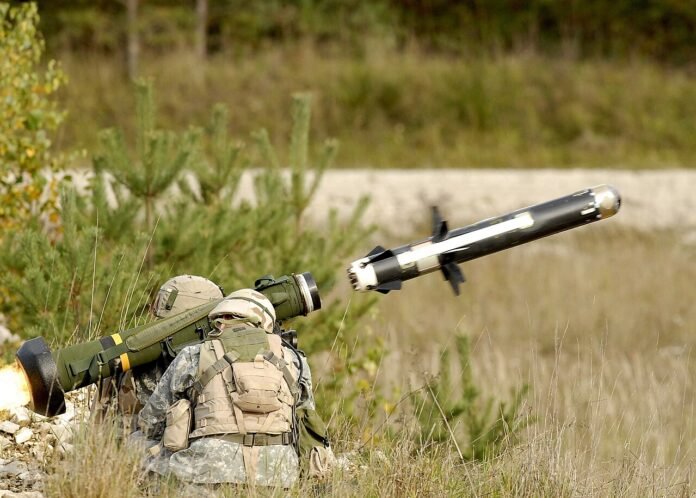
On August 28, 2026, India signed a Letter of Offer and Acceptance with Washington for the FGM-148 Javelin, the American fire-and-forget anti-tank missile that has become almost as famous for its battlefield record in Ukraine as for its price tag. The package, roughly 60 missile rounds and 25 lightweight command launch units, was fast-tracked under emergency procurement powers created after Operation Sindoor. Tata Advanced Systems has since agreed to explore final assembly of the Javelin round in India. On paper, this looks like progress: an urgent capability gap closed, an American defence relationship deepened, and a local company brought into a global supply chain. Look closer, and the deal tells an older, more uncomfortable story, one India has now lived through three times with three different missiles.
A Gap Two Decades in the Making
The Indian Army’s front-line anti-tank missiles, the Konkurs and the Milan-2T, are Soviet and French designs from the 1970s and 80s, wire-guided, short-ranged by modern standards, and steadily thinning from the inventory. The replacement was supposed to be indigenous. Instead, the record reads like a case study in how not to run a weapons programme. In 2010, India first explored the Javelin. In 2017, it walked away from a nearly finalised deal for the Israeli Spike, betting instead on DRDO’s Nag missile, only to have the Army flag technical shortcomings during trials. The government reopened talks with Israel in 2018, cancelled that too in 2019, and instead placed an emergency order for a limited batch of Spike-LR missiles to plug the hole, while promising the indigenous Man-Portable ATGM, or MPATGM, would be ready by 2021.

In 2010, India first explored the Javelin. In 2017, it walked away from a nearly finalised deal for the Israeli Spike, betting instead on DRDO’s Nag missile. The government reopened talks with Israel in 2018, cancelled that too in 2019, and instead placed an order for a limited batch of Spike-LR missiles to plug the hole
It was not. The Nag itself, cleared for induction as early as 2018 and again in 2023 according to DRDO, has continued to stumble in Army user trials as recently as this year, with reports of missiles failing to hit their targets and the NAMICA carrier underperforming. Each time DRDO said the technology had matured, the user observed fresh shortcomings. Thus, the look outside to meet the operational void. The Javelin deal is not a new chapter so much as the third rerun of the same plot.
What the Javelin Actually Brings
Credit where it belongs: the Javelin is a genuinely mature system. It uses an imaging infrared seeker with lock-on-before-launch guidance, so the gunner can fire and immediately duck for cover rather than steering the missile to the target under fire, the fatal weakness of wire-guided systems like Milan and Konkurs. Its top-attack mode strikes armour where protection is thinnest, on the roof, and its soft-launch design lets infantry fire from confined spaces such as buildings or trenches. It has been combat-tested extensively in Ukraine and earlier in Iraq and Afghanistan, which is more than can be said for any Indian system currently in the pipeline. For soldiers who have waited years for a reliable man-portable weapon, that operational maturity is not a small thing. But maturity bought off the shelf is not the same as capability built at home, and this is where the deal’s real weaknesses show.
The Nag was cleared for induction as early as 2018 and again in 2023, according to DRDO, but has continued to stumble in Army user trials as recently as this year, with reports of missiles failing to hit their targets and the NAMICA carrier underperforming. Each time DRDO said the technology had matured, the user observed fresh shortcomings
No Technology, Only Assembly
India’s interest in the Javelin stalled in the mid-2010s over exactly this issue: the United States was willing to sell the missile but not to transfer the underlying technology, particularly the seeker and propulsion know-how that make it a fire-and-forget weapon. Nothing in the 2026 deal changes that pattern. The Tata Advanced Systems arrangement covers final assembly and integration of the Javelin All Up Round, useful for jobs and for building a supply relationship with Lockheed Martin and RTX, but it does not confer design authority. India will screw together a missile it cannot redesign, cannot upgrade independently, and cannot produce without continued American sign-off on components and licences. That is a world away from the stated goal of Aatmanirbhar Bharat, self-reliance in defence manufacturing, which the government has spent a decade insisting is the organising principle of its procurement policy. An assembly line is not a drawing board.
The Multiple-Inventory Problem
There is also a quieter cost that rarely makes headlines: logistical fragmentation. The Indian infantry now operates, or is scheduled to operate, Milan-2T, Konkurs, a small tranche of Israeli Spike, and Javelin, alongside an MPATGM that DRDO insists is close to induction after a successful January 2026 test against a moving target with top-attack capability. Four or five distinct missile families mean four or five distinct training pipelines, spares chains, maintenance ecosystems, and ammunition stockpiles, each sourced from a different country with its own political weather. In a high-intensity conflict, that is not redundancy; it is fragility. A shortage of one missile type cannot be covered by a surplus of another, because none of them is interchangeable. Compare this to an army that standardises on a single indigenous family it can scale, modify, and resupply domestically under sanction or embargo. The strategic cost of India’s stop-start procurement becomes obvious.

The specifications DRDO claims for the MPATGM are in the same bracket as the imported options. The problem was never the paper capability of the Indian design. It has been the gap between what DRDO claims and what the missile does in front of Army evaluators on a firing range, a gap the Nag has now failed to close for the better part of two decades
How Javelin Stacks Up Globally
The Javelin is not competing in a vacuum. Every serious army in the world fields or is developing a third-generation man-portable or vehicle-mounted ATGM, and India’s own systems, both fielded and in trials, fall within that same category. The table below lists the major systems India has bought, considered, or built, so the Javelin’s real position becomes clear: a strong but unexceptional performer, surrounded by comparable or superior alternatives, several of which India has already walked away from once. An open-source comparative table is below:-
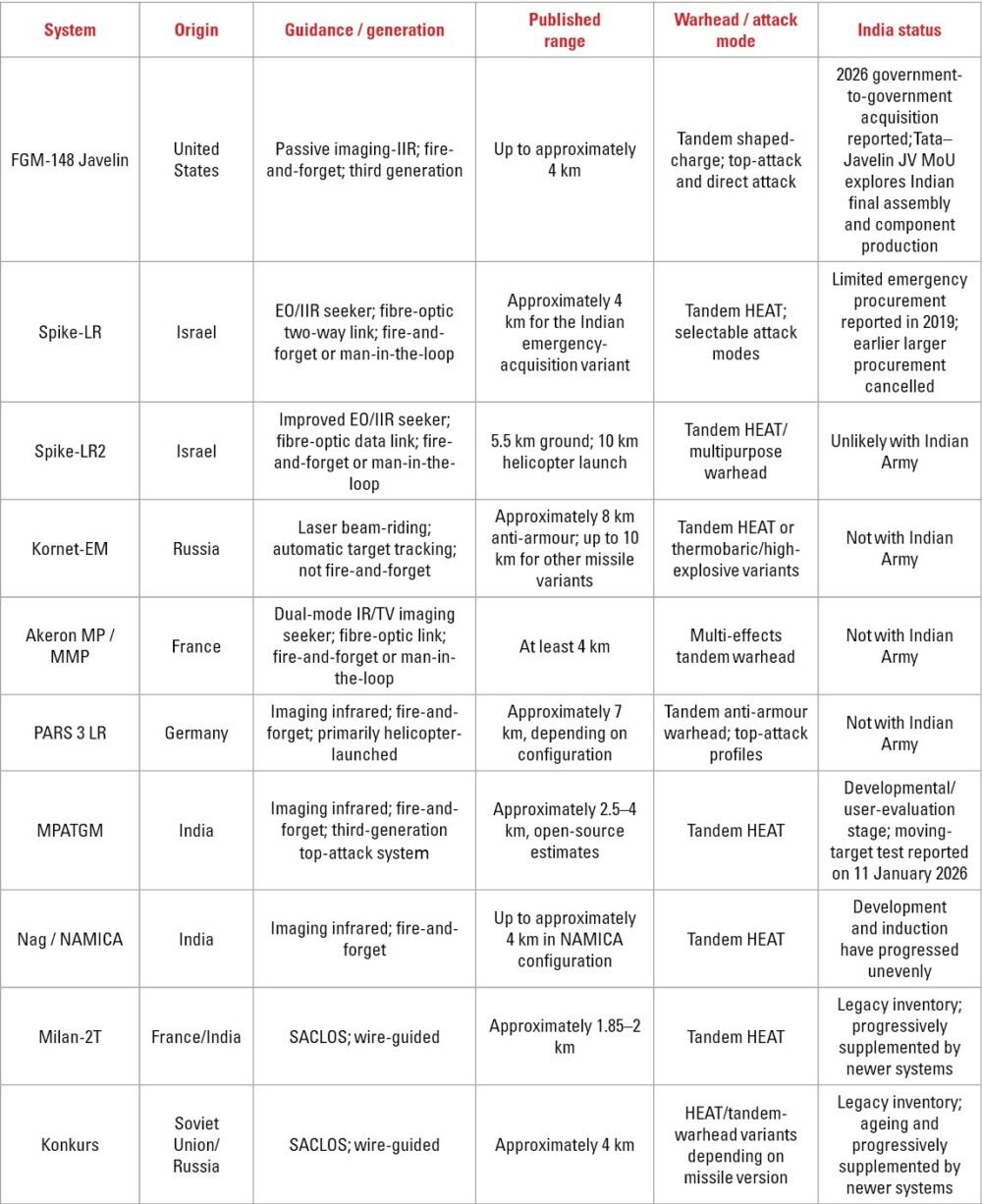

Two things stand out. First, on raw specifications, the Javelin is respectable but not dominant; Kornet-EM and PARS 3 LR both outrange it, and Spike-LR2 offers a flexibility- fibre-optic override alongside fire-and-forget- that Javelin does not. India picked Javelin primarily for its combat pedigree and the speed of the FMS route, not because it topped every technical column. Second, and more importantly for the argument above, the specifications DRDO claims for the MPATGM are already in the same bracket as the imported options. The problem was never the paper capability of the Indian design. It has been the gap between what DRDO claims in a press release and what the missile does in front of Army evaluators on a firing range, a gap the Nag has now failed to close for the better part of two decades.
Is Javelin the Best Option?
As an emergency purchase, yes, it plugs an immediate, real capability gap facing the infantry on contested borders, and its combat record justifies the confidence placed in it. As a strategic solution, no. It is the same pattern India followed with the Spike in 2019: buy a small foreign batch to bridge a gap, promise the indigenous system is nearly ready, then find the gap has not closed by the time the promise comes due. Defence analysts studying the MPATGM programme, including voices at India Today and elsewhere, have made the point plainly: DRDO’s system is, by specification, competitive with anything in the world, tandem warhead, top-attack mode, imaging infrared seeker included. What it lacks is not engineering but institutional discipline, in testing rigour, production scaling, and an Army willing to commit to a system through its teething troubles rather than reaching for an American or Israeli alternative at the first sign of trouble.
The Way Forward
First, freeze the shopping list. India should treat Javelin strictly as a stop-gap for specific high-threat sectors, not a long-term backbone, and resist the temptation to keep expanding the order once the emergency window closes.
India must freeze the shopping list and treat Javelin strictly as a stop-gap for specific high-threat sectors. Secondly, it should set a hard, publicly tracked deadline for MPATGM induction, with the Army and DRDO jointly accountable when trials slip. Also, India should insist that any future co-production arrangement, Javelin included, has a genuine technology-transfer clause
Second, set a hard, publicly tracked deadline for MPATGM induction, with the Army and DRDO jointly accountable rather than each blaming the other when trials slip.
Third, insist that any future co-production arrangement, Javelin included, include a genuine technology transfer clause covering seeker and propulsion systems, not merely a final assembly line; India, as one of the largest arms importers in the world, has the negotiating weight to demand this rather than accept assembly dressed up as partnership.
Fourth, consolidate the inventory: pick one or two missile families for the next generation and retire the rest on a fixed timeline, rather than layering a fifth system onto an already crowded arsenal.
Finally, fund DRDO and BDL for volume production, not just prototypes, because a missile that exists only in trial batches protects no one.
Sixth, give impetus to the private defence industry and academia to develop indigenous solutions for such critical technologies.
The Javelin will serve Indian soldiers well in the interim. But an army that keeps needing interim solutions has not solved its underlying problem; it has only postponed it. India does not lack the engineering talent to build its own missile. It lacks the patience to see the job through before reaching for someone else’s.

The writer, a PVSM, AVSM, VSM has had an illustrious career spanning nearly four decades. A distinguished Armoured Corps officer, he has served in various prestigious staff and command appointments including Commander Independent Armoured Brigade, ADG PP, GOC Armoured Division and GOC Strike 1. The officer retired as DG Mechanised Forces in December 2017 during which he was the architect to initiate process for reintroduction of Light Tank and Chairman on the study on C5ISR for Indian Army. Subsequently he was Consultant MoD/OFB from 2018 to 2020. He is also a reputed defence analyst, a motivational speaker and prolific writer on matters of military, defence technology and national security. The views expressed are personal and do not necessarily carry the views of Raksha Anirveda





