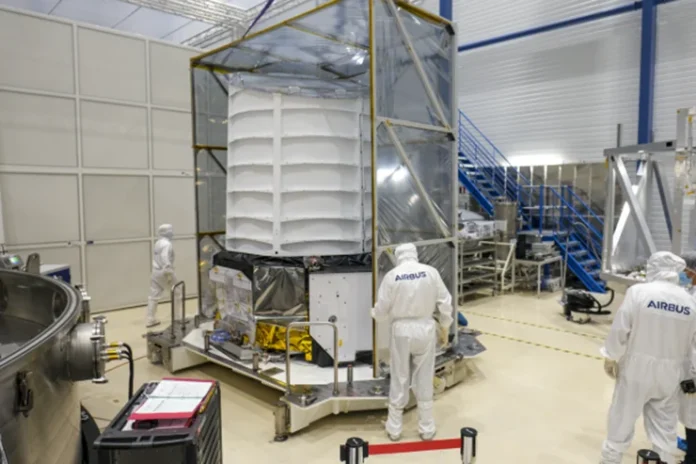
Toulouse. The European Space Agency’s (ESA) Euclid science spacecraft has been successfully launched from Kennedy Space Centre. A high-precision 1.2m diameter telescope and payload module designed and built by Airbus will enable Euclid to explore the composition and evolution of the Universe including the role of dark matter and dark energy.
Built by Thales Alenia Space for ESA, Euclid will collect high-resolution images in visible and infrared wavelengths. Within six years of observation, covering more than one third of the entire sky, Euclid will measure the shapes of, and distances to, more than 1 billion galaxies.

Jean-Marc Nasr, Head of Space Systems at Airbus said: “Euclid is another world-inspiring space mission that will aid humanity’s understanding of the structure and evolution of the Universe. This is the largest telescope with the highest optical performance ever designed and integrated by Airbus and testament to the skills and expertise of our space instruments team.”
Euclid will create a map of the large-scale structure of the Universe and will explore how the Universe has expanded and how structure has formed over cosmic history, revealing more about the role of gravity and dark energy.
Euclid will also examine the effects of “weak lensing”, an effect that distorts the shapes of distant galaxy images due to the presence of dark matter between the Earth and those galaxies. In this way it will map out the distribution of dark matter across the Universe with unprecedented accuracy.
The full silicon carbide (SiC) telescope will have to operate in extremely cold conditions of 100 Kelvin (-170°C), it builds on Airbus’ world-leading expertise in silicon carbide technology for space, already proven in orbit on ESA’s Herschel and Gaia missions.

Euclid is a “Medium Class” mission in ESA’s Cosmic Vision programme. Thales Alenia Space was the industrial prime contractor for the satellite and Airbus was responsible for the payload module, of which the telescope is the main instrument.
Euclid will reach its operational orbit around Lagrange 2 four weeks after launch when testing will begin, with full operations expected to start after three months.