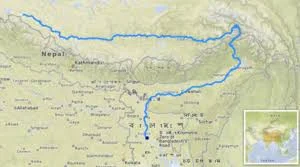
New Delhi: Reports of China planning to construct the world’s largest dam on the river Brahmaputra has indeed aroused concerns in India and Bangladesh as these are the lower riparian states and a dam could well restrict the water flow into these countries.

The river has flowed unimpeded for millennia, carving and clawing its way through rock, sand and ice, as the Yarlung-Tsangpo, through the Tibetan plateau and meadow, before rushing through the hidden gorge and entering India at the village of Gelling in Arunachal Pradesh.
The Chinese had earlier planned to build a series of 11 dams on the river, of which several are complete. Most of these were cascade dams without pondage or reservoirs but used the fall of the river to maximise the gravitational surge of power through the turbines.
China’s hydro engineers and political and economic establishment have now set their eyes on the heart of the river in the Namcha Barwa gorge, where it gathers its phenomenal pace and power on its way to Arunachal Pradesh, Assam, Bangladesh and eventually the Bay of Bengal.
While infrastructure building is not a new development on either side of Himalayas, there has been a huge push on the Chinese side with a surge of roads, railroads, bridges, tunnels and power plants. What is the impact of noise and dynamite blasting, excavators and heavy drills on such sensitive ecosystems? Trains thunder through once silent gorges and valleys where only the chants of monks or rumble of occasional trucks, or the gurgle of the flood in summer and the cries of birds would pierce the air. But there are limits to the knowledge of engineers. It is also not known whether any assessments have been made by either Chinese or independent experts on the damage to permafrost, the vast volume of water trapped in ice form below the earth’s surface.

Thawing permafrost alters natural ecosystem; makes soil vulnerable to landslides and erosion; introduces new sediment to waterways, which may alter the flow of rivers and streams; degrades water quality; impacts human life, livelihoods, and aquatic wildlife; and introduces new threats of ancient microbes.
India says that issues of trans-border rivers with China are discussed through “an institutionalised expert-level mechanism which was established in 2000” as well as through “diplomatic channels”. Does exchange of data contain the impact of these huge interventions? India and Bangladesh, which is also enriched by the Brahmaputra, must take up the issue robustly.

China’s decision represents a strike at the heart of a sacred and ancient land and tampering with forces that are not fully comprehended. The recent disaster in Uttarakhand is testimony to this. To Assam, the Brahmaputra is folklore and legend, home to a myriad of communities, cultures and faiths, the endangered Gangetic dolphins and the great balladeer Bhupen Hazarika. It is sacred to the Buddhists and it has its origins near Mount Kailash.
These massive interventions are an invitation to disaster downstream. Of course, we need power and energy. But dams clean the waters of nutrients; the water to enter the turbines must be wiped clean of all sand, rocks and sediment to produce hydro-electricity. Yet, it is this sediment which gives the Brahmaputra and its tributaries their nourishing powers as they reach farms and river-dependent human and non-human populations downstream. It is not the volume of the water that flows into India that matters as much as its quality.
The Dhaka-based scholar Imtiaz Ahmed says that states and people should guarantee rights on the river for these impinge on the right to life. Such rights exist for seas and oceans under the United Nation Convention on the Law of the Sea.