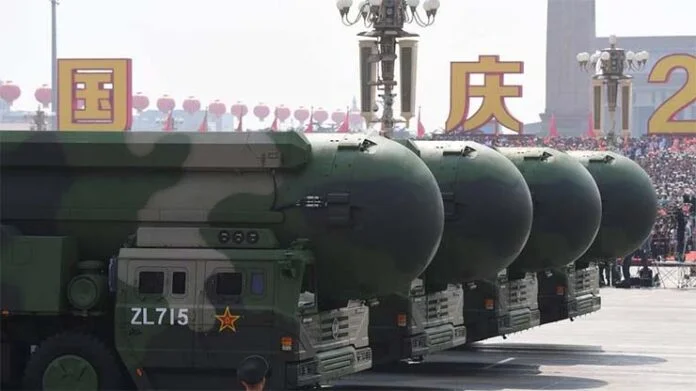
Washington: China’s nuclear arsenal has more than doubled in the last three years, amid what a senior Pentagon official calls a “major expansion of their nuclear forces.”
As of May 2023, China had around 500 operational nuclear warheads, according to the just-released China Military Power Report, an annual catalogue of the People’s Liberation Army (PLA) strength. The last time a number was given — in the 2020 report — the stockpile was said to be “in the low 200s.”

In keeping with past assessments, the Pentagon still expects that China will possess more than 1,000 operational warheads by the end of the decade and 1,500 by 2035. But a senior US defence official, speaking to reporters on background, acknowledged that the growth thus far has been faster than expected.
“They are exceeding some of our previous projections and so if you take that out beyond 2030 I think it’s safe to say that that’s a trend that we think would continue,” the official said.
China’s nuclear development is not limited to warheads themselves. It’s been increasing its inventory of nuclear delivery systems on land, sea and air, according to the report. Additionally, the Beijing government investing in the infrastructure needed to sustain this growth.
In 2022, the report says, China likely finished construction on three new solid-propellant silo fields, housing 300 intercontinental ballistic missile silos. Some ICBMs are probably loaded into silos already, the document states.

China also has been adding to its silos for liquid-fuelled ICBMs. Together, the investments are pushing its nuclear force to a “launch on warning” posture, or the ability to fire more quickly, the report assesses.
Expanding its stock of warheads has been a priority for Beijing in its decades-long push to modernize its military. Chinese leader Xi Jinping has tasked the PLA to become a “world class” military by 2049, the 100-year anniversary of the People’s Republic of China. By 2035, though, that modernization is supposed to be “basically complete,” in the words of the Chinese leader.

“Compared to the PLA’s nuclear modernization efforts a decade ago, current efforts dwarf previous attempts in both scale and complexity,” the Pentagon report reads.
At the end of September, the Defence Department released an updated strategy to counter weapons of mass destruction. The last time it released such a plan was in 2014, when the Pentagon’s focus in the area was on terrorist groups and rogue states like Iran and North Korea.
With nuclear investments from Russia and China, which Pentagon officials cite as their two core adversaries, that focus has since changed.
“China is aggressively pursuing a rapid expansion and modernization of its nuclear forces,” said John Plumb, the Pentagon’s head of integrated deterrence, at a Brookings Institution event. “The speed and scale has been nothing short of breath-taking.”
The strategy contends with growing nuclear threats seen in China, North Korea and Iran, which is close to developing nuclear weapons following the end of a deal with the US by the Trump administration.
At the same time, arms control agreements have eroded. In 2018 and 2020, the US withdrew from two such treaties: the Intermediate Range Nuclear Forces Treaty and the Treaty on Open Skies. During its invasion of Ukraine, Russia has routinely teased the use of nuclear weapons.
Notwithstanding, the Pentagon official expressed hope that China would be more open about its nuclear forces as those forces grow.
“The PRC has often stated that their aversion to greater transparency about their nuclear force has been based on the numerical asymmetry between the US and Russia,” the official said.
According to the Federation of American Scientists, the US and Russia each have more than 5,000 nuclear warheads, almost 90% of the world’s stockpiles.
“As we see them building up to larger numbers that raises some questions, at least in my mind about whether they might … be more willing to be more transparent,” the official said.