


The Shanghai Cooperation Organisation (SCO) was founded in 2001, evolving out of the “Shanghai Five” security dialogue among China, Russia and three Central Asian states formed after the Soviet collapse. The SCO gives India a rare platform to engage Russia and China simultaneously while pressing its own agenda on terrorism, connectivity and regional stability, despite Pakistan and China’s entrenched presence in the bloc.
The SCO now marks its 25th year as the world’s largest regional grouping by population and geography, spanning China, Russia, Pakistan, Iran, Belarus, and the five Central Asian republics.

India joined as an observer in 2005 and became a full member only in 2017 – a relatively recent entry into a bloc China has long used to anchor its regional influence. In that short window, India has pushed the SCO toward its own priorities: naming and condemning cross-border terrorism without double standards, championing connectivity projects like Chabahar and the International North-South Transport Corridor and advocating reform and modernisation of the organisation’s structures.
India chaired the SCO summit in 2023 and has since used its membership to balance Beijing’s dominance while keeping communication channels open with Moscow, even as it competes with both Pakistan and China for influence across the same Central Asian geography.
Modi in Uzbekistan: Setting the Stage Before Bishkek
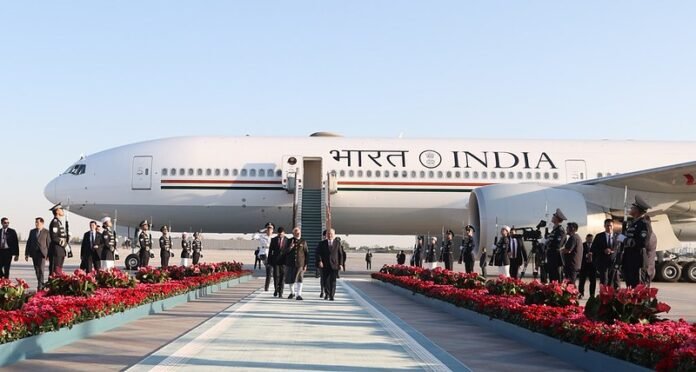
PM Modi’s decision to visit Tashkent before Bishkek was deliberate positioning. Uzbekistan, Central Asia’s most populous state, styles itself the region’s natural leader while pursuing a “multi-vector” policy that keeps it close to Russia, China, Turkey, Pakistan and India at once.
Founded in 2001 and marking its 25th year, the SCO gives India – a full member only since 2017 – a rare platform to engage Russia and China simultaneously while pressing its own agenda on terrorism, connectivity and regional stability, despite Pakistan and China’s entrenched presence in the bloc
The visit elevated bilateral ties to a Comprehensive Strategic Partnership, set a $5-billion trade target by 2030, and produced eleven MoUs spanning uranium supply, critical minerals, digital payments, healthcare, education and culture – including a Letter of Intent to conserve the Buddhist heritage sites of Kara Tepa and Fayaz Tepa in Termez, once a major Kushan-era Buddhist centre and Central Asia’s only cave monastery complex.

Notably, this is the same broader region – the Fergana Valley – that produced Babur, the Timurid prince who, after being driven from Samarkand, crossed into Hindustan and founded the Mughal dynasty in India.
PM Modi’s outreach deliberately reaches past that chapter, anchoring the relationship instead in an older Buddhist-era exchange of monks, traders and ideas along the Silk Road. Uzbekistan capped the visit by conferring on PM Modi its highest state honour, the Oliy Darajali Do’stlik order.

Counter-Terrorism: India’s Core Ask at the Summit
Terrorism sits at the top of India’s SCO agenda, sharpened since the April 2025 Pahalgam attack and the subsequent Operation Sindoor. Significantly, Uzbekistan’s joint statement with India explicitly condemned “cross-border terrorism” – a phrase Tashkent had avoided in apex-level statements after summits in 2015, 2018 and 2020 – signalling tightening alignment ahead of Bishkek.
Uzbekistan’s unprecedented use of “cross-border terrorism” in its joint statement with India signals the kind of unambiguous language New Delhi wants replicated in the SCO’s Bishkek declaration, despite likely resistance from Pakistan
India will press SCO members to adopt similarly unambiguous language in the summit declaration, reiterating zero tolerance for terror financing, safe havens and cross-border infrastructure and resisting any dilution of the text given Pakistan’s presence at the same table.
Trade, Energy and Central Asia’s Economic Pull
Economically, the five Central Asian republics – Kazakhstan, Kyrgyzstan, Tajikistan, Turkmenistan and Uzbekistan – trade only a few billion dollars annually with India, dwarfed by China’s roughly $100-billion footprint built through the Belt and Road Initiative.
Yet, their resource base of uranium, rare earths and critical minerals is vital to India’s energy security and clean-tech ambitions, as reflected in the fresh Uzbek uranium arrangement.
India’s structural handicap remains the absence of a direct land border with the region, which is why it continues to invest in workarounds: the International North-South Transport Corridor, the Ashgabat Agreement joined in 2018 and the Chabahar port project in Iran that bypasses Pakistan entirely.
Since PM Modi’s landmark 2015 tour of all five republics, India has built supporting institutions – the Connect Central Asia policy, an India-Central Asia Dialogue since 2019, and a leaders’-level Summit mechanism since 2022 – to convert goodwill into measurable trade.
Strategic Interest: Countering China’s Shadow
Beyond resources, India’s Central Asia push is explicitly strategic. China’s economic dominance in the region, cemented through Belt and Road Initiative financing, gives Beijing outsized leverage over states India considers part of its extended neighbourhood.
Expect modest, incremental outcomes from Bishkek – firmer anti-terror language and continued connectivity talk – with the real measure of success lying in whether Tashkent’s uranium and cultural agreements are followed through rather than left as symbolic gestures
India’s answer has been softer instruments – digital public infrastructure exports, UPI-style payment systems, education and Hindi-language scholarships, defence cooperation and cultural diplomacy such as the Termez Buddhist conservation project – designed to offer Central Asian states an alternative partner without competing dollar-for-dollar on infrastructure spending.
Institutionalising ties through mechanisms like the new Uzbekistan Foreign-Ministers-led coordination panel, and backing India’s UN Security Council bid in return, extends this soft-balancing approach into the diplomatic arena, particularly valuable with India’s non-permanent UNSC candidacy for 2028-29 and its BRICS chairship this year both in play.
Possible Outcomes from Bishkek
The summit is unlikely to produce dramatic breakthroughs given the competing interests of China, Russia, Pakistan and India within the same room, but incremental gains are plausible: a joint declaration with firmer anti-terrorism language building on the Uzbekistan precedent, further momentum on connectivity projects and continued positioning ahead of India’s BRICS hosting and UNSC campaign.
The real test will be whether uranium contracts, MoUs and cultural outreach signed in Tashkent translate into durable economic ties over the coming years, or remain, as in past cycles, high on symbolism and slow on delivery.

-The writer is a New Delhi-based senior commentator on international and strategic affairs, environmental issues, an interfaith practitioner, and a media consultant. The views expressed are personal and do not necessarily carry the views of Raksha Anirveda





